QUESTION IMAGE
Question
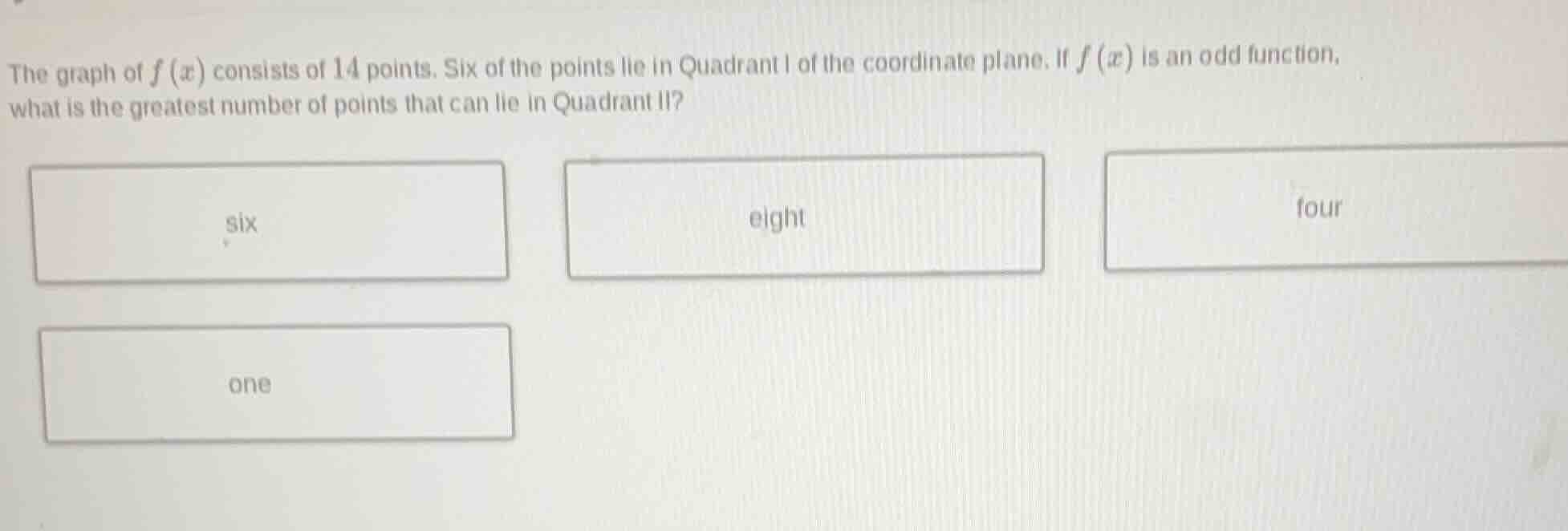
the graph of $f(x)$ consists of 14 points. six of the points lie in quadrant i of the coordinate plane. if $f(x)$ is an odd function, what is the greatest number of points that can lie in quadrant ii? six eight four one
Step1: Recall property of odd functions
For an odd function \( f(x) \), if \( (a,b) \) is a point on the graph, then \( (-a,-b) \) is also a point. So, points in Quadrant I (\( x>0,y>0 \)) correspond to points in Quadrant III (\( x<0,y<0 \)), and points in Quadrant II (\( x<0,y>0 \)) correspond to points in Quadrant IV (\( x>0,y<0 \)). Also, the origin \( (0,0) \) is on the graph of an odd function if \( f(0) = 0 \).
Step2: Calculate number of points from Quadrant I correspondence
We know there are 6 points in Quadrant I. By the odd - function property, these 6 points correspond to 6 points in Quadrant III. Let the number of points in Quadrant II be \( x \), then the number of points in Quadrant IV will also be \( x \) (from the odd - function property: if \( (x,y) \) is in II (\( x<0,y>0 \)), then \( (-x,-y) \) is in IV (\( x>0,y<0 \))). Let the number of points on the origin be \( z \) (either 0 or 1, since it's a function, but we want to maximize the number of points in Quadrant II, so we minimize \( z \), so \( z = 0 \) for maximum \( x \)).
The total number of points on the graph is the sum of points in each quadrant and the origin. So, \( 6+6 + x+x+z=14 \).
Step3: Solve for \( x \)
Substitute \( z = 0 \) into the equation: \( 6 + 6+x+x+0=14 \)
Simplify the left - hand side: \( 12 + 2x=14 \)
Subtract 12 from both sides: \( 2x=14 - 12=2 \)
Divide both sides by 2: \( x = 1 \)? Wait, no, wait. Wait, we made a mistake. Wait, the total number of points: points in I: 6, points in III: 6 (corresponding to I), points in II: \( x \), points in IV: \( x \) (corresponding to II), and points on the axes (origin). But we want to maximize the number of points in II, so we need to consider that the origin may or may not be included. Wait, let's re - express the total number of points.
Total points \( T=\) points in I \(+\) points in III \(+\) points in II \(+\) points in IV \(+\) points on axes.
Since for odd function:
- Points in I (\( n_1 = 6 \)) \(\Leftrightarrow\) Points in III (\( n_3=6 \))
- Points in II (\( n_2=x \)) \(\Leftrightarrow\) Points in IV (\( n_4 = x \))
- Points on axes (\( n_0 \)): \( n_0 = 0\) or \( 1\) (because \( f(0)=0 \) for odd function, so at most one point at the origin)
So \( T=n_1 + n_3+n_2 + n_4 + n_0\)
We know \( T = 14\), \( n_1=6\), \( n_3 = 6\), \( n_4=x\), \( n_2=x\), \( n_0\geq0\)
So \( 6 + 6+x+x + n_0=14\)
\(12 + 2x+n_0=14\)
\(2x + n_0=2\)
To maximize \( x \), we need to minimize \( n_0 \). The minimum value of \( n_0 \) is 0 (because if \( f(0) = 0\), it's one point, but we can have \( f(0)\) not defined? No, for a function, \( x = 0\) is in the domain or not, but since the graph has 14 points, we can assume that if we want to maximize the number of points in II, we set \( n_0 = 0\) (because if \( n_0=1\), then \( 2x=1\), which is not an integer, and \( x\) must be an integer). Wait, no, let's check again.
Wait, the total number of points: \( 6\) (I) \(+6\) (III) \(+x\) (II) \(+x\) (IV) \(+n_0=14\)
\(12 + 2x+n_0 = 14\)
\(2x=2 - n_0\)
Since \( x\) must be a non - negative integer, and \( n_0\) is either 0 or 1 (because the origin is a single point if it's on the graph).
If \( n_0 = 0\), then \( 2x=2\), so \( x = 1\)? Wait, that can't be right. Wait, maybe we misapplied the correspondence. Wait, no: the correspondence is:
- Quadrant I: \( (x,y),x>0,y>0\) \(\Leftrightarrow\) Quadrant III: \( (-x,-y),x<0,y<0\)
- Quadrant II: \( (x,y),x<0,y>0\) \(\Leftrightarrow\) Quadrant IV: \( (-x,-y),x>0,y<0\)
So the number of points in I and III must be equal, and the number of points in II and…

Snap & solve any problem in the app
Get step-by-step solutions on Sovi AI
Photo-based solutions with guided steps
Explore more problems and detailed explanations
one