QUESTION IMAGE
Question
graph each equation.
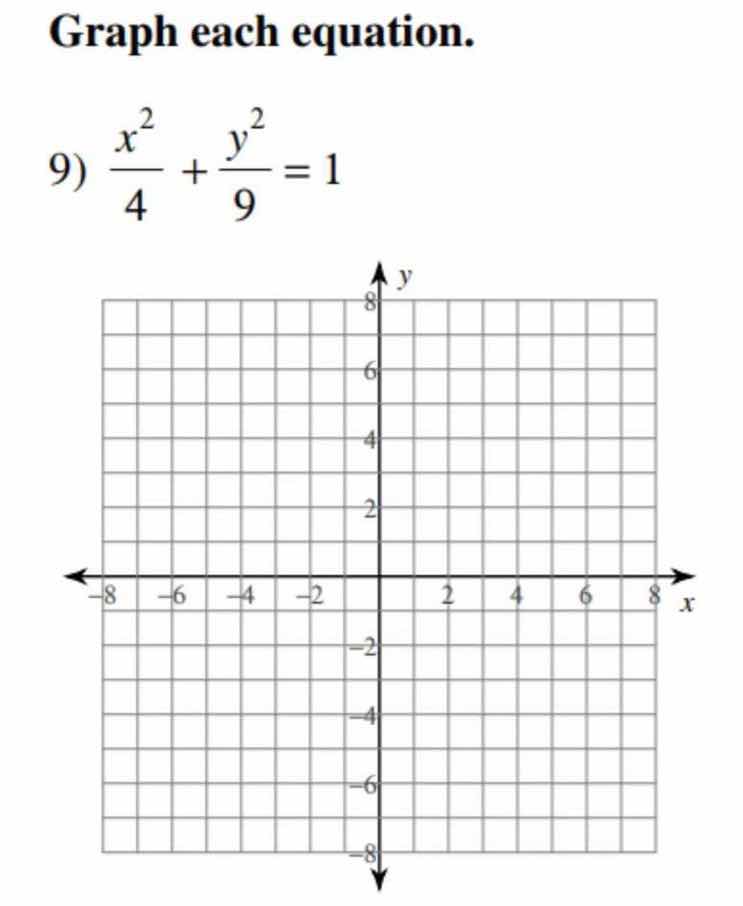
- \\(\dfrac{x^2}{4} + \dfrac{y^2}{9} = 1\\)
coordinate grid image omitted
Step1: Identify the conic section
The equation $\frac{x^2}{4}+\frac{y^2}{9} = 1$ is in the standard form of an ellipse, $\frac{x^2}{b^2}+\frac{y^2}{a^2}=1$ (since $a^2 = 9$ and $b^2=4$, and $a>b$), so it is a vertical ellipse centered at the origin $(0,0)$.
Step2: Find the vertices and co - vertices
For a vertical ellipse $\frac{x^2}{b^2}+\frac{y^2}{a^2}=1$, the vertices are at $(0,\pm a)$ and the co - vertices are at $(\pm b,0)$.
Given $a^2 = 9$, then $a = 3$ (we take the positive square root since it represents a length), and $b^2=4$, so $b = 2$.
So the vertices are $(0, 3)$ and $(0,- 3)$? Wait, no. Wait, $a^2=9\Rightarrow a = 3$, so the vertices (the endpoints of the major axis) are at $(0,\pm a)=(0,3)$ and $(0, - 3)$? Wait, no, wait. Wait, the standard form $\frac{x^2}{b^2}+\frac{y^2}{a^2}=1$ with $a>b$: the major axis is along the $y$-axis. So the vertices (endpoints of major axis) are $(0,\pm a)=(0,3)$ and $(0, - 3)$? Wait, no, $a^2 = 9$, so $a = 3$, so the vertices are $(0,3)$ and $(0, - 3)$? Wait, no, wait, $a$ is the distance from the center to the vertex along the major axis. Wait, actually, if the equation is $\frac{x^2}{b^2}+\frac{y^2}{a^2}=1$, then the length of the semi - major axis is $a$ (along $y$-axis) and semi - minor axis is $b$ (along $x$-axis). So:
- Vertices (on the major axis, $y$-axis): When $x = 0$, we solve for $y$: $\frac{0^2}{4}+\frac{y^2}{9}=1\Rightarrow y^2=9\Rightarrow y=\pm3$. So vertices are $(0,3)$ and $(0, - 3)$.
- Co - vertices (on the minor axis, $x$-axis): When $y = 0$, we solve for $x$: $\frac{x^2}{4}+\frac{0^2}{9}=1\Rightarrow x^2 = 4\Rightarrow x=\pm2$. So co - vertices are $(2,0)$ and $(-2,0)$.
Step3: Plot the points and draw the ellipse
- Plot the center at $(0,0)$.
- Plot the vertices $(0,3)$ and $(0, - 3)$ and the co - vertices $(2,0)$ and $(-2,0)$.
- Then, sketch a smooth curve connecting these points to form the ellipse. The ellipse will be symmetric about both the $x$-axis and $y$-axis.
To graph the ellipse:
- Mark the center at (0,0).
- Mark the points (0, 3), (0, - 3), (2, 0), and (- 2, 0).
- Draw a smooth oval - shaped curve passing through these points, symmetric about the x - axis and y - axis.
(Note: Since the question is to graph the equation, the final answer is the graph of the ellipse with center at (0,0), vertices at (0, ±3) and co - vertices at (±2, 0) as described above.)

Snap & solve any problem in the app
Get step-by-step solutions on Sovi AI
Photo-based solutions with guided steps
Explore more problems and detailed explanations
Step1: Identify the conic section
The equation $\frac{x^2}{4}+\frac{y^2}{9} = 1$ is in the standard form of an ellipse, $\frac{x^2}{b^2}+\frac{y^2}{a^2}=1$ (since $a^2 = 9$ and $b^2=4$, and $a>b$), so it is a vertical ellipse centered at the origin $(0,0)$.
Step2: Find the vertices and co - vertices
For a vertical ellipse $\frac{x^2}{b^2}+\frac{y^2}{a^2}=1$, the vertices are at $(0,\pm a)$ and the co - vertices are at $(\pm b,0)$.
Given $a^2 = 9$, then $a = 3$ (we take the positive square root since it represents a length), and $b^2=4$, so $b = 2$.
So the vertices are $(0, 3)$ and $(0,- 3)$? Wait, no. Wait, $a^2=9\Rightarrow a = 3$, so the vertices (the endpoints of the major axis) are at $(0,\pm a)=(0,3)$ and $(0, - 3)$? Wait, no, wait. Wait, the standard form $\frac{x^2}{b^2}+\frac{y^2}{a^2}=1$ with $a>b$: the major axis is along the $y$-axis. So the vertices (endpoints of major axis) are $(0,\pm a)=(0,3)$ and $(0, - 3)$? Wait, no, $a^2 = 9$, so $a = 3$, so the vertices are $(0,3)$ and $(0, - 3)$? Wait, no, wait, $a$ is the distance from the center to the vertex along the major axis. Wait, actually, if the equation is $\frac{x^2}{b^2}+\frac{y^2}{a^2}=1$, then the length of the semi - major axis is $a$ (along $y$-axis) and semi - minor axis is $b$ (along $x$-axis). So:
- Vertices (on the major axis, $y$-axis): When $x = 0$, we solve for $y$: $\frac{0^2}{4}+\frac{y^2}{9}=1\Rightarrow y^2=9\Rightarrow y=\pm3$. So vertices are $(0,3)$ and $(0, - 3)$.
- Co - vertices (on the minor axis, $x$-axis): When $y = 0$, we solve for $x$: $\frac{x^2}{4}+\frac{0^2}{9}=1\Rightarrow x^2 = 4\Rightarrow x=\pm2$. So co - vertices are $(2,0)$ and $(-2,0)$.
Step3: Plot the points and draw the ellipse
- Plot the center at $(0,0)$.
- Plot the vertices $(0,3)$ and $(0, - 3)$ and the co - vertices $(2,0)$ and $(-2,0)$.
- Then, sketch a smooth curve connecting these points to form the ellipse. The ellipse will be symmetric about both the $x$-axis and $y$-axis.
To graph the ellipse:
- Mark the center at (0,0).
- Mark the points (0, 3), (0, - 3), (2, 0), and (- 2, 0).
- Draw a smooth oval - shaped curve passing through these points, symmetric about the x - axis and y - axis.
(Note: Since the question is to graph the equation, the final answer is the graph of the ellipse with center at (0,0), vertices at (0, ±3) and co - vertices at (±2, 0) as described above.)