QUESTION IMAGE
Question
graph the equation shown below by transforming the given graph of the parent function.
$y = x^3 + 2$
Step1: Identify Parent Function
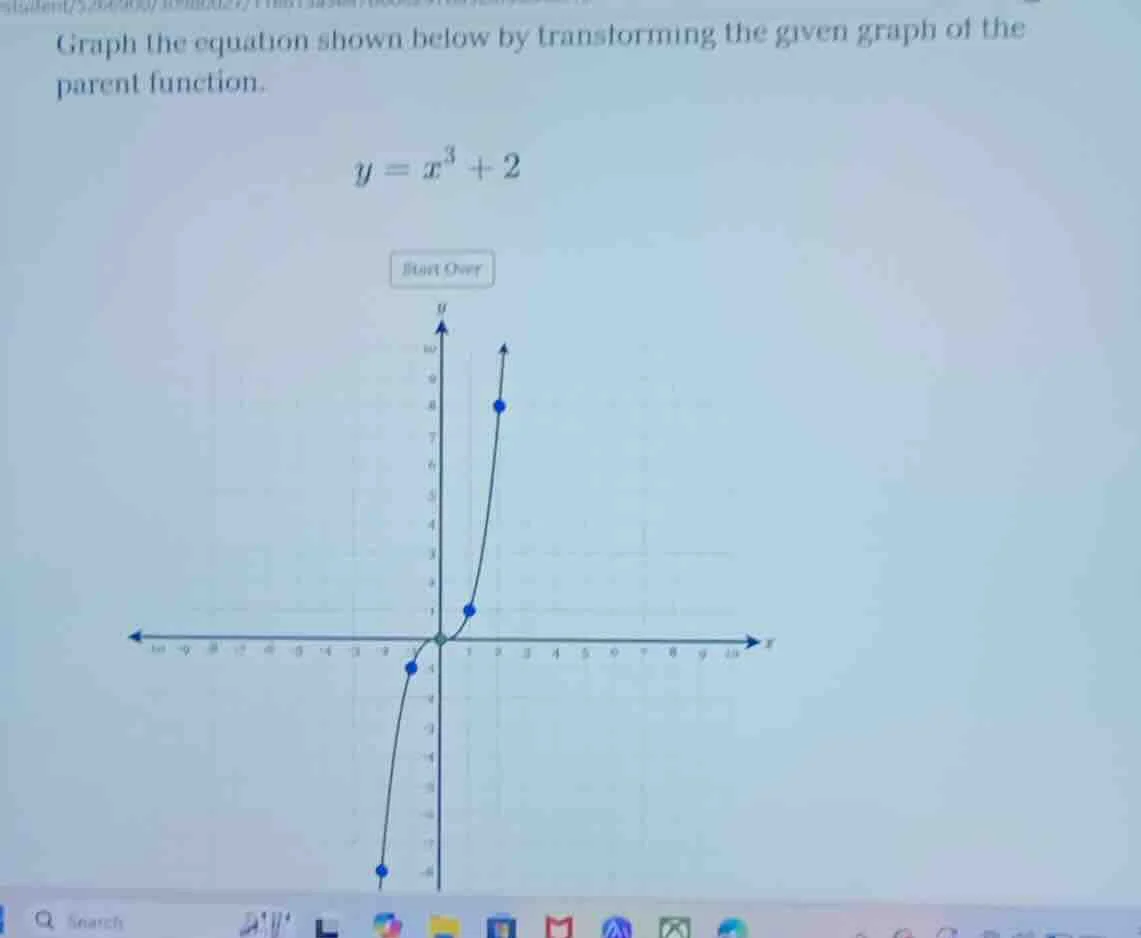
The parent function here is \( y = x^3 \), which has a characteristic cubic curve passing through the origin \((0,0)\), with points like \((1,1)\), \((-1,-1)\), \((2,8)\), \((-2,-8)\) etc.
Step2: Analyze Transformation
The given function is \( y = x^3 + 2 \). This is a vertical shift (translation) of the parent function \( y = x^3 \). The general rule for vertical shift is: if we have \( y = f(x)+k \), when \( k>0 \), the graph of \( f(x) \) is shifted up by \( k \) units. Here, \( k = 2 \), so we shift the graph of \( y = x^3 \) up by 2 units.
Step3: Transform Key Points
- For the parent function \( y = x^3 \), key points are:
- When \( x = 0 \), \( y = 0^3=0 \). After shifting up by 2, the point becomes \((0,0 + 2)=(0,2)\).
- When \( x = 1 \), \( y = 1^3 = 1 \). After shifting up by 2, the point becomes \((1,1 + 2)=(1,3)\).
- When \( x = -1 \), \( y = (-1)^3=-1 \). After shifting up by 2, the point becomes \((-1,-1 + 2)=(-1,1)\).
- When \( x = 2 \), \( y = 2^3 = 8 \). After shifting up by 2, the point becomes \((2,8 + 2)=(2,10)\).
- When \( x = -2 \), \( y = (-2)^3=-8 \). After shifting up by 2, the point becomes \((-2,-8 + 2)=(-2,-6)\).
Step4: Graph the Transformed Function
Using the transformed key points \((0,2)\), \((1,3)\), \((-1,1)\), \((2,10)\), \((-2,-6)\) etc., we draw the curve of \( y=x^3 + 2 \) which is the graph of \( y = x^3 \) shifted up by 2 units.

Snap & solve any problem in the app
Get step-by-step solutions on Sovi AI
Photo-based solutions with guided steps
Explore more problems and detailed explanations
To graph \( y=x^3 + 2 \), shift the graph of the parent function \( y = x^3 \) up by 2 units. Key points of \( y = x^3 \) (e.g., \((0,0)\), \((1,1)\), \((-1,-1)\)) are transformed to \((0,2)\), \((1,3)\), \((-1,1)\) etc., and the curve is drawn through these new points.