QUESTION IMAGE
Question
graph the equation shown below by transforming the given graph of the parent function.
$y = -|-x| + 2$
Step1: Analyze the parent function
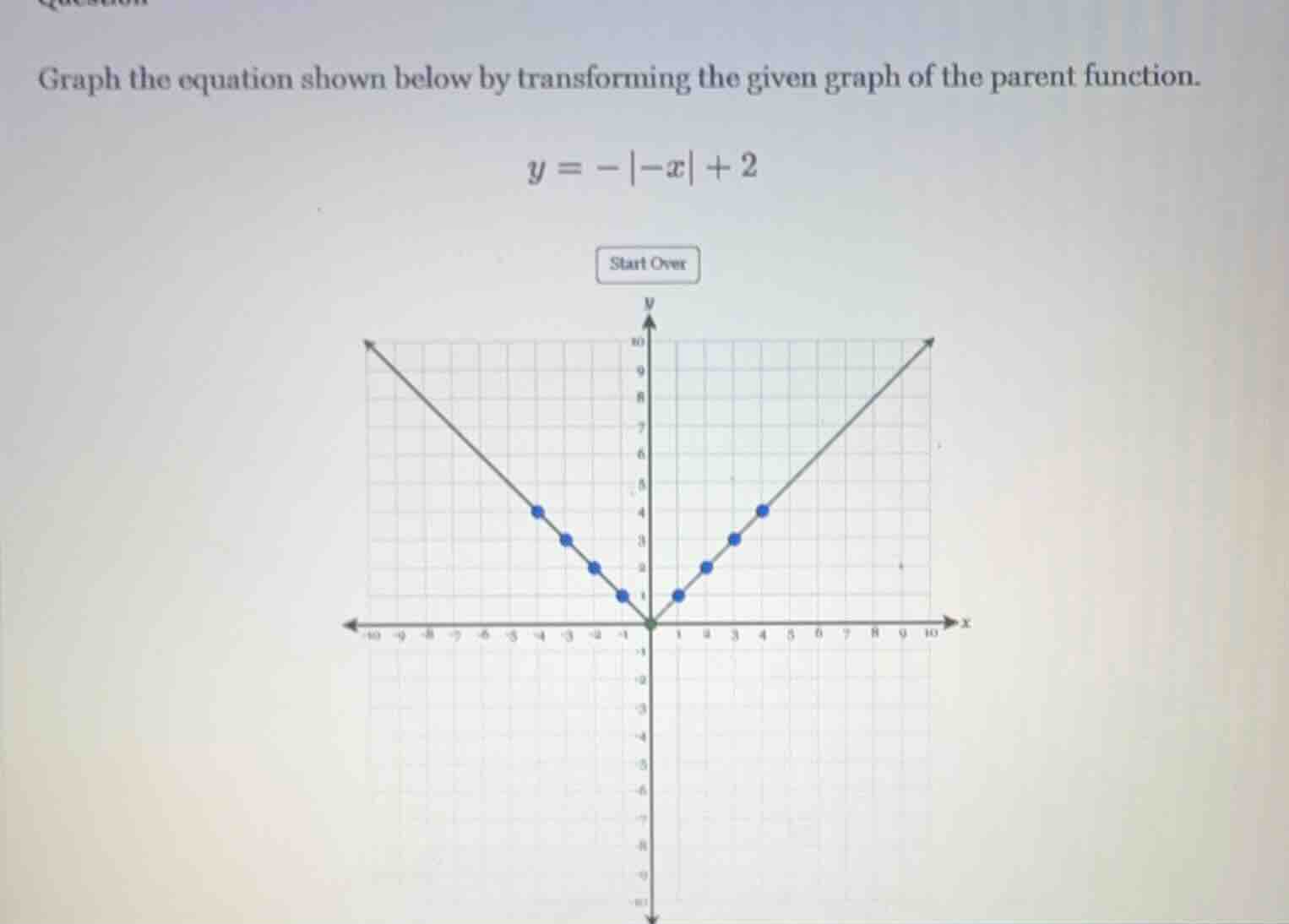
The parent function of absolute - value functions is \(y = |x|\), which has a V - shape with the vertex at \((0,0)\), and for \(x\geq0\), \(y=x\); for \(x < 0\), \(y=-x\). The given graph in the problem is the graph of \(y = |x|\) (since it has the characteristic V - shape with vertex at the origin and the two linear parts \(y = x\) for \(x\geq0\) and \(y=-x\) for \(x < 0\)).
Step2: Simplify the given function
We know that \(|-x|=|x|\) because the absolute value of a negative number is the same as the absolute value of its positive counterpart. So the function \(y=-\vert - x\vert+2\) can be simplified to \(y=-|x| + 2\).
Step3: Analyze the transformations
Reflection:
The function \(y=-|x|\) is a reflection of the parent function \(y = |x|\) over the \(x\) - axis. For a function \(y = f(x)\), the transformation \(y=-f(x)\) reflects the graph of \(y = f(x)\) over the \(x\) - axis. So, the graph of \(y = |x|\) (which opens upwards) will open downwards after the reflection, and the slope of the right - hand side (for \(x\geq0\)) will change from \(1\) to \(- 1\), and the slope of the left - hand side (for \(x < 0\)) will change from \(-1\) to \(1\).
Vertical shift:
The function \(y=-|x|+2\) is a vertical shift of the function \(y=-|x|\) upwards by \(2\) units. For a function \(y = f(x)\), the transformation \(y=f(x)+k\) shifts the graph of \(y = f(x)\) up by \(k\) units when \(k>0\).
Step4: Determine the vertex and key points
- Vertex: The vertex of the parent function \(y = |x|\) is \((0,0)\). After reflecting over the \(x\) - axis and shifting up by \(2\) units, the vertex of \(y=-|x| + 2\) will be at \((0,2)\).
- Key points on the parent function and their transformations:
- For the parent function \(y = |x|\), when \(x = 0\), \(y = 0\); when \(x = 1\), \(y = 1\); when \(x=-1\), \(y = 1\); when \(x = 2\), \(y = 2\); when \(x=-2\), \(y = 2\); when \(x = 3\), \(y = 3\); when \(x=-3\), \(y = 3\); when \(x = 4\), \(y = 4\); when \(x=-4\), \(y = 4\).
- For the function \(y=-|x|+2\):
- When \(x = 0\), \(y=-|0| + 2=2\).
- When \(x = 1\), \(y=-|1|+2=-1 + 2 = 1\).
- When \(x=-1\), \(y=-|-1|+2=-1 + 2 = 1\).
- When \(x = 2\), \(y=-|2|+2=-2 + 2 = 0\).
- When \(x=-2\), \(y=-|-2|+2=-2 + 2 = 0\).
- When \(x = 3\), \(y=-|3|+2=-3 + 2=-1\).
- When \(x=-3\), \(y=-|-3|+2=-3 + 2=-1\).
- When \(x = 4\), \(y=-|4|+2=-4 + 2=-2\).
- When \(x=-4\), \(y=-|-4|+2=-4 + 2=-2\).
Step5: Graph the transformed function
- Start with the vertex \((0,2)\).
- For \(x\geq0\), the equation of the line is \(y=-x + 2\) (since \(y=-|x|+2\) and for \(x\geq0\), \(|x|=x\), so \(y=-x + 2\)). We can plot points like \((1,1)\), \((2,0)\), \((3,-1)\), \((4,-2)\) on the right - hand side.
- For \(x < 0\), the equation of the line is \(y=x + 2\) (since for \(x < 0\), \(|x|=-x\), so \(y=-(-x)+2=x + 2\)). We can plot points like \((-1,1)\), \((-2,0)\), \((-3,-1)\), \((-4,-2)\) on the left - hand side.
- Connect these points to get the graph of \(y=-|x|+2\) (or \(y =-\vert - x\vert+2\)). The graph will be a downward - opening V - shape with the vertex at \((0,2)\), the right - hand side having a slope of \(-1\) and the left - hand side having a slope of \(1\), and it is shifted \(2\) units up from the graph of \(y=-|x|\).

Snap & solve any problem in the app
Get step-by-step solutions on Sovi AI
Photo-based solutions with guided steps
Explore more problems and detailed explanations
To graph \(y =-\vert - x\vert+2\) (which is equivalent to \(y=-|x| + 2\)):
- Reflect the graph of \(y = |x|\) (the given parent graph) over the \(x\) - axis to get the graph of \(y=-|x|\).
- Shift the graph of \(y=-|x|\) upward by \(2\) units. The resulting graph has a vertex at \((0,2)\), for \(x\geq0\), the line is \(y=-x + 2\) (with points like \((1,1)\), \((2,0)\), \((3,-1)\), etc.), and for \(x < 0\), the line is \(y=x + 2\) (with points like \((-1,1)\), \((-2,0)\), \((-3,-1)\), etc.). The graph is a downward - opening V - shape centered at \((0,2)\).