QUESTION IMAGE
Question
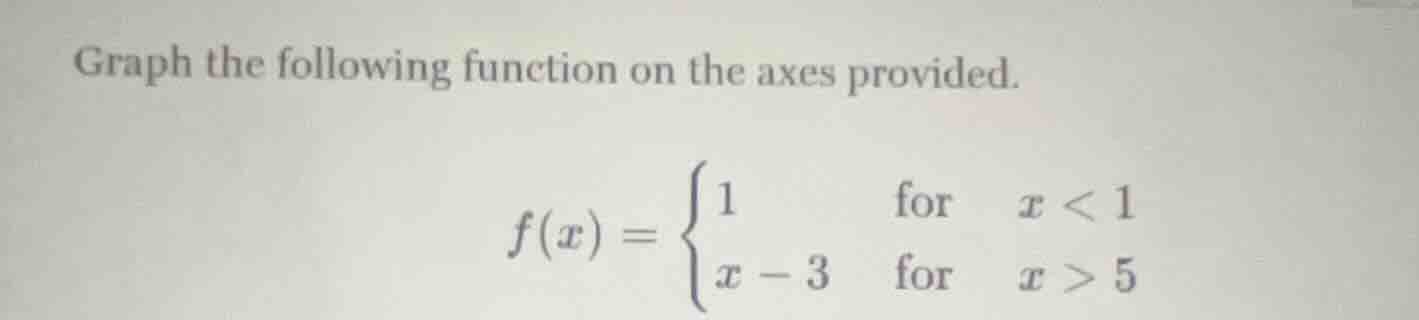
graph the following function on the axes provided.
$f(x) = \
$
Step1: Analyze the first piece ($x < 1$)
The function is \( f(x) = 1 \) when \( x < 1 \). This is a horizontal line. We plot a horizontal line at \( y = 1 \) for all \( x \)-values less than 1. At \( x = 1 \), we use an open circle (since the inequality is \( x < 1 \), not \( x \leq 1 \)) to indicate that the point \( (1, 1) \) is not included in this part of the function.
Step2: Analyze the second piece ($x > 5$)
The function is \( f(x) = x - 3 \) when \( x > 5 \). This is a linear function with a slope of 1 and a y-intercept of -3. To graph this, we can find a point on this line. When \( x = 5 \), \( f(5) = 5 - 3 = 2 \), but since the inequality is \( x > 5 \), we use an open circle at \( (5, 2) \). Then, we can find another point, for example, when \( x = 6 \), \( f(6) = 6 - 3 = 3 \), so we plot the point \( (6, 3) \) and draw a line with slope 1 starting from the open circle at \( (5, 2) \) and going to the right (for \( x > 5 \)).
Graph Description:
- For \( x < 1 \): A horizontal line segment (or ray) at \( y = 1 \), with an open circle at \( (1, 1) \), extending to the left (as \( x \) decreases).
- For \( x > 5 \): A line with slope 1, starting with an open circle at \( (5, 2) \), and passing through points like \( (6, 3) \), \( (7, 4) \), etc., extending to the right (as \( x \) increases).
(Note: Since we can't draw the actual graph here, this description helps in constructing it on paper or using graphing software. The key elements are the horizontal line for \( x < 1 \) and the linear line for \( x > 5 \) with the appropriate open circles at the endpoints of their respective domains.)

Snap & solve any problem in the app
Get step-by-step solutions on Sovi AI
Photo-based solutions with guided steps
Explore more problems and detailed explanations
To graph \( f(x) \):
- Draw a horizontal line at \( y = 1 \) for all \( x < 1 \) (open circle at \( (1, 1) \)).
- Draw a line with slope \( 1 \) (equation \( y = x - 3 \)) for all \( x > 5 \) (open circle at \( (5, 2) \)), passing through points like \( (6, 3) \), \( (7, 4) \), etc.