QUESTION IMAGE
Question
graph the following functions on the same axes.
(a) ( f(x) = 4^x )
(b) ( g(x) = 4^{x + 4} )
(c) ( h(x) = 4^{x - 2} )
(d) if ( c ) is a positive constant, explain how the graphs of ( y = 4^{x + c} ) and ( y = 4^{x - c} ) are related to the graph of ( f(x) = 4^x ).
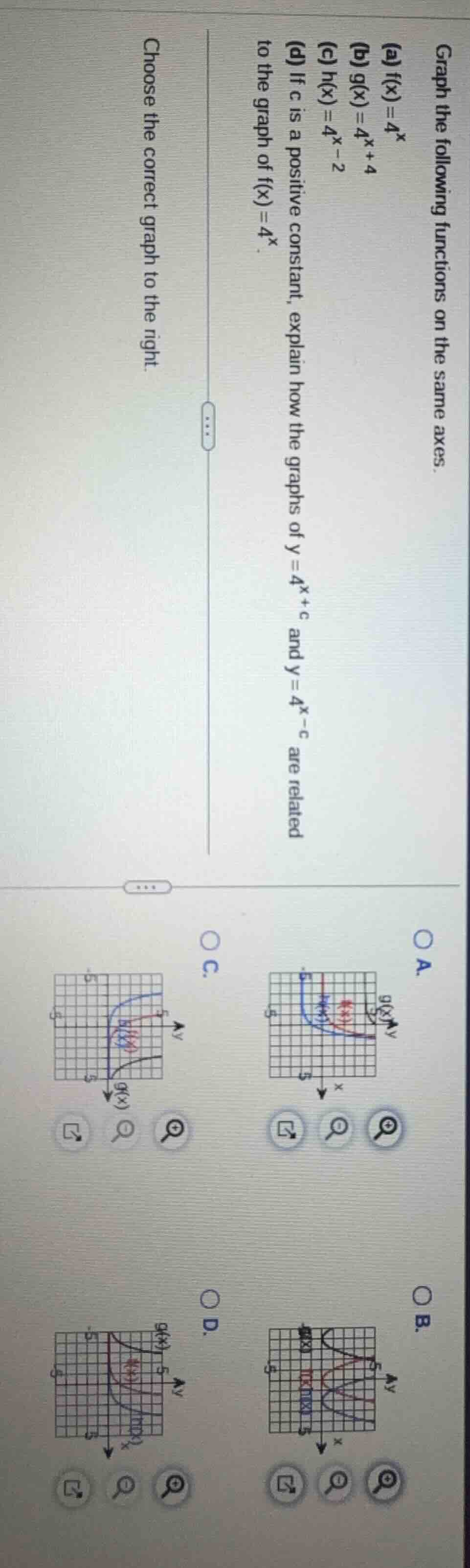
choose the correct graph to the right.
(images of graphs labeled a, b, c, d are shown)
Step1: Analyze base function $f(x)=4^x$
The base exponential function $f(x)=4^x$ passes through $(0,1)$, increases as $x$ increases, and approaches $y=0$ as $x\to-\infty$.
Step2: Transform for $g(x)=4^{x+4}$
This is a horizontal shift: $g(x)=f(x+4)$, so shift $f(x)$ left 4 units.
Step3: Transform for $h(x)=4^{x}-2$
This is a vertical shift: $h(x)=f(x)-2$, so shift $f(x)$ down 2 units.
Step4: Match to correct graph
Graph A shows an increasing base exponential, a left-shifted version, and a down-shifted version, matching the functions.
Step5: Explain general shifts
For positive $c$, $y=4^{x+c}=f(x+c)$ shifts $f(x)$ left $c$ units. $y=4^{x-c}=f(x-c)$ shifts $f(x)$ right $c$ units.

Snap & solve any problem in the app
Get step-by-step solutions on Sovi AI
Photo-based solutions with guided steps
Explore more problems and detailed explanations
- Correct graph: A.
- For positive constant $c$:
- The graph of $y=4^{x+c}$ is the graph of $f(x)=4^x$ shifted horizontally to the left by $c$ units.
- The graph of $y=4^{x-c}$ is the graph of $f(x)=4^x$ shifted horizontally to the right by $c$ units.