QUESTION IMAGE
Question
graph the function.
$g(x) = \frac{3}{4} \cdot 2^x$
Step1: Identify base function form
This is an exponential function: $g(x) = \frac{3}{4} \cdot 2^x$, a scaled version of $2^x$.
Step2: Find y-intercept (x=0)
Substitute $x=0$:
$g(0) = \frac{3}{4} \cdot 2^0 = \frac{3}{4} \cdot 1 = 0.75$
Step3: Find another point (x=2)
Substitute $x=2$:
$g(2) = \frac{3}{4} \cdot 2^2 = \frac{3}{4} \cdot 4 = 3$
Step4: Analyze end behavior
As $x \to -\infty$, $2^x \to 0$, so $g(x) \to 0$ (horizontal asymptote at $y=0$).
As $x \to +\infty$, $2^x \to +\infty$, so $g(x) \to +\infty$.
Step5: Plot points and curve
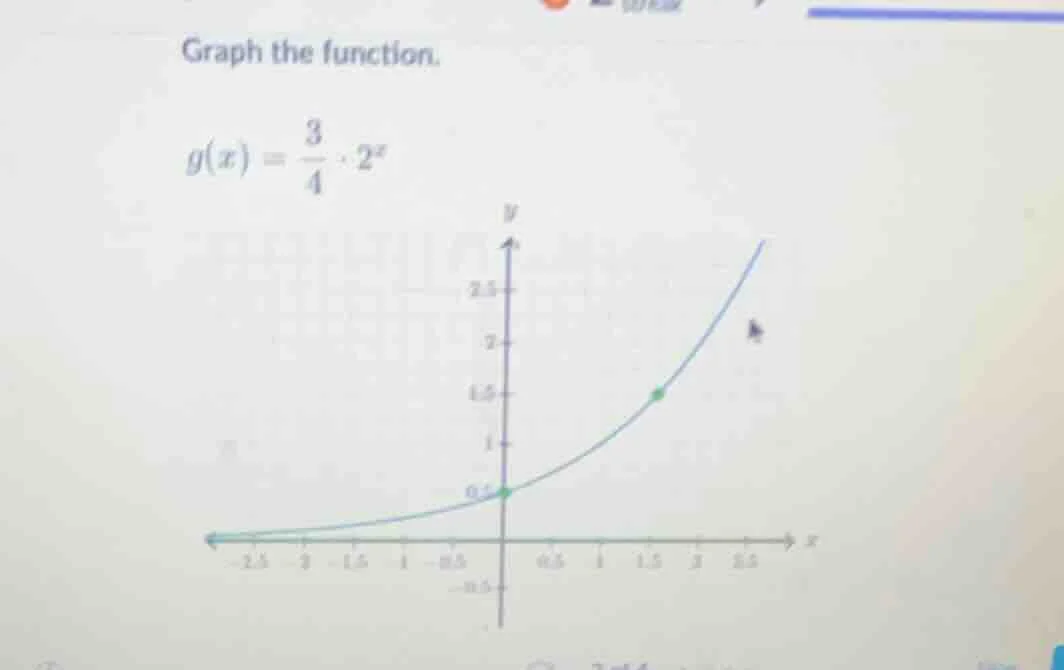
Plot $(0, 0.75)$, $(2, 3)$, the asymptote $y=0$, and draw a smooth increasing curve through the points, approaching the asymptote as $x$ decreases.

Snap & solve any problem in the app
Get step-by-step solutions on Sovi AI
Photo-based solutions with guided steps
Explore more problems and detailed explanations
The graph is an increasing exponential curve with a horizontal asymptote at $y=0$, passing through $(0, 0.75)$ and $(2, 3)$, approaching 0 as $x \to -\infty$ and growing without bound as $x \to +\infty$.