QUESTION IMAGE
Question
graph the function.
$y = \sqrt3{x} + 1$
Step1: Identify the parent function
The parent function is \( y = \sqrt[3]{x} \), which has a cubic root curve passing through the origin \((0,0)\), with a point at \((1,1)\) and \((-1,-1)\), and is symmetric about the origin.
Step2: Determine the transformation
The given function is \( y = \sqrt[3]{x + 1} \). This is a horizontal shift of the parent function \( y=\sqrt[3]{x} \). The rule for horizontal shifts is: if we have \( y = \sqrt[3]{x - h} \), it shifts \( h \) units to the right. Here, \( h=-1 \), so the graph of \( y = \sqrt[3]{x} \) is shifted 1 unit to the left.
Step3: Find key points
- For the parent function \( y = \sqrt[3]{x} \), key points are:
- When \( x = 0 \), \( y = 0 \)
- When \( x = 1 \), \( y = 1 \)
- When \( x = -1 \), \( y = -1 \)
- When \( x = 8 \), \( y = 2 \)
- When \( x = -8 \), \( y = -2 \)
- For the shifted function \( y=\sqrt[3]{x + 1} \), we substitute \( x+1 \) for the \( x \) in the parent function's key points. So we solve for \( x \) in \( x+1=\text{parent } x \) to get the new \( x \)-values:
- For parent \( x = 0 \): \( x+1 = 0\Rightarrow x=-1 \), so the point is \((-1,0)\)
- For parent \( x = 1 \): \( x + 1=1\Rightarrow x = 0 \), so the point is \((0,1)\)
- For parent \( x=-1 \): \( x + 1=-1\Rightarrow x=-2 \), so the point is \((-2,-1)\)
- For parent \( x = 8 \): \( x+1 = 8\Rightarrow x=7 \), so the point is \((7,2)\)
- For parent \( x=-8 \): \( x + 1=-8\Rightarrow x=-9 \), so the point is \((-9,-2)\)
Step4: Plot the points and draw the curve
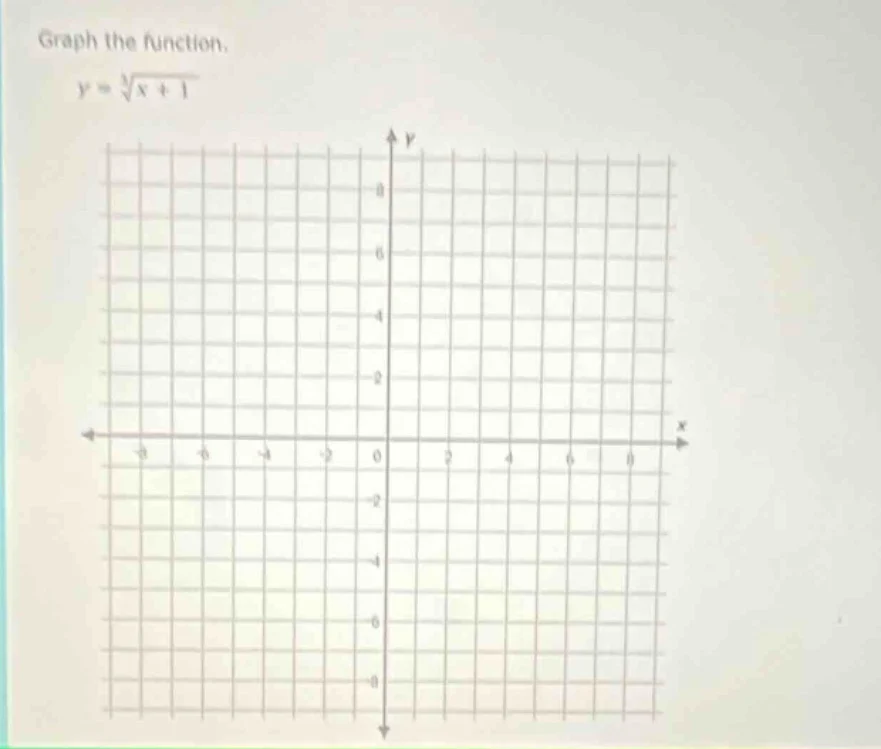
Plot the points \((-9,-2)\), \((-2,-1)\), \((-1,0)\), \((0,1)\), \((7,2)\) (and any other additional points you calculate) on the coordinate grid. Then draw a smooth curve through these points, following the shape of the cubic root function (which has a single inflection point and passes through these points with the characteristic cubic root curve shape, increasing slowly, then more steeply, then slowly again, and symmetric in a way around the inflection point). The curve should pass through the plotted points and have the general shape of a cubic root curve shifted 1 unit to the left.

Snap & solve any problem in the app
Get step-by-step solutions on Sovi AI
Photo-based solutions with guided steps
Explore more problems and detailed explanations
To graph \( y=\sqrt[3]{x + 1} \), follow these steps:
- Identify Transformation: The function is a horizontal shift of \( y = \sqrt[3]{x} \) 1 unit to the left.
- Find Key Points:
- \((-1, 0)\) (from \( x+1 = 0 \)),
- \((0, 1)\) (from \( x+1 = 1 \)),
- \((-2, -1)\) (from \( x+1 = -1 \)),
- \((7, 2)\) (from \( x+1 = 8 \)),
- \((-9, -2)\) (from \( x+1 = -8 \)).
- Plot Points on the grid and draw a smooth, continuous curve through them, matching the shape of a cubic root curve (symmetric, passing through the points with the characteristic "S - shaped" inflection at \((-1, 0)\)).
(Note: The graph will resemble the parent cubic root curve \( y = \sqrt[3]{x} \) but shifted left by 1 unit, passing through \((-1, 0)\), \((0, 1)\), \((-2, -1)\), etc.)