QUESTION IMAGE
Question
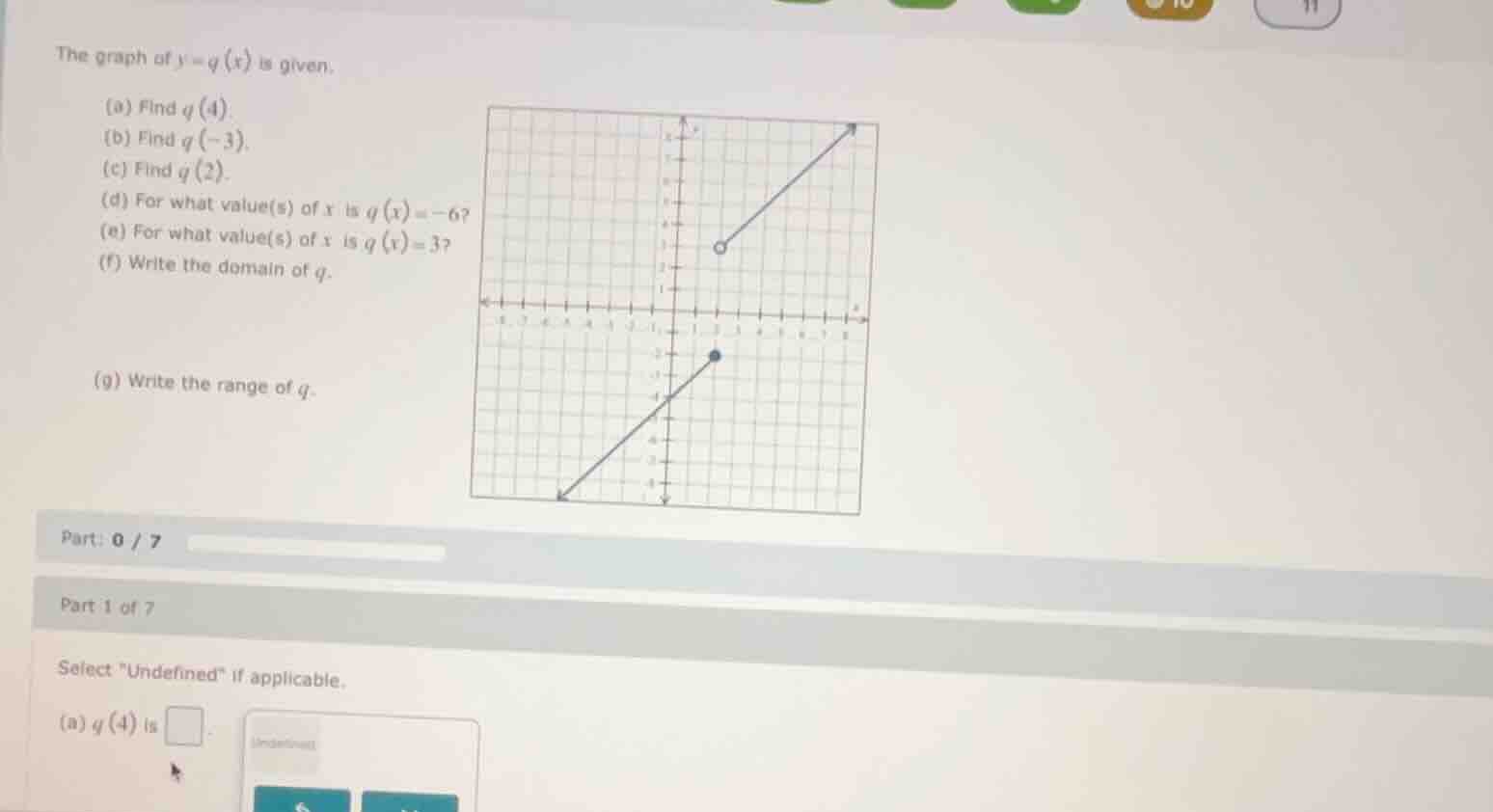
the graph of $y = g(x)$ is given.
(a) find $g(4)$.
(b) find $g(-3)$.
(c) find $g(2)$.
(d) for what value(s) of $x$ is $g(x) = -6$?
(e) for what value(s) of $x$ is $g(x) = 3$?
(f) write the domain of $g$.
(g) write the range of $g$.
part: 0 / 7
part 1 of 7
select \undefined\ if applicable.
(a) $g(4)$ is \\(\square\\).
Step1: Analyze the graph for \( x = 4 \)
To find \( q(4) \), we look at the graph of \( y = q(x) \) and find the \( y \)-value when \( x = 4 \). From the graph, the line segment (the part with the defined points) and the other segment. Let's identify the coordinates. The upper segment starts from an open circle at \( (2, 3) \) (wait, no, let's check the grid. Wait, the lower segment has a closed dot at \( (2, -3) \)? Wait, no, looking at the graph, the upper line: let's see the x-axis and y-axis. Let's assume the grid: each square is 1 unit. Let's find the equation of the upper line. The upper line has a starting point (open circle) at, say, \( (2, 3) \)? Wait, no, the lower line: from the left, going up, with a closed dot at \( (2, -3) \)? Wait, no, let's re-examine. Wait, the problem is about finding \( q(4) \). Let's see the upper line: when \( x = 4 \), what's \( y \)? Let's see the slope. Wait, maybe the upper line passes through points. Wait, maybe the upper line: let's take two points. Suppose the upper line has a point at \( x = 2 \) (open circle) with \( y = 3 \)? No, wait, the lower line: from the left, the end is at \( (2, -3) \) (closed dot), and the upper line starts at \( (2, 3) \) (open dot) and goes up. Wait, maybe the upper line's equation: let's see, when \( x = 2 \), open dot at \( y = 3 \), and when \( x = 8 \), what's \( y \)? Wait, maybe the upper line has a slope. Wait, alternatively, let's look at \( x = 4 \). Let's see the upper line: if we move from \( x = 2 \) (open dot, \( y = 3 \)) to \( x = 8 \), \( y = 9 \)? Wait, no, maybe the upper line's equation is \( y = x + 1 \)? Wait, no, let's check. Wait, maybe the upper line: when \( x = 2 \), \( y = 3 \) (open), \( x = 3 \), \( y = 4 \), \( x = 4 \), \( y = 5 \)? Wait, no, maybe I'm miscalculating. Wait, the key is to find the \( y \)-value when \( x = 4 \) on the graph. Let's assume that the upper line (the one with the open circle at \( x = 2 \)) has a slope of 1, so when \( x = 2 \), \( y = 3 \) (open), then \( x = 3 \), \( y = 4 \), \( x = 4 \), \( y = 5 \)? Wait, no, maybe the upper line starts at \( (2, 3) \) (open) and goes up, so for \( x \geq 2 \) (but open at \( x = 2 \)), so \( x = 4 \) is in the domain of the upper line. Wait, maybe the upper line's equation is \( y = x + 1 \)? Wait, when \( x = 2 \), \( y = 3 \) (open), \( x = 3 \), \( y = 4 \), \( x = 4 \), \( y = 5 \)? Wait, but maybe the correct way is: looking at the graph, when \( x = 4 \), the \( y \)-value is 5? Wait, no, maybe I made a mistake. Wait, let's start over. The problem is to find \( q(4) \), which is the value of the function at \( x = 4 \). So we look at the graph, find the point where \( x = 4 \), and read the \( y \)-coordinate. Let's assume that the upper line (the one with the open circle at \( x = 2 \)) passes through \( x = 4 \), and the \( y \)-value there is 5? Wait, no, maybe the upper line's equation is \( y = x + 1 \), so when \( x = 4 \), \( y = 5 \). Alternatively, maybe the upper line has a point at \( x = 2 \), \( y = 3 \) (open), and \( x = 8 \), \( y = 9 \), so slope is \( (9 - 3)/(8 - 2) = 1 \), so equation \( y - 3 = 1*(x - 2) \), so \( y = x + 1 \). Therefore, when \( x = 4 \), \( y = 4 + 1 = 5 \). So \( q(4) = 5 \).

Snap & solve any problem in the app
Get step-by-step solutions on Sovi AI
Photo-based solutions with guided steps
Explore more problems and detailed explanations
\( 5 \)