QUESTION IMAGE
Question
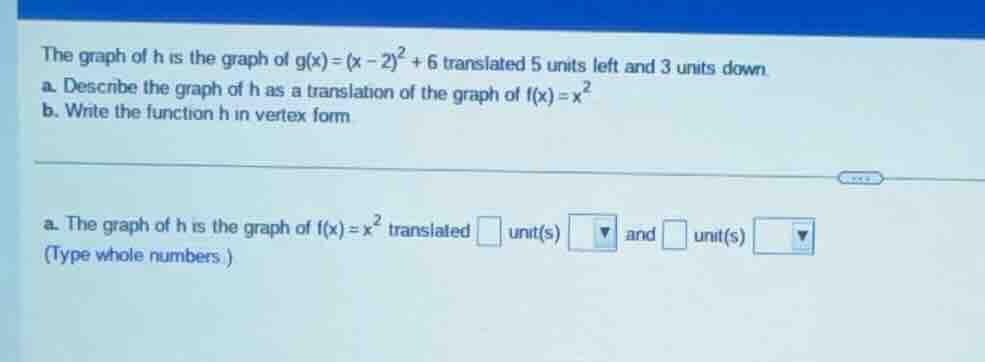
the graph of h is the graph of g(x)=(x - 2)² + 6 translated 5 units left and 3 units down. a. describe the graph of h as a translation of the graph of f(x)=x² b. write the function h in vertex form. a. the graph of h is the graph of f(x)=x² translated unit(s) and unit(s) (type whole numbers.)
Part a
Step1: Analyze translation of g from f
The function \( g(x)=(x - 2)^2+6 \) is a translation of \( f(x)=x^2 \). For \( f(x)=x^2 \) to \( g(x)=(x - 2)^2+6 \), the horizontal translation is 2 units right (since the form is \( (x - h) \) with \( h = 2 \)) and vertical translation is 6 units up.
Step2: Analyze translation of h from g
Now, \( h(x) \) is \( g(x) \) translated 5 units left and 3 units down. To find the translation from \( f(x) \) to \( h(x) \), we combine the translations.
- Horizontal translation: From \( f \) to \( g \) is 2 units right, then from \( g \) to \( h \) is 5 units left. So total horizontal translation: \( 2\) units right is equivalent to \( - 2\) units left, then adding 5 units left: \( - 2+(- 5)=-7 \)? Wait, no, better way: The horizontal shift of \( g \) from \( f \) is \( h = 2 \) (right), then shifting \( g \) 5 units left: new horizontal shift is \( 2-5=-3 \) (so 3 units left from \( f \)). Wait, let's recall the vertex form \( y=(x - h)^2+k \), where \( (h,k) \) is the vertex.
- Vertex of \( f(x)=x^2 \) is \( (0,0) \).
- Vertex of \( g(x)=(x - 2)^2+6 \) is \( (2,6) \).
- Vertex of \( h(x) \): translating \( g(x) \) 5 units left (so \( x \)-coordinate of vertex: \( 2-5=-3 \)) and 3 units down ( \( y \)-coordinate: \( 6 - 3=3 \)). So vertex of \( h(x) \) is \( (-3,3) \).
So from \( f(x)=x^2 \) (vertex \( (0,0) \)) to \( h(x) \) (vertex \( (-3,3) \)): horizontal translation is \( - 3-0=-3 \) (3 units left) and vertical translation is \( 3 - 0 = 3 \) units up? Wait, no, wait the translation of \( g \) to \( h \) is 5 left and 3 down. So \( g(x) \) has vertex \( (2,6) \), \( h(x) \) has vertex \( (2 - 5,6 - 3)=(-3,3) \). So from \( f(x) \) (vertex \( (0,0) \)) to \( h(x) \) (vertex \( (-3,3) \)): horizontal translation is \( - 3 \) (3 units left) and vertical translation is \( 3 \) units up? Wait, no, the vertical translation: \( g \) is 6 units up from \( f \), then \( h \) is 3 units down from \( g \), so total vertical translation: \( 6-3 = 3 \) units up? Wait, no, \( g \) is 6 up from \( f \), then \( h \) is 3 down from \( g \), so \( 6-3 = 3 \) up from \( f \). And horizontal: \( g \) is 2 right from \( f \), \( h \) is 5 left from \( g \), so \( 2-5=-3 \) (3 left from \( f \)). Wait, but the question is: "The graph of \( h \) is the graph of \( f(x)=x^2 \) translated \(\square\) unit(s) \(\square\) and \(\square\) unit(s) \(\square\)". Wait, maybe I made a mistake. Let's re - express:
Wait, the function \( g(x)=(x - 2)^2+6 \) is \( f(x) \) shifted 2 units right and 6 units up. Then \( h(x) \) is \( g(x) \) shifted 5 units left and 3 units down. So to find the shift from \( f \) to \( h \):
- Horizontal shift: 2 units right (from \( f \) to \( g \)) and 5 units left (from \( g \) to \( h \)). So total horizontal shift: \( 2-5=-3 \), which means 3 units left.
- Vertical shift: 6 units up (from \( f \) to \( g \)) and 3 units down (from \( g \) to \( h \)). So total vertical shift: \( 6 - 3=3 \) units up.
Wait, but let's check the vertex. Vertex of \( f \): \( (0,0) \). Vertex of \( g \): \( (2,6) \). Vertex of \( h \): \( (2 - 5,6 - 3)=(-3,3) \). So from \( (0,0) \) to \( (-3,3) \): move 3 units left (since \( x \) goes from 0 to - 3) and 3 units up ( \( y \) goes from 0 to 3).
Wait, but the problem says "translated 5 units left and 3 units down" from \( g \) to \( h \). So \( g(x) \) to \( h(x) \): replace \( x \) with \( x + 5 \) (since left translation) and \( y \) with \( y-3 \) (down translation). So \( h(x)=g(x + 5)-3=( (x + 5)-2)^2+6-3=(x + 3)^2+3 \). So \( h(x)=(x + 3)^2+3 \), which is…
Step1: Start with \( g(x) \)
Given \( g(x)=(x - 2)^2+6 \).
Step2: Apply left translation
To translate \( g(x) \) 5 units left, we replace \( x \) with \( x + 5 \) in \( g(x) \). So we get \( g(x + 5)=((x + 5)-2)^2+6=(x + 3)^2+6 \).
Step3: Apply down translation
To translate the result 3 units down, we subtract 3 from the function. So \( h(x)=(x + 3)^2+6-3=(x + 3)^2+3 \).
The vertex form of a quadratic function is \( y=(x - h)^2+k \), where \( (h,k) \) is the vertex. Here, \( h=-3 \) and \( k = 3 \), so \( h(x)=(x+3)^2 + 3 \) or \( h(x)=(x-(-3))^2+3 \).

Snap & solve any problem in the app
Get step-by-step solutions on Sovi AI
Photo-based solutions with guided steps
Explore more problems and detailed explanations
s:
a. The graph of \( h \) is the graph of \( f(x)=x^2 \) translated \(\boldsymbol{3}\) unit(s) \(\boldsymbol{\text{left}}\) and \(\boldsymbol{3}\) unit(s) \(\boldsymbol{\text{up}}\)
b. The function \( h \) in vertex form is \(\boldsymbol{h(x)=(x + 3)^2+3}\)