QUESTION IMAGE
Question
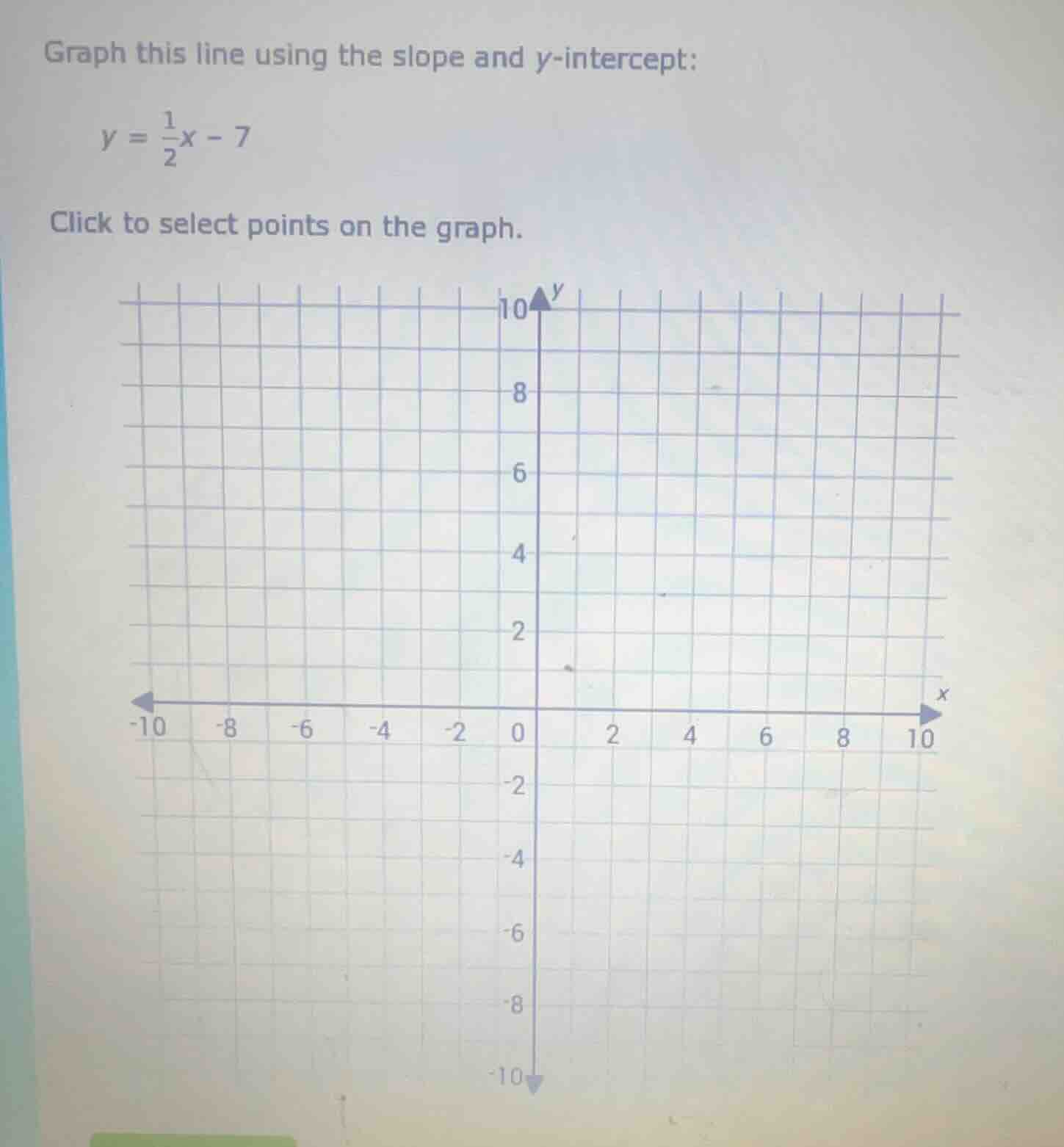
graph this line using the slope and y-intercept:
$y = \frac{1}{2}x - 7$
click to select points on the graph.
(there is a coordinate grid with x-axis from -10 to 10 and y-axis from -10 to 10, with grid lines and axes labeled.)
Step1: Identify y-intercept
The equation is in slope - intercept form \(y = mx + b\), where \(b\) is the y - intercept. For \(y=\frac{1}{2}x - 7\), \(b=-7\). So the y - intercept is the point \((0,-7)\).
Step2: Identify slope
The slope \(m=\frac{1}{2}\), which can be written as \(\frac{\text{rise}}{\text{run}}=\frac{1}{2}\). This means from the y - intercept \((0, - 7)\), we move up 1 unit and then 2 units to the right.
Step3: Find another point
Starting from \((0,-7)\), moving up 1 (rise = 1) and right 2 (run = 2) gives the point \((0 + 2,-7+1)=(2,-6)\). We can also move down 1 and left 2 from \((0,-7)\) to get \((0 - 2,-7 - 1)=(-2,-8)\) (optional, but helps in graphing).
Step4: Graph the line
Plot the points \((0,-7)\) and \((2,-6)\) (or other points found using the slope) and draw a straight line through them.
(Note: Since the question is about graphing, the key points to plot are the y - intercept \((0,-7)\) and another point using the slope, like \((2,-6)\) or \((-2,-8)\) etc. To graph, mark \((0,-7)\) on the y - axis (7 units below the origin) and then use the slope to find the next point. For example, from \((0,-7)\), moving 1 unit up (because slope numerator is 1) and 2 units to the right (because slope denominator is 2) lands at \((2,-6)\). Then draw a line connecting these points.)

Snap & solve any problem in the app
Get step-by-step solutions on Sovi AI
Photo-based solutions with guided steps
Explore more problems and detailed explanations
To graph \(y=\frac{1}{2}x - 7\):
- Plot the y - intercept at \((0,-7)\) (since when \(x = 0\), \(y=-7\)).
- Use the slope \(m=\frac{1}{2}\) (rise = 1, run = 2). From \((0,-7)\), move up 1 unit and right 2 units to get the point \((2,-6)\).
- Draw a straight line through \((0,-7)\) and \((2,-6)\) (or other points found using the slope) to represent the line.