QUESTION IMAGE
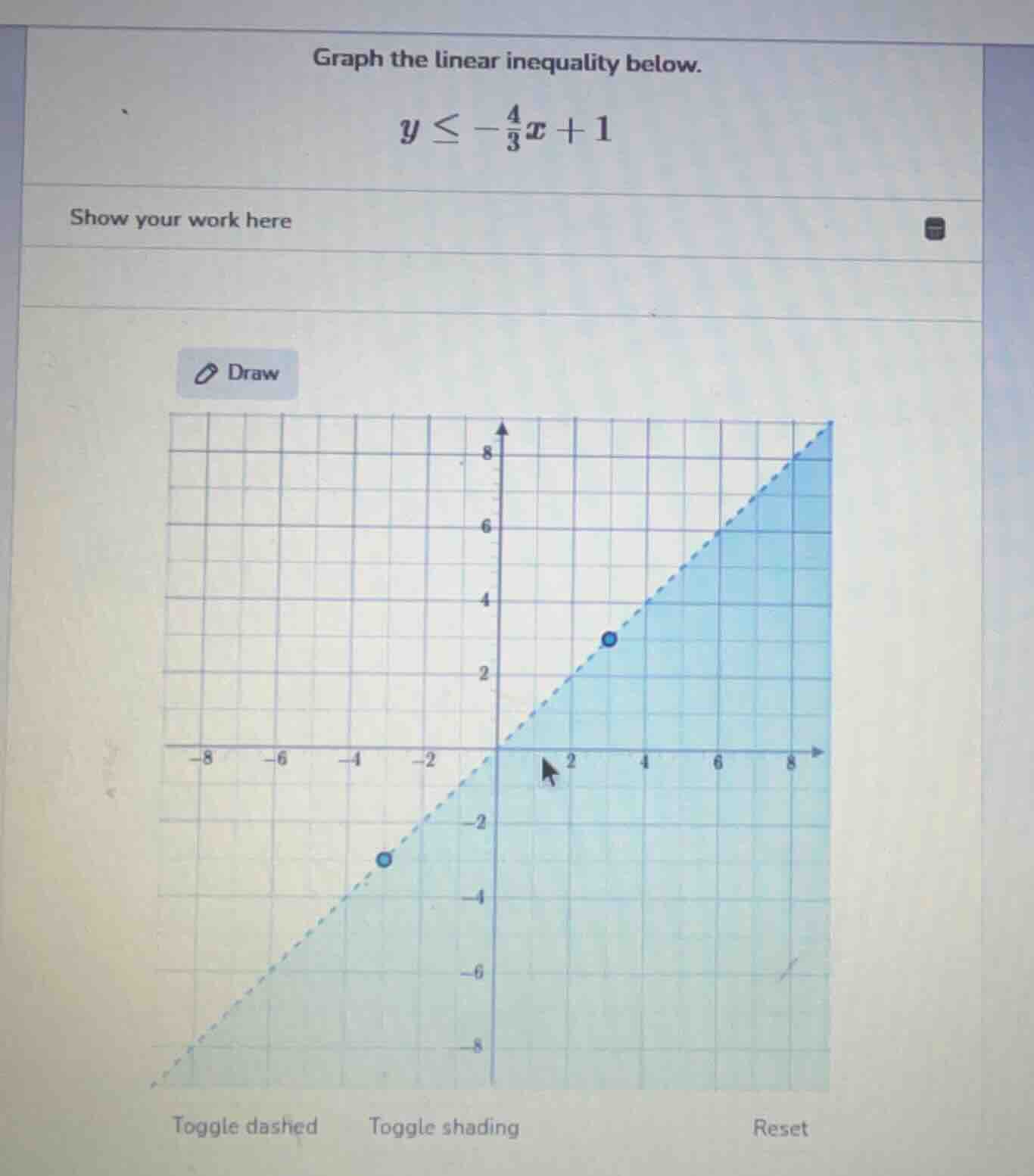
Question
graph the linear inequality below.
$y \leq -\frac{4}{3}x + 1$
show your work here
Step1: Identify the boundary line
The inequality is \( y \leq -\frac{4}{3}x + 1 \). First, we consider the equation of the boundary line, which is \( y = -\frac{4}{3}x + 1 \). This is a linear equation in slope - intercept form \( y=mx + b \), where the slope \( m=-\frac{4}{3} \) and the y - intercept \( b = 1 \).
To graph the boundary line, we start by plotting the y - intercept. The y - intercept is at the point \( (0,1) \) (since when \( x = 0 \), \( y=-\frac{4}{3}(0)+1 = 1 \)). Then, using the slope \( m=-\frac{4}{3}=\frac{\text{rise}}{\text{run}} \), from the point \( (0,1) \), we can go down 4 units (because the slope is negative) and then to the right 3 units. So, from \( (0,1) \), moving down 4 gives \( y=1 - 4=-3 \) and moving right 3 gives \( x = 0+3 = 3 \), so we get the point \( (3,-3) \). We can also go up 4 units and left 3 units (since a negative slope can also be thought of as \( \frac{4}{-3} \)) from \( (0,1) \): up 4 gives \( y = 1+4 = 5 \), left 3 gives \( x=0 - 3=-3 \), so the point \( (-3,5) \).
Since the inequality is \( y\leq-\frac{4}{3}x + 1 \) (the "less than or equal to" symbol), the boundary line should be a solid line (because the inequality includes the equal sign, so the points on the line are part of the solution set).
Step2: Determine the shading region
To determine which side of the line to shade, we can use a test point. A common test point is \( (0,0) \) (as long as it is not on the boundary line). We substitute \( x = 0 \) and \( y = 0 \) into the inequality:
\( 0\leq-\frac{4}{3}(0)+1 \)
\( 0\leq1 \), which is a true statement. So, the point \( (0,0) \) is part of the solution set. This means we shade the region that contains the point \( (0,0) \), which is the region below the line \( y = -\frac{4}{3}x+1 \) (since the y - value of the test point is less than the y - value of the line at \( x = 0 \)).
Step3: Graph the inequality
- Draw the solid line \( y=-\frac{4}{3}x + 1 \) by connecting the points we found (e.g., \( (0,1) \), \( (3,-3) \), \( (-3,5) \) etc.).
- Shade the region below the solid line (the region that contains the point \( (0,0) \)) to represent the solution set of the inequality \( y\leq-\frac{4}{3}x + 1 \).

Snap & solve any problem in the app
Get step-by-step solutions on Sovi AI
Photo-based solutions with guided steps
Explore more problems and detailed explanations
To graph \( y\leq-\frac{4}{3}x + 1 \):
- Plot the boundary line \( y = -\frac{4}{3}x+1 \) as a solid line (using the y - intercept \( (0,1) \) and the slope \( -\frac{4}{3} \) to find additional points like \( (3,-3) \) or \( (-3,5) \)).
- Shade the region below the solid line (the region that includes the test point \( (0,0) \) since \( 0\leq-\frac{4}{3}(0)+1 \) is true).