QUESTION IMAGE
Question
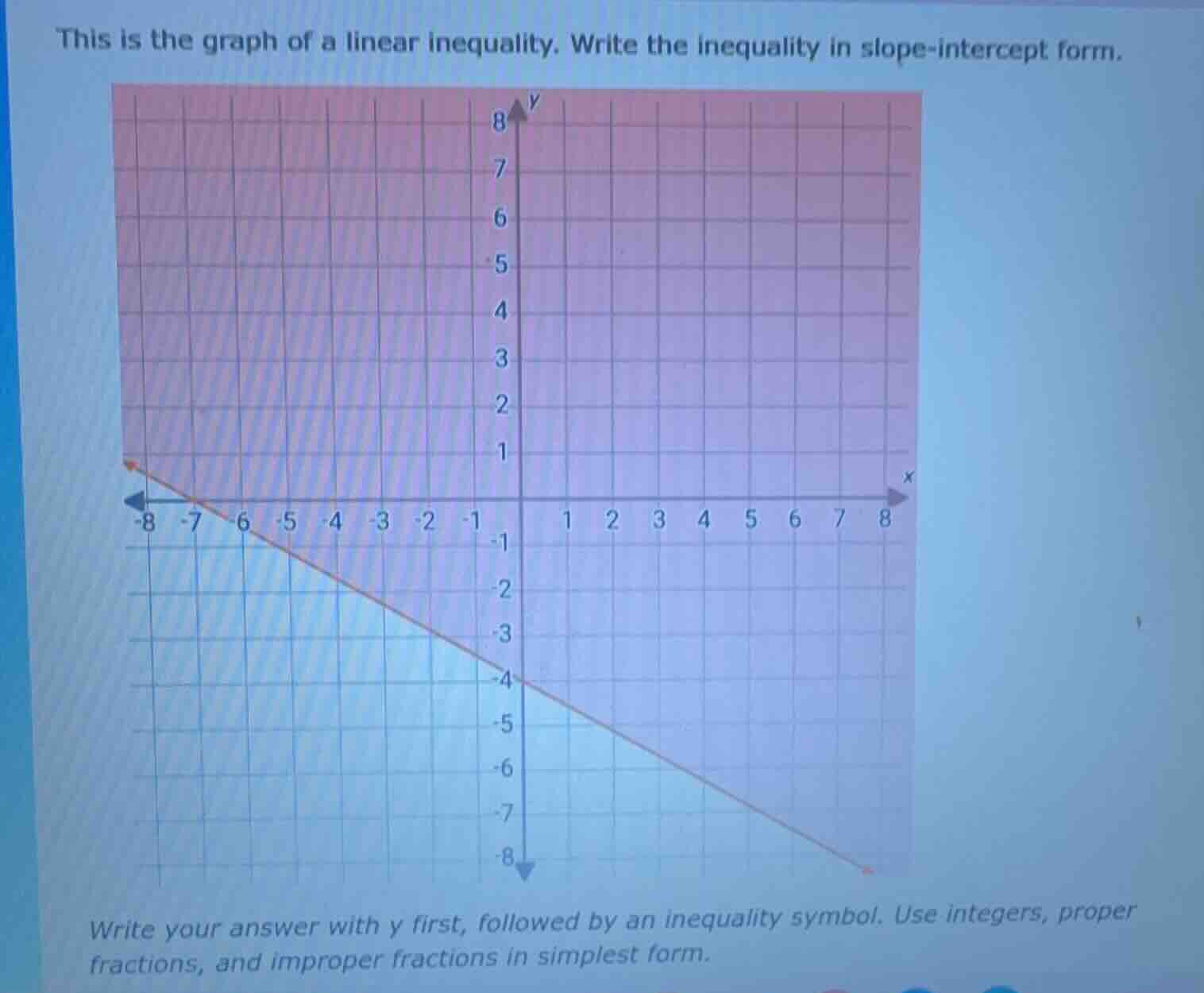
this is the graph of a linear inequality. write the inequality in slope - intercept form.
write your answer with y first, followed by an inequality symbol. use integers, proper fractions, and improper fractions in simplest form.
Step1: Find the slope of the line
The line passes through points \((-8, 1)\) and \((0, -4)\). The slope \(m\) is calculated as \(m=\frac{y_2 - y_1}{x_2 - x_1}=\frac{-4 - 1}{0 - (-8)}=\frac{-5}{8}\).
Step2: Determine the y - intercept
The line crosses the y - axis at \((0, -4)\), so the y - intercept \(b=-4\). The equation of the line in slope - intercept form (\(y = mx + b\)) is \(y=-\frac{5}{8}x - 4\).
Step3: Determine the inequality symbol
The line is solid (since the boundary is included, we can tell from the graph's line style, and the shaded region is above the line. For a linear inequality, if the shaded region is above the line \(y = mx + b\), the inequality is \(y\geq mx + b\) (if the line is solid) or \(y>mx + b\) (if the line is dashed). Here the line is solid (from the graph, the line is a solid line as we can see the points on the line are included in the boundary), and the shaded region is above the line, so the inequality is \(y\geq-\frac{5}{8}x - 4\)? Wait, no, wait. Wait, let's re - check the graph. Wait, the shaded region: looking at the graph, the red (or pink) region is above the line? Wait, no, let's take a point. Let's take the origin \((0,0)\). Is \((0,0)\) in the shaded region? The line goes from \((-8,1)\) to \((0, - 4)\) to, say, when \(x = 8\), \(y=-\frac{5}{8}(8)-4=-5 - 4=-9\). The shaded region is the upper part. Let's check the point \((0,0)\): plug into \(y\) and the line equation. The line at \(x = 0\) is \(y=-4\). \(0>-4\), and the shaded region includes \((0,0)\). Also, the line is solid, so the inequality is \(y\geq-\frac{5}{8}x - 4\)? Wait, no, wait, maybe I made a mistake in the slope. Wait, let's recalculate the slope. The two points: when \(x=-8\), \(y = 0\)? Wait, wait, looking at the graph again. Wait, the line passes through \((-8,0)\) and \((0, - 4)\)? Wait, maybe I misread the points. Let's look at the x - axis and y - axis. The left - most point is at \(x=-8\), \(y = 0\) (since it's on the x - axis), and then it goes to \((0, - 4)\). Oh! I made a mistake earlier. So the two points are \((-8,0)\) and \((0, - 4)\). Then the slope \(m=\frac{-4 - 0}{0-(-8)}=\frac{-4}{8}=-\frac{1}{2}\). Ah, that's a better calculation. So slope \(m =-\frac{1}{2}\), y - intercept \(b=-4\). So the equation of the line is \(y =-\frac{1}{2}x-4\). Now, check the shaded region. The shaded region is above the line? Wait, no, let's take \((0,0)\): \(y = 0\), the line at \(x = 0\) is \(y=-4\). \(0>-4\), and the shaded region (the pink area) includes \((0,0)\). The line is solid (so the inequality is either \(\geq\) or \(\leq\)). Since the shaded region is above the line, and the line is solid, the inequality is \(y\geq-\frac{1}{2}x - 4\)? Wait, no, wait, maybe the line is going from \((-8,0)\) to \((0, - 4)\), so when \(x\) increases, \(y\) decreases. Let's take another point, say \(x=-8\), \(y = 0\); \(x = 0\), \(y=-4\); \(x = 8\), \(y=-\frac{1}{2}(8)-4=-4 - 4=-8\). The shaded region is the upper part (the pink area). So for a point in the shaded region, like \((-8,1)\), plug into \(y\) and the line equation: \(1\) vs \(-\frac{1}{2}(-8)-4 = 4 - 4 = 0\). \(1>0\), so the inequality is \(y\geq-\frac{1}{2}x - 4\)? Wait, no, the line is solid, so the boundary is included. Wait, maybe I messed up the points. Let's re - examine the graph. The line crosses the x - axis at \((-8,0)\) and the y - axis at \((0, - 4)\). So the slope is \(\frac{-4-0}{0 - (-8)}=\frac{-4}{8}=-\frac{1}{2}\). The equation of the line is \(y=-\frac{1}{2}x - 4\). Now, the shaded region: since the line is solid and the shaded area is above the lin…

Snap & solve any problem in the app
Get step-by-step solutions on Sovi AI
Photo-based solutions with guided steps
Explore more problems and detailed explanations
\(y\geq-\frac{1}{2}x - 4\)