QUESTION IMAGE
Question
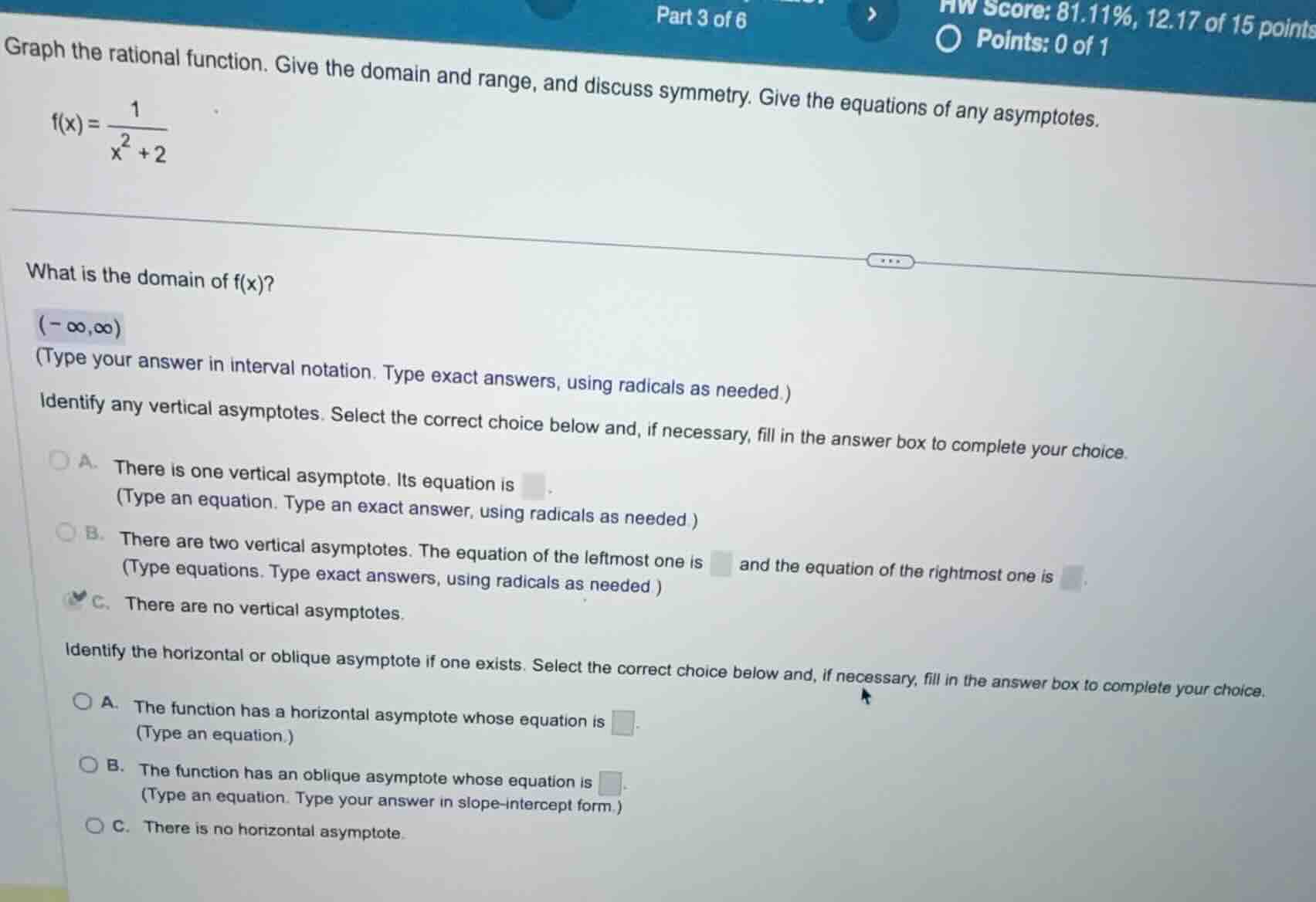
graph the rational function. give the domain and range, and discuss symmetry. give the equations of any asymptotes.\\( f(x) = \frac{1}{x^2 + 2} \\)\
what is the domain of \\( f(x) \\)?\\( (-\infty,\infty) \\)\
(type your answer in interval notation. type exact answers, using radicals as needed.)\
identify any vertical asymptotes. select the correct choice below and, if necessary, fill in the answer box to complete your choice.\
\\( \bigcirc \\) a. there is one vertical asymptote. its equation is \\( \square \\).\
(type an equation. type an exact answer, using radicals as needed.)\
\\( \bigcirc \\) b. there are two vertical asymptotes. the equation of the leftmost one is \\( \square \\) and the equation of the rightmost one is \\( \square \\).\
(type equations. type exact answers, using radicals as needed.)\
\\( \bigcirc \\) c. there are no vertical asymptotes.\
identify the horizontal or oblique asymptote if one exists. select the correct choice below and, if necessary, fill in the answer box to complete your choice.\
\\( \bigcirc \\) a. the function has a horizontal asymptote whose equation is \\( \square \\).\
(type an equation.)\
\\( \bigcirc \\) b. the function has an oblique asymptote whose equation is \\( \square \\).\
(type an equation. type your answer in slope - intercept form.)\
\\( \bigcirc \\) c. there is no horizontal asymptote.
Domain
Step1: Analyze denominator
The function is \( f(x)=\frac{1}{x^2 + 2} \). We need to find when the denominator \( x^2+2 = 0 \).
Step2: Solve \( x^2+2 = 0 \)
\( x^2=- 2 \), but for real numbers, \( x^2\geq0 \), so no real solutions. Thus, the denominator is never zero for real \( x \).
Step1: Recall vertical asymptote condition
Vertical asymptotes occur where the denominator is zero (and numerator non - zero) for real \( x \).
Step2: Check denominator roots
As we saw, \( x^2 + 2=0 \) has no real roots. So there are no vertical asymptotes.
Step1: Recall horizontal asymptote rules
For a rational function \( f(x)=\frac{N(x)}{D(x)} \), if the degree of \( N(x) \) (degree of numerator) is less than the degree of \( D(x) \) (degree of denominator), the horizontal asymptote is \( y = 0 \).
Step2: Analyze degrees
Here, \( N(x)=1 \) (degree 0) and \( D(x)=x^2 + 2 \) (degree 2). Since \( 0<2 \), the horizontal asymptote is \( y = 0 \).

Snap & solve any problem in the app
Get step-by-step solutions on Sovi AI
Photo-based solutions with guided steps
Explore more problems and detailed explanations
\( (-\infty, \infty) \)