QUESTION IMAGE
Question
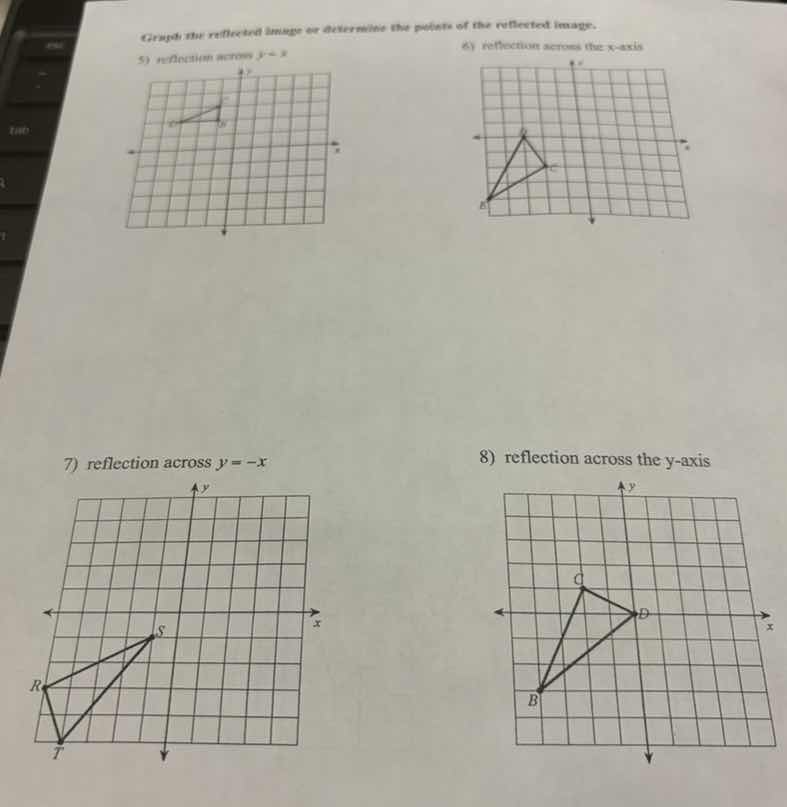
graph the reflected image or determine the points of the reflected image.
- reflection across ( y = x )
- reflection across the x - axis
- reflection across ( y=-x )
- reflection across the y - axis
To solve these reflection problems, we use the rules for reflecting points over different lines:
5) Reflection across \( y = x \)
The rule for reflecting a point \((x, y)\) across \( y = x \) is \((x, y)
ightarrow (y, x)\).
- Identify the coordinates of the original points from the graph.
- Apply the rule to each point to find the reflected points.
- Plot the reflected points to graph the image.
6) Reflection across the \( x \)-axis
The rule for reflecting a point \((x, y)\) across the \( x \)-axis is \((x, y)
ightarrow (x, -y)\).
- Identify the coordinates of the original triangle’s vertices.
- For each vertex \((x, y)\), compute \((x, -y)\).
- Plot these new points to graph the reflected triangle.
7) Reflection across \( y = -x \)
The rule for reflecting a point \((x, y)\) across \( y = -x \) is \((x, y)
ightarrow (-y, -x)\).
- Find the coordinates of points \( R \), \( S \), and \( T \) from the graph.
- For each point \((x, y)\), apply \((-y, -x)\) to get the reflected coordinates.
- Plot the reflected points to graph the image.
8) Reflection across the \( y \)-axis
The rule for reflecting a point \((x, y)\) across the \( y \)-axis is \((x, y)
ightarrow (-x, y)\).
- Identify the coordinates of points \( B \), \( C \), and \( D \) from the graph.
- For each vertex \((x, y)\), compute \((-x, y)\).
- Plot these new points to graph the reflected figure.
Example (for a typical triangle with vertices):
Suppose a triangle has vertices \( A(2, 3) \), \( B(4, 1) \), \( C(1, 2) \):
- Reflection across \( y = x \): \( A(3, 2) \), \( B(1, 4) \), \( C(2, 1) \).
- Reflection across \( x \)-axis: \( A(2, -3) \), \( B(4, -1) \), \( C(1, -2) \).
- Reflection across \( y = -x \): \( A(-3, -2) \), \( B(-1, -4) \), \( C(-2, -1) \).
- Reflection across \( y \)-axis: \( A(-2, 3) \), \( B(-4, 1) \), \( C(-1, 2) \).
To graph the reflected images, follow these steps for each problem:
- Identify original coordinates.
- Apply the reflection rule.
- Plot the new points.
For specific coordinates (e.g., from the graph):
- Let’s assume the triangle in problem 6 has vertices \( A(-5, 3) \), \( B(-6, 1) \), \( C(-3, 2) \).
- Reflection across \( x \)-axis: \( A(-5, -3) \), \( B(-6, -1) \), \( C(-3, -2) \).
Final Answer (General Approach):
For each problem, apply the reflection rule to the original points and plot the results. The key is to use the correct transformation rule for each line of reflection.
- 5) \( y = x \): Swap \( x \) and \( y \) coordinates.
- 6) \( x \)-axis: Negate the \( y \)-coordinate.
- 7) \( y = -x \): Negate both \( x \) and \( y \), then swap.
- 8) \( y \)-axis: Negate the \( x \)-coordinate.
Graph the reflected points using these rules.

Snap & solve any problem in the app
Get step-by-step solutions on Sovi AI
Photo-based solutions with guided steps
Explore more problems and detailed explanations
To solve these reflection problems, we use the rules for reflecting points over different lines:
5) Reflection across \( y = x \)
The rule for reflecting a point \((x, y)\) across \( y = x \) is \((x, y)
ightarrow (y, x)\).
- Identify the coordinates of the original points from the graph.
- Apply the rule to each point to find the reflected points.
- Plot the reflected points to graph the image.
6) Reflection across the \( x \)-axis
The rule for reflecting a point \((x, y)\) across the \( x \)-axis is \((x, y)
ightarrow (x, -y)\).
- Identify the coordinates of the original triangle’s vertices.
- For each vertex \((x, y)\), compute \((x, -y)\).
- Plot these new points to graph the reflected triangle.
7) Reflection across \( y = -x \)
The rule for reflecting a point \((x, y)\) across \( y = -x \) is \((x, y)
ightarrow (-y, -x)\).
- Find the coordinates of points \( R \), \( S \), and \( T \) from the graph.
- For each point \((x, y)\), apply \((-y, -x)\) to get the reflected coordinates.
- Plot the reflected points to graph the image.
8) Reflection across the \( y \)-axis
The rule for reflecting a point \((x, y)\) across the \( y \)-axis is \((x, y)
ightarrow (-x, y)\).
- Identify the coordinates of points \( B \), \( C \), and \( D \) from the graph.
- For each vertex \((x, y)\), compute \((-x, y)\).
- Plot these new points to graph the reflected figure.
Example (for a typical triangle with vertices):
Suppose a triangle has vertices \( A(2, 3) \), \( B(4, 1) \), \( C(1, 2) \):
- Reflection across \( y = x \): \( A(3, 2) \), \( B(1, 4) \), \( C(2, 1) \).
- Reflection across \( x \)-axis: \( A(2, -3) \), \( B(4, -1) \), \( C(1, -2) \).
- Reflection across \( y = -x \): \( A(-3, -2) \), \( B(-1, -4) \), \( C(-2, -1) \).
- Reflection across \( y \)-axis: \( A(-2, 3) \), \( B(-4, 1) \), \( C(-1, 2) \).
To graph the reflected images, follow these steps for each problem:
- Identify original coordinates.
- Apply the reflection rule.
- Plot the new points.
For specific coordinates (e.g., from the graph):
- Let’s assume the triangle in problem 6 has vertices \( A(-5, 3) \), \( B(-6, 1) \), \( C(-3, 2) \).
- Reflection across \( x \)-axis: \( A(-5, -3) \), \( B(-6, -1) \), \( C(-3, -2) \).
Final Answer (General Approach):
For each problem, apply the reflection rule to the original points and plot the results. The key is to use the correct transformation rule for each line of reflection.
- 5) \( y = x \): Swap \( x \) and \( y \) coordinates.
- 6) \( x \)-axis: Negate the \( y \)-coordinate.
- 7) \( y = -x \): Negate both \( x \) and \( y \), then swap.
- 8) \( y \)-axis: Negate the \( x \)-coordinate.
Graph the reflected points using these rules.