QUESTION IMAGE
Question
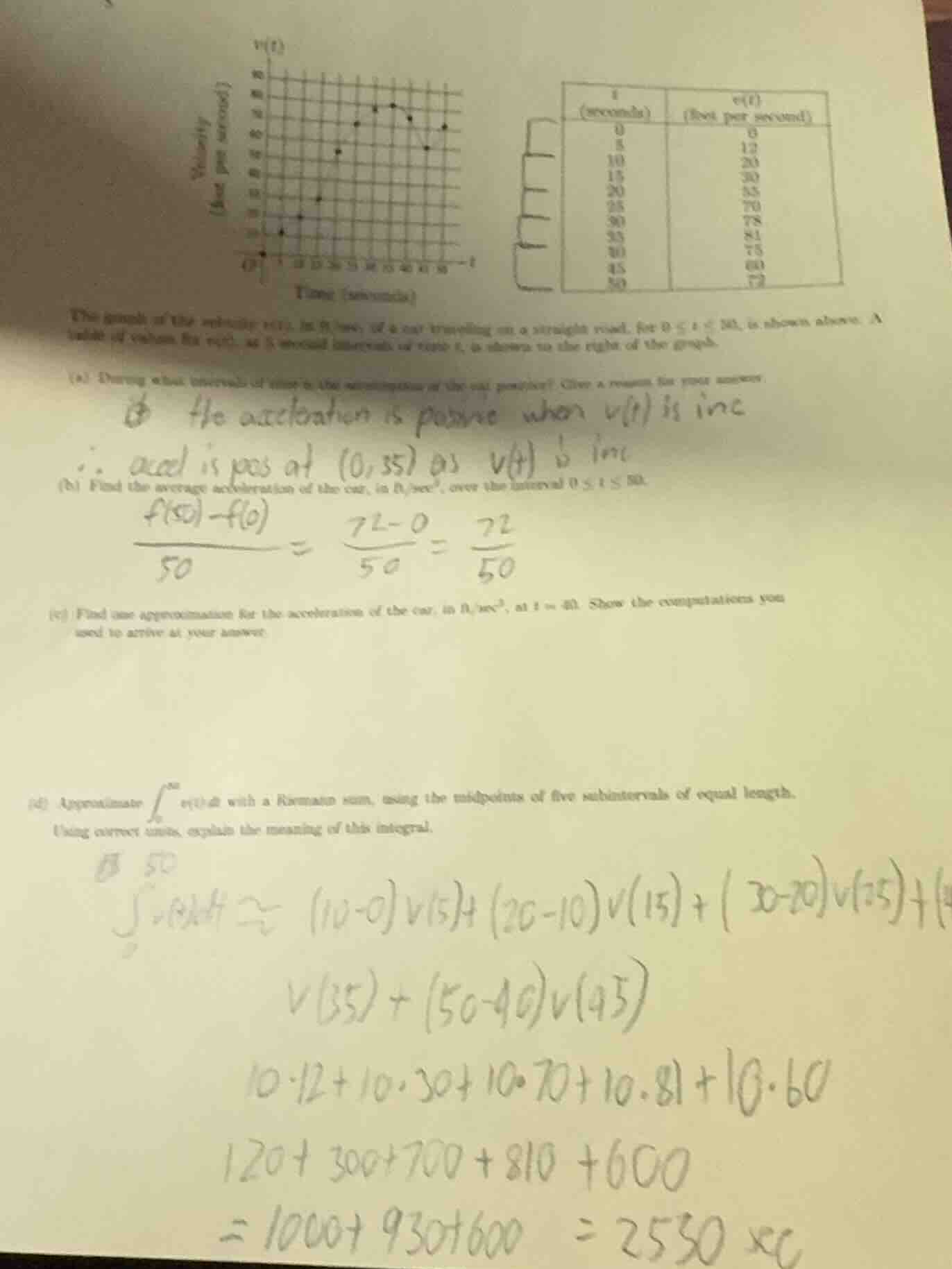
the graph of the velocity ( v(t) ), in ft/sec, of a car traveling on a straight road, for ( 0 leq t leq 50 ), is shown above. a table of values for ( v(t) ), at 5 - second intervals of time ( t ), is shown to the right of the graph.
(a) during what intervals of time is the acceleration of the car positive? give a reason for your answer.
(b) find the average acceleration of the car, in ft/sec², over the interval ( 0 leq t leq 50 ).
(c) find an approximation for the acceleration of the car, in ft/sec², at ( t = 40 ). show the computations you used to arrive at your answer.
(d) approximate ( int_{0}^{50} v(t) dt ) with a riemann sum, using the midpoints of five subintervals of equal length. using correct units, explain the meaning of this integral.
Part (a)
Step1: Recall Acceleration Definition
Acceleration \( a(t) \) is the derivative of velocity \( v(t) \), so \( a(t)=v'(t) \). Positive acceleration occurs when \( v(t) \) is increasing (since the derivative is positive for an increasing function), and negative acceleration occurs when \( v(t) \) is decreasing (derivative negative).
Step2: Analyze Velocity Trend
From the graph/table, observe when \( v(t) \) increases or decreases. The velocity \( v(t) \) increases on \( [0, 35] \) (as values rise: \( 0, 12, 20, 30, 55, 70, 78 \)) and decreases on \( [35, 50] \) (values fall: \( 78, 81, 75, 60, 72 \)? Wait, correction: Wait, the table at \( t = 30 \): 78, \( t = 35 \): 81 (increase), \( t = 40 \): 75 (decrease), \( t = 45 \): 60, \( t = 50 \): 72? Wait, maybe the initial analysis: Let's check the table:
\( t \): 0 (0), 5 (12), 10 (20), 15 (30), 20 (55), 25 (70), 30 (78), 35 (81), 40 (75), 45 (60), 50 (72). Wait, from \( t=0 \) to \( t=35 \), \( v(t) \) goes from 0 to 81 (increasing). From \( t=35 \) to \( t=50 \), \( v(t) \) first decreases to 75, 60, then increases to 72? Wait, maybe the key is: Acceleration is positive when \( v(t) \) is increasing (so \( a(t)>0 \) when \( v(t) \) is increasing), negative when decreasing.
So, \( v(t) \) is increasing on \( [0, 35] \) (since \( v(35)=81 > v(30)=78 \), and prior values are increasing), and decreasing on \( [35, 50] \) (from \( t=35 \) to \( t=45 \), \( v \) drops from 81 to 60, then at \( t=50 \) it's 72, but the main decrease is \( [35, 45] \), but maybe the interval where \( v(t) \) is increasing is \( [0, 35] \) (since the function rises there) and decreasing on \( [35, 50] \) (since after \( t=35 \), the velocity starts to decrease (from 81 to 75 at \( t=40 \), etc.), even though at \( t=50 \) it's 72 (maybe a small increase, but overall, the dominant trend after 35 is decreasing). So positive acceleration on \( (0, 35) \) (open interval, since at endpoints, derivative is undefined or we look at intervals where it's increasing), negative on \( (35, 50) \).
Step1: Recall Average Acceleration Formula
Average acceleration over \( [a, b] \) is \( \frac{v(b) - v(a)}{b - a} \), since acceleration is the rate of change of velocity.
Step2: Substitute Values
Here, \( a = 0 \), \( b = 50 \), \( v(0) = 0 \) ft/sec, \( v(50) = 72 \) ft/sec. So:
\( \text{Average acceleration} = \frac{v(50) - v(0)}{50 - 0} = \frac{72 - 0}{50} \)
Step3: Simplify
\( \frac{72}{50} = \frac{36}{25} = 1.44 \) ft/sec².
Step1: Approximate Acceleration at \( t = 40 \)
Acceleration at \( t = 40 \) is the derivative \( v'(40) \), approximated by the average rate of change of \( v(t) \) around \( t = 40 \), e.g., using the interval \( [35, 45] \) (since \( t = 35 \) and \( t = 45 \) are adjacent to \( t = 40 \)).
Step2: Calculate Average Rate of Change
The formula for average rate of change (approximating derivative) is \( \frac{v(45) - v(35)}{45 - 35} \).
From the table: \( v(35) = 81 \) ft/sec, \( v(45) = 60 \) ft/sec.
So, \( a(40) \approx \frac{60 - 81}{45 - 35} = \frac{-21}{10} = -2.1 \) ft/sec².
(Alternative: Use \( [35, 40] \): \( \frac{75 - 81}{40 - 35} = \frac{-6}{5} = -1.2 \); or \( [40, 45] \): \( \frac{60 - 75}{45 - 40} = \frac{-15}{5} = -3 \). The midpoint or symmetric interval is better, so \( [35, 45] \) gives a central approximation.)

Snap & solve any problem in the app
Get step-by-step solutions on Sovi AI
Photo-based solutions with guided steps
Explore more problems and detailed explanations
Positive acceleration on \( \boldsymbol{[0, 35]} \) (or \( (0, 35) \)) because velocity \( v(t) \) is increasing (so \( v'(t) = a(t) > 0 \)); negative acceleration on \( \boldsymbol{[35, 50]} \) (or \( (35, 50) \)) because \( v(t) \) is decreasing (so \( v'(t) = a(t) < 0 \)).