QUESTION IMAGE
Question
graphing exercise
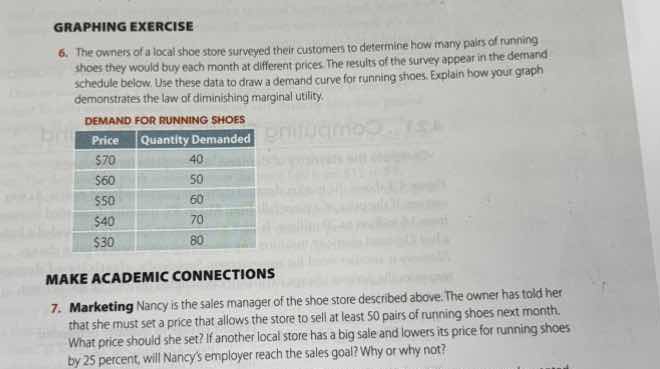
- the owners of a local shoe store surveyed their customers to determine how many pairs of running shoes they would buy each month at different prices. the results of the survey appear in the demand schedule below. use these data to draw a demand curve for running shoes. explain how your graph demonstrates the law of diminishing marginal utility.
demand for running shoes
| price | quantity demanded |
|---|---|
| $60 | 50 |
| $50 | 60 |
| $40 | 70 |
| $30 | 80 |
make academic connections
- marketing nancy is the sales manager of the shoe store described above. the owner has told her that she must set a price that allows the store to sell at least 50 pairs of running shoes next month. what price should she set? if another local store has a big sale and lowers its price for running shoes by 25 percent, will nancy’s employer reach the sales goal? why or why not?
For Question 6:
Step1: Set up graph axes
Label x-axis: Quantity Demanded, y-axis: Price (\$)
Step2: Plot data points
Plot pairs: $(40, 70), (50, 60), (60, 50), (70, 40), (80, 30)$
Step3: Draw demand curve
Connect plotted points with a downward-sloping line
Step4: Link to diminishing MU
As quantity rises, willingness to pay (price) falls, since each additional pair gives less marginal utility.
Step1: Find price for 50 pairs
Locate quantity 50 in the demand schedule.
Step2: Identify corresponding price
The price paired with 50 units is \$60.
Step3: Analyze competitor price cut
Calculate new competitor price: $\$60 \times (1 - 0.25) = \$45$
Step4: Evaluate sales goal impact
At \$45, consumers will demand more than 50 pairs (since \$40 corresponds to 70 pairs, \$45 is between \$40 and \$50, so quantity demanded is between 60-70 pairs).

Snap & solve any problem in the app
Get step-by-step solutions on Sovi AI
Photo-based solutions with guided steps
Explore more problems and detailed explanations
The downward-sloping demand curve (connecting points (40,70), (50,60), (60,50), (70,40), (80,30)) shows that as the quantity of running shoes purchased increases, the maximum price consumers are willing to pay decreases. This reflects the law of diminishing marginal utility: each additional pair of shoes provides less additional satisfaction than the previous one, so consumers will only buy more if the price is lower.
---