QUESTION IMAGE
Question
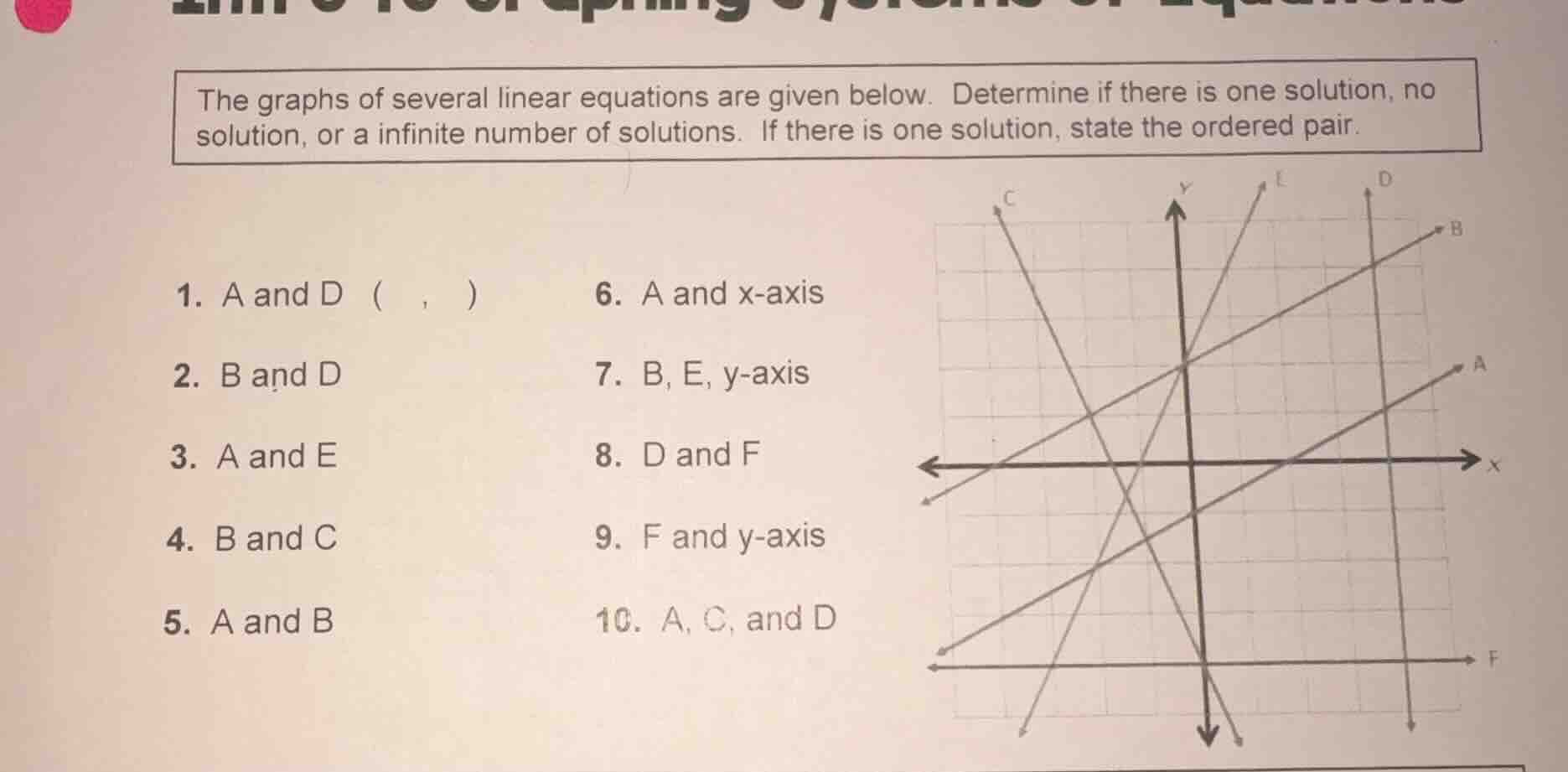
the graphs of several linear equations are given below. determine if there is one solution, no solution, or a infinite number of solutions. if there is one solution, state the ordered pair. 1. a and d ( , ) 2. b and d 3. a and e 4. b and c 5. a and b 6. a and x - axis 7. b, e, y - axis 8. d and f 9. f and y - axis 10. a, c, and d
1. A and D
Step1: Analyze the lines
Line A is a linear graph, and line D is a vertical line (since it's parallel to the y - axis). To find their intersection, we look at the x - coordinate of line D and the corresponding y - coordinate on line A. From the graph, line D is at \(x = 3\) (assuming the grid has integer coordinates). We find the y - value of line A when \(x=3\). By observing the graph, when \(x = 3\), the y - coordinate for line A is \(2\) (by checking the intersection point of A and D).
Step2: Determine the ordered pair
The intersection point of A and D is \((3,2)\) because that's the point where both lines meet.
Step1: Analyze the lines
Line B is a linear graph, and line D is a vertical line (\(x = 3\)). We find the y - value of line B when \(x = 3\). From the graph, when \(x=3\), the y - coordinate for line B is \(3\) (by looking at the intersection point of B and D).
Step2: Determine the solution type
Since there is one point of intersection, there is one solution. The ordered pair is \((3,3)\) (by identifying the intersection point of B and D on the graph).
Step1: Analyze the lines
Lines A and E are non - parallel (they have different slopes) and non - coincident. So, they will intersect at one point. By looking at the graph, we can see that they intersect at the y - axis (where \(x = 0\)). The y - coordinate at \(x = 0\) for both lines (from the graph) is \(1\) (assuming the intersection point is \((0,1)\) by observing the graph where A, E, and the y - axis related lines meet). Wait, actually, from the graph, lines A and E intersect at the point \((0,1)\)? Wait, no, looking again, lines A and E: line E passes through the origin? Wait, no, let's re - examine. Line A and line E: line E has a steeper slope. Wait, actually, from the graph, lines A and E intersect at the point \((0,1)\)? No, maybe I made a mistake. Wait, the correct way: two non - parallel lines intersect at one point. By looking at the graph, the intersection of A and E is at \((0,1)\)? Wait, no, let's check the graph again. Wait, line A and line E: line E passes through the y - axis at \((0,1)\) and has a steeper slope. Line A also passes through the y - axis at \((0,1)\)? Wait, no, maybe they are parallel? Wait, no, if they have the same slope, they are parallel. Wait, from the graph, lines A and E: if they are parallel, there is no solution. Wait, looking at the graph, line A and line E have the same slope (they are parallel), so they never intersect.
Step2: Determine the solution type
Since two parallel lines (non - coincident) never intersect, there is no solution.

Snap & solve any problem in the app
Get step-by-step solutions on Sovi AI
Photo-based solutions with guided steps
Explore more problems and detailed explanations
\((3, 2)\)