QUESTION IMAGE
Question
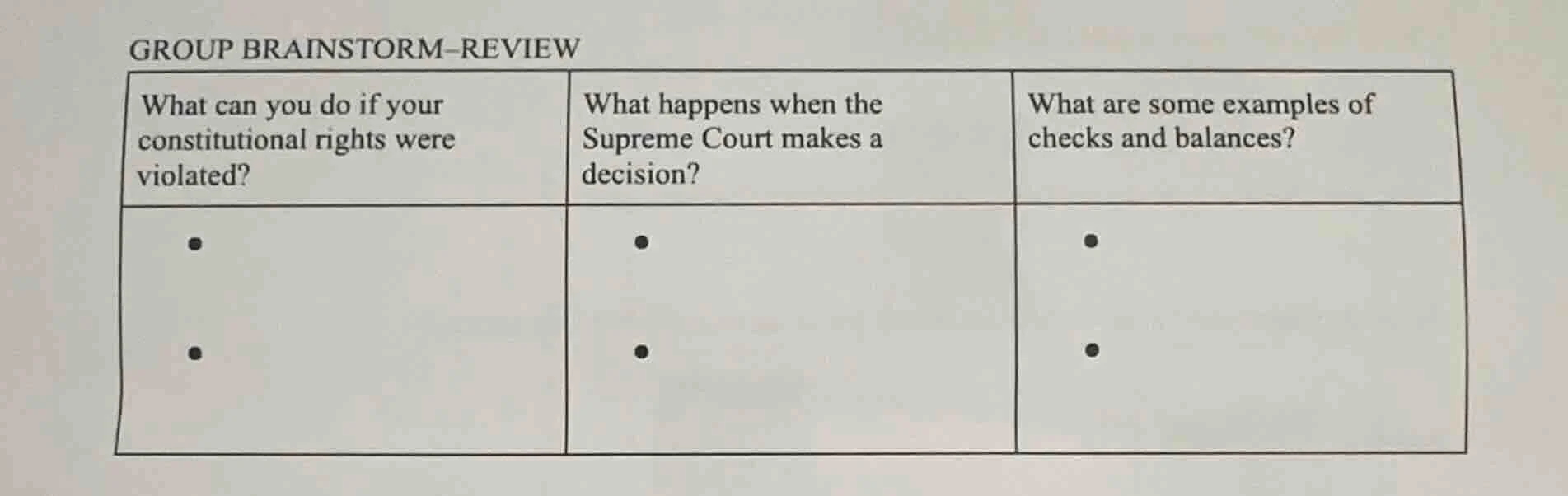
group brainstorm-review
what can you do if your constitutional rights were violated?
what happens when the supreme court makes a decision?
what are some examples of checks and balances?
For "What can you do if your constitutional rights were violated?"
If constitutional rights are violated, one can file a lawsuit in federal or state court, often seeking legal remedies like injunctions or damages. Another option is to contact civil rights organizations for support and guidance. Also, in some cases, filing a complaint with relevant government agencies (e.g., the Department of Justice for civil rights violations) is possible.
When the Supreme Court makes a decision, it becomes binding precedent (stare decisis) for lower courts, meaning lower courts must follow the legal reasoning. The decision can also impact public policy, as it interprets the law (including the Constitution) and can shape how laws are enforced or applied. Additionally, it may lead to legislative or executive responses, such as Congress amending a law or the President adjusting enforcement policies.
One example is the President (executive) can veto legislation passed by Congress (legislative), but Congress can override the veto with a two - thirds vote in both houses. Another is the Supreme Court (judicial) can declare laws passed by Congress or actions of the President unconstitutional, checking the other two branches. Also, the Senate (part of legislative) confirms presidential appointments (executive), providing a check on the executive branch's personnel decisions.

Snap & solve any problem in the app
Get step-by-step solutions on Sovi AI
Photo-based solutions with guided steps
Explore more problems and detailed explanations
- File a lawsuit in court (seeking remedies like injunctions/damages).
- Contact civil rights organizations for support.
- File a complaint with relevant government agencies (e.g., DOJ for civil rights violations).