QUESTION IMAGE
Question
groups 1-1
triangle: justification: triangle: justification: triangle: justification:
triangle image with sides 17 cm, 17 cm, 17 cm they are equilateral triangles so they are congruent by... how all three of the first right triangle image with legs 8 cm, 15 cm? and hypotenuse 17 cm since all three sides of this triangle have distinct lengths, it is classified as scalene triangle. (it is also an acute triangle, as... isosceles triangle image with two sides 17 cm and vertex angle 60°
triangle image with two sides 8 cm, 8 cm and base 17 cm, vertex angle 60° triangle sides are 17 meaning its congruent triangle image with sides 8 cm, 17 cm, and angle 60°? triangle image with two sides 17 cm and base angles 60°?
triangle image with two angles 60° and side 17 cm scalene triangle image with sides 8 cm, 15 cm, 17 cm triangle image with angles 70°, 70°, 40°? and sides 17 cm, 17 cm, 10 cm?
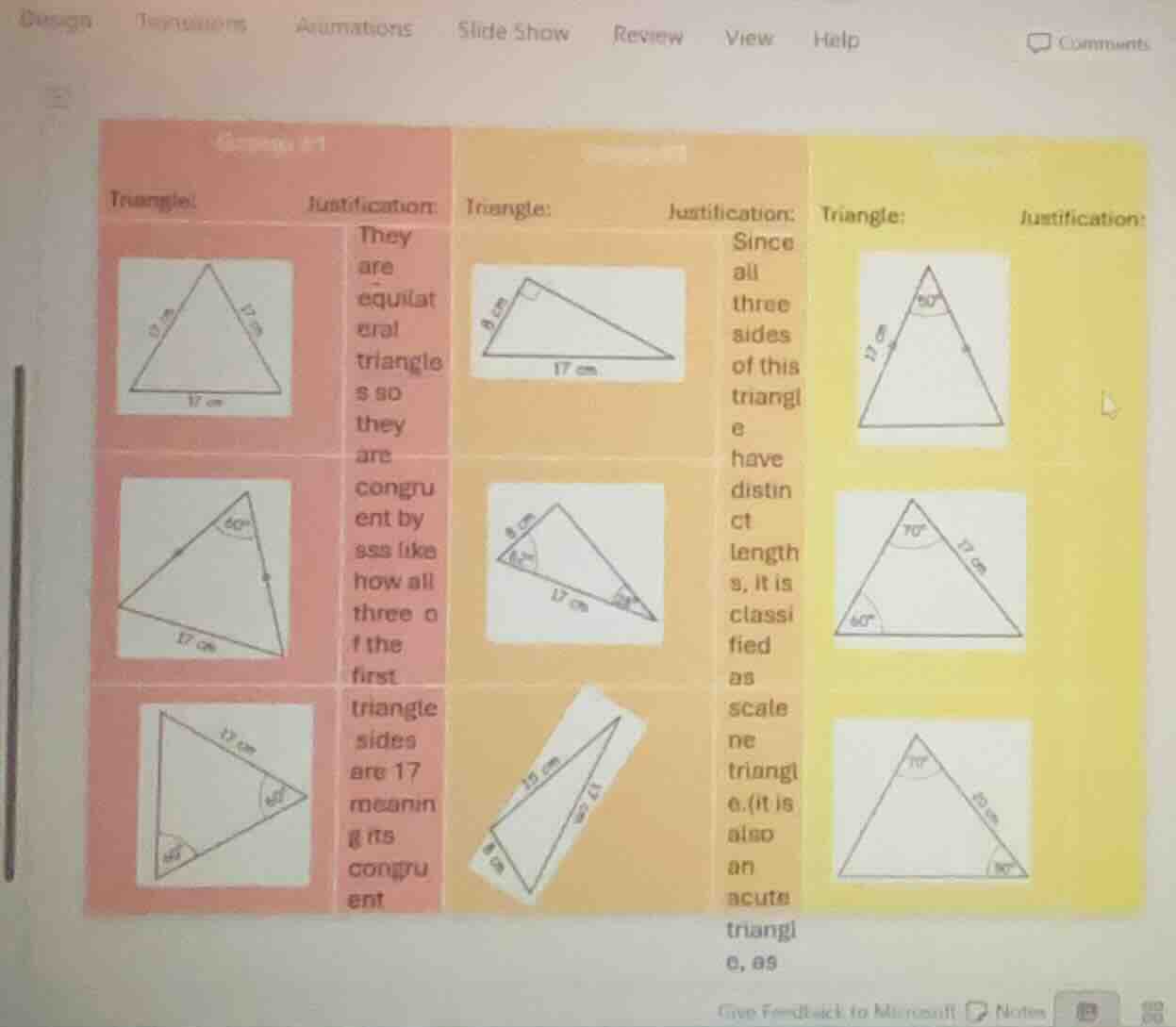
To analyze the triangles and their justifications, we can use the properties of triangle congruence and classification (e.g., equilateral, isosceles, scalene, acute, right, obtuse). Here's a breakdown of each triangle:
1. Pink Column (First Group)
- Top Triangle: All sides are 17 cm, so it's an equilateral triangle. By the definition of equilateral triangles (all sides equal), it's congruent to other equilateral triangles with the same side length.
- Middle Triangle: Two sides are equal (marked with the same tick), and the included angle is 60°. By the SAS (Side - Angle - Side) congruence criterion, if two sides and the included angle of one triangle are equal to two sides and the included angle of another triangle, the triangles are congruent. Also, since two sides are equal, it's an isosceles triangle.
- Bottom Triangle: Two angles are 60°, so the third angle is also 60° (since the sum of angles in a triangle is 180°: \(180-(60 + 60)=60\)). So it's an equilateral triangle (all angles 60° implies all sides equal). By the ASA (Angle - Side - Angle) or AAA (Angle - Angle - Angle, which for equilateral triangles implies congruence) criterion, it's congruent to other equilateral triangles.
2. Orange Column (Second Group)
- Top Triangle: Sides are 8 cm, 15 cm (we can calculate the third side using Pythagoras: \(8^{2}+15^{2}=64 + 225 = 289=17^{2}\)), so it's a right - angled triangle (right - angled at the vertex between 8 cm and 15 cm sides). It's a scalene triangle (all sides of different lengths: 8, 15, 17) and also an acute - angled? No, it's right - angled. Wait, 8, 15, 17 is a Pythagorean triple (\(a^{2}+b^{2}=c^{2}\) where \(a = 8\), \(b = 15\), \(c = 17\)).
- Middle Triangle: Angles are 60°, 60°, and 60°? Wait, the angles are marked as 60°, 60°, and 60°? Wait, the sides are 8 cm, 17 cm, and the included angle? Wait, no, the angles are marked as 60°, 60°, and 60°? Wait, the triangle has sides 8 cm, 17 cm, and the angles: if two angles are 60°, the third is 60°, so it's equilateral? No, the sides are 8, 17? Wait, maybe a typo. Wait, the side lengths: 8 cm, 17 cm, and the other side? Wait, the angle - side - angle: if two angles are 60° and the included side is equal to the side of the first equilateral triangle (17 cm), then by ASA, it's congruent to the first equilateral triangle.
- Bottom Triangle: Sides are 8 cm, 15 cm, 17 cm (same as the top triangle in the orange column). By SSS (Side - Side - Side) congruence criterion, if all three sides of one triangle are equal to all three sides of another triangle, the triangles are congruent. So it's congruent to the top triangle in the orange column. Also, since \(8^{2}+15^{2}=17^{2}\), it's a right - angled triangle.
3. Yellow Column (Third Group)
- Top Triangle: Two sides are equal (marked with the same tick), and the included angle is 60°. By SAS, it's congruent to the middle triangle in the pink column. Also, since two sides are equal and the included angle is 60°, it's an equilateral triangle (because in an isosceles triangle, if the included angle between the equal sides is 60°, the triangle is equilateral).
- Middle Triangle: Angles are 70°, 60°, so the third angle is \(180-(70 + 60)=50\). All angles are less than 90°, so it's an acute - angled triangle. Two sides are equal (marked with the same tick), so it's an isosceles triangle.
- Bottom Triangle: Angles are 70°, 50°, so the third angle is \(180-(70 + 50)=60\). All angles are less than 90°, so it's an acute - angled triangle. Two sides are equal (marked with the same tick), s…

Snap & solve any problem in the app
Get step-by-step solutions on Sovi AI
Photo-based solutions with guided steps
Explore more problems and detailed explanations
To analyze the triangles and their justifications, we can use the properties of triangle congruence and classification (e.g., equilateral, isosceles, scalene, acute, right, obtuse). Here's a breakdown of each triangle:
1. Pink Column (First Group)
- Top Triangle: All sides are 17 cm, so it's an equilateral triangle. By the definition of equilateral triangles (all sides equal), it's congruent to other equilateral triangles with the same side length.
- Middle Triangle: Two sides are equal (marked with the same tick), and the included angle is 60°. By the SAS (Side - Angle - Side) congruence criterion, if two sides and the included angle of one triangle are equal to two sides and the included angle of another triangle, the triangles are congruent. Also, since two sides are equal, it's an isosceles triangle.
- Bottom Triangle: Two angles are 60°, so the third angle is also 60° (since the sum of angles in a triangle is 180°: \(180-(60 + 60)=60\)). So it's an equilateral triangle (all angles 60° implies all sides equal). By the ASA (Angle - Side - Angle) or AAA (Angle - Angle - Angle, which for equilateral triangles implies congruence) criterion, it's congruent to other equilateral triangles.
2. Orange Column (Second Group)
- Top Triangle: Sides are 8 cm, 15 cm (we can calculate the third side using Pythagoras: \(8^{2}+15^{2}=64 + 225 = 289=17^{2}\)), so it's a right - angled triangle (right - angled at the vertex between 8 cm and 15 cm sides). It's a scalene triangle (all sides of different lengths: 8, 15, 17) and also an acute - angled? No, it's right - angled. Wait, 8, 15, 17 is a Pythagorean triple (\(a^{2}+b^{2}=c^{2}\) where \(a = 8\), \(b = 15\), \(c = 17\)).
- Middle Triangle: Angles are 60°, 60°, and 60°? Wait, the angles are marked as 60°, 60°, and 60°? Wait, the sides are 8 cm, 17 cm, and the included angle? Wait, no, the angles are marked as 60°, 60°, and 60°? Wait, the triangle has sides 8 cm, 17 cm, and the angles: if two angles are 60°, the third is 60°, so it's equilateral? No, the sides are 8, 17? Wait, maybe a typo. Wait, the side lengths: 8 cm, 17 cm, and the other side? Wait, the angle - side - angle: if two angles are 60° and the included side is equal to the side of the first equilateral triangle (17 cm), then by ASA, it's congruent to the first equilateral triangle.
- Bottom Triangle: Sides are 8 cm, 15 cm, 17 cm (same as the top triangle in the orange column). By SSS (Side - Side - Side) congruence criterion, if all three sides of one triangle are equal to all three sides of another triangle, the triangles are congruent. So it's congruent to the top triangle in the orange column. Also, since \(8^{2}+15^{2}=17^{2}\), it's a right - angled triangle.
3. Yellow Column (Third Group)
- Top Triangle: Two sides are equal (marked with the same tick), and the included angle is 60°. By SAS, it's congruent to the middle triangle in the pink column. Also, since two sides are equal and the included angle is 60°, it's an equilateral triangle (because in an isosceles triangle, if the included angle between the equal sides is 60°, the triangle is equilateral).
- Middle Triangle: Angles are 70°, 60°, so the third angle is \(180-(70 + 60)=50\). All angles are less than 90°, so it's an acute - angled triangle. Two sides are equal (marked with the same tick), so it's an isosceles triangle.
- Bottom Triangle: Angles are 70°, 50°, so the third angle is \(180-(70 + 50)=60\). All angles are less than 90°, so it's an acute - angled triangle. Two sides are equal (marked with the same tick), so it's an isosceles triangle.
If we want to correct the justifications:
- For the right - angled triangle in the orange column (top), the justification should be: "Since \(8^{2}+15^{2}=17^{2}\) (by the Pythagorean theorem \(a^{2}+b^{2}=c^{2}\) where \(a = 8\), \(b = 15\), \(c = 17\)), this triangle is a right - angled triangle. It is a scalene triangle as all sides (\(8\mathrm{cm}\), \(15\mathrm{cm}\), \(17\mathrm{cm}\)) have distinct lengths."
- For the middle triangle in the orange column, if the angles are 60°, 60°, 60°, and the side is 17 cm, the justification should be: "Since all angles are \(60^{\circ}\), by the property of triangles (if all angles are equal, all sides are equal), this is an equilateral triangle. It is congruent to the top triangle in the pink column by the SSS (or ASA or SAS) congruence criterion as all sides (or angles) are equal."
If we are to find congruent triangles:
- The top triangle in the pink column (equilateral, side 17) is congruent to the top triangle in the yellow column (equilateral, side 17) and the middle triangle in the orange column (if it's equilateral with side 17) by SSS (all sides 17).
- The middle triangle in the pink column (SAS with two equal sides and included 60°) is congruent to the top triangle in the yellow column (SAS with two equal sides and included 60°) by SAS.
- The bottom triangle in the pink column (equilateral, angles 60°) is congruent to the top triangle in the pink column and top triangle in the yellow column by AAA (or SSS).
- The top triangle in the orange column (right - angled, sides 8, 15, 17) is congruent to the bottom triangle in the orange column (right - angled, sides 8, 15, 17) by SSS.