QUESTION IMAGE
Question
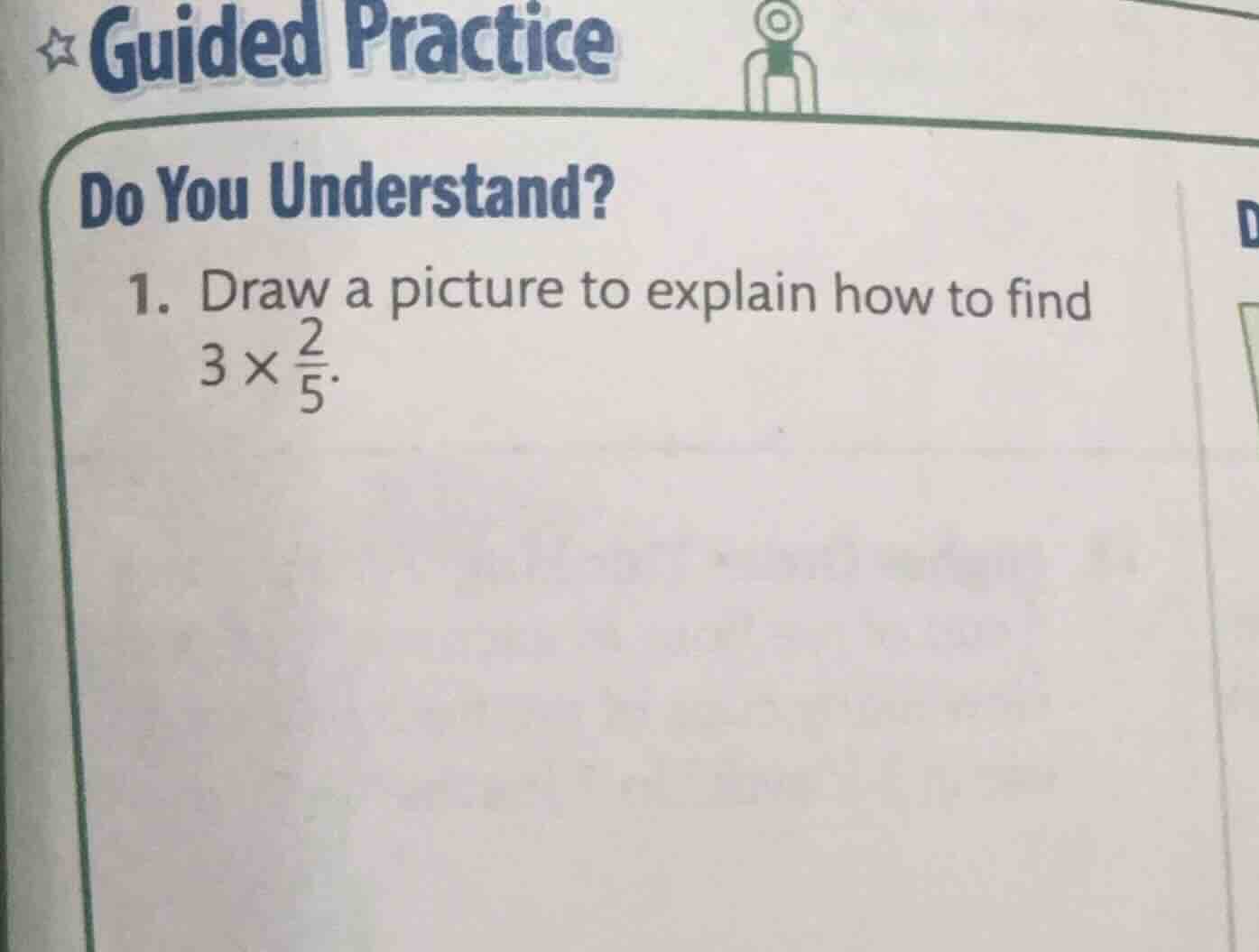
guided practice do you understand? 1. draw a picture to explain how to find 3×(2/5).
Step1: Understand the meaning of multiplication
The expression \(3\times\frac{2}{5}\) can be interpreted as finding the sum of 3 groups of \(\frac{2}{5}\) or as taking \(\frac{2}{5}\) of 3. To represent this with a picture, we can use rectangles or circles divided into equal parts.
Step2: Represent \(\frac{2}{5}\)
First, draw a rectangle (or a circle) and divide it into 5 equal parts. Shade 2 of these parts to represent \(\frac{2}{5}\). This shaded portion represents one group of \(\frac{2}{5}\).
Step3: Draw 3 groups of \(\frac{2}{5}\)
Now, draw two more identical rectangles (or circles) and shade 2 parts in each of them, just like the first one. So now we have 3 rectangles, each with 2 out of 5 parts shaded.
Step4: Combine the shaded parts
To find the total, we can count the number of shaded parts across all 3 rectangles. Each rectangle has 2 shaded parts, so 3 rectangles will have \(3\times2 = 6\) shaded parts. Since each rectangle is divided into 5 parts, the total number of parts is \(3\times5=15\)? Wait, no, actually, when we are multiplying a whole number by a fraction, we can think of the whole number as a fraction with denominator 1. So \(3\times\frac{2}{5}=\frac{3\times2}{5}=\frac{6}{5}\) or \(1\frac{1}{5}\). Alternatively, when we have 3 groups of \(\frac{2}{5}\), the total shaded area is the sum of the three shaded regions. Each shaded region is \(\frac{2}{5}\), so adding them up: \(\frac{2}{5}+\frac{2}{5}+\frac{2}{5}=\frac{2 + 2+ 2}{5}=\frac{6}{5}\).
Visually, if we consider each of the 3 rectangles (divided into 5 parts) with 2 shaded parts, we can also combine them into a single rectangle divided into 5 parts, and see how many times the shaded parts fit. But maybe a better way is to use a number line or a bar model.
Bar Model Approach:
- Draw a bar and divide it into 5 equal segments. Shade 2 segments to represent \(\frac{2}{5}\).
- Now, draw two more identical bars, each with 2 segments shaded.
- To find the total, we can see that we have 3 times the shaded portion of \(\frac{2}{5}\). So the total shaded length (or area) is \(3\times\frac{2}{5}=\frac{6}{5}\).
Another way: Think of 3 as a whole. Divide the whole (3) into 5 equal parts (since the denominator of the fraction is 5) and take 2 of those parts. But the first interpretation of 3 groups of \(\frac{2}{5}\) is more straightforward for drawing.
So, to draw the picture:
- Draw 3 separate rectangles (or circles), each divided into 5 equal parts.
- Shade 2 parts in each rectangle.
- The total number of shaded parts is \(3\times2 = 6\), and since each rectangle has 5 parts, the fraction representing the total shaded area is \(\frac{6}{5}\) (or \(1\frac{1}{5}\) if we convert it to a mixed number).

Snap & solve any problem in the app
Get step-by-step solutions on Sovi AI
Photo-based solutions with guided steps
Explore more problems and detailed explanations
To find \(3\times\frac{2}{5}\) using a picture:
Step 1: Represent \(\boldsymbol{\frac{2}{5}}\)
Draw a rectangle (or circle) and divide it into 5 equal parts. Shade 2 of these parts to represent \(\frac{2}{5}\). This is one group of \(\frac{2}{5}\).
Step 2: Draw 3 groups of \(\boldsymbol{\frac{2}{5}}\)
Draw two more identical rectangles (or circles), each divided into 5 equal parts. Shade 2 parts in each of these new rectangles. Now you have 3 rectangles, each with 2 out of 5 parts shaded.
Step 3: Combine the shaded parts
Count the total number of shaded parts: \(3 \times 2 = 6\). Since each rectangle has 5 parts, the total shaded area represents \(\frac{6}{5}\) (or \(1\frac{1}{5}\)).
Visually, this shows that \(3 \times \frac{2}{5} = \frac{6}{5}\) (or \(1\frac{1}{5}\)).
(Note: You can also use a single bar divided into 5 parts, then repeat the "2 - shaded - parts" segment 3 times to show the total.)