QUESTION IMAGE
Question
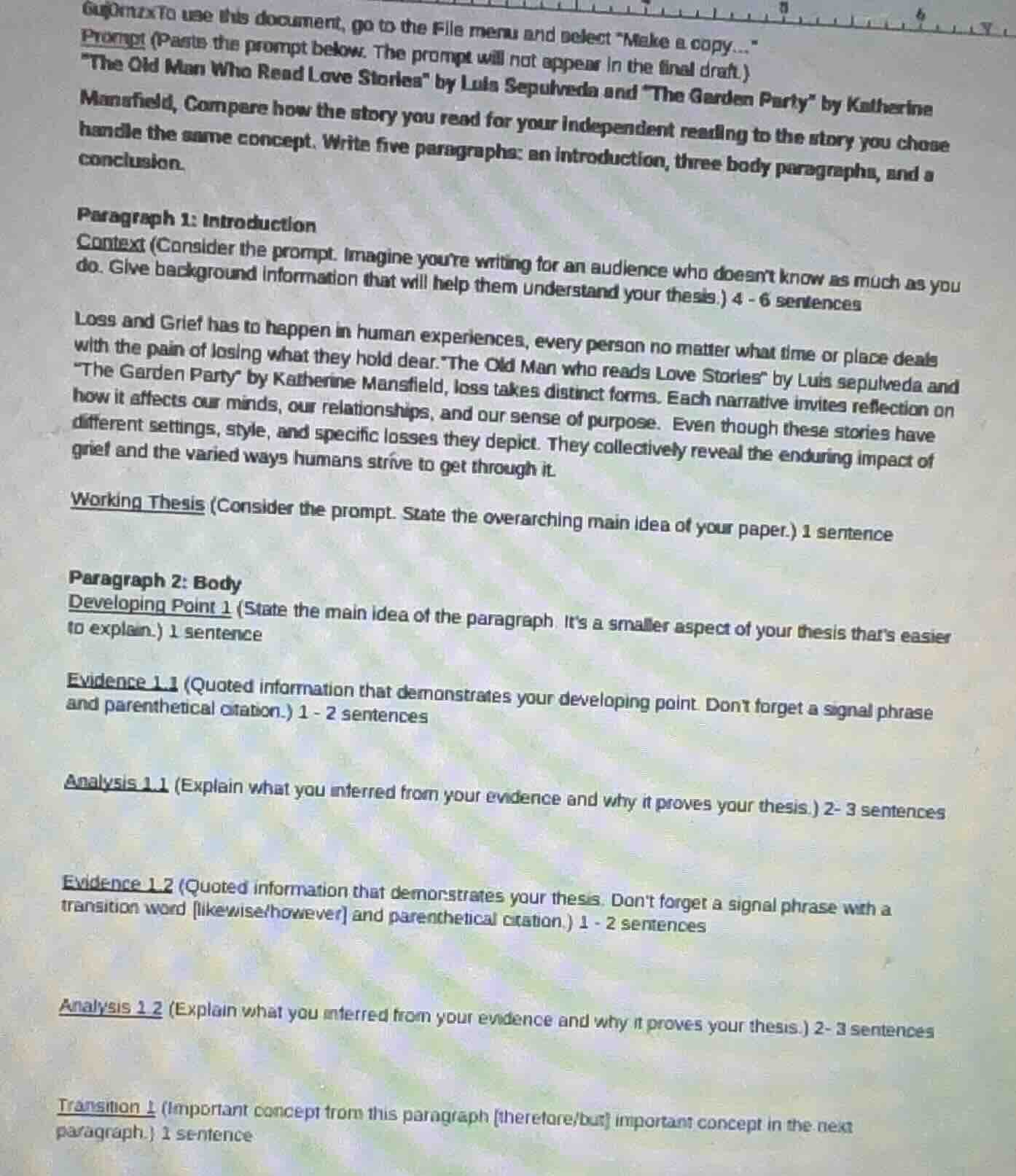
gujdmzxto use this document, go to the file menu and select \make a copy...\prompt (paste the prompt below. the prompt will not appear in the final draft.)\the old man who read love stories\ by luis sepulveda and \the garden party\ by katherine mansfield, compare how the story you read for your independent reading to the story you chose handle the same concept. write five paragraphs: an introduction, three body paragraphs, and a conclusion.paragraph 1: introductioncontext (consider the prompt. imagine youre writing for an audience who doesnt know as much as you do. give background information that will help them understand your thesis.) 4 - 6 sentencesloss and grief has to happen in human experiences, every person no matter what time or place deals with the pain of losing what they hold dear.\the old man who reads love stories\ by luis sepulveda and \the garden party\ by katherine mansfield, loss takes distinct forms. each narrative invites reflection on how it affects our minds, our relationships, and our sense of purpose. even though these stories have different settings, style, and specific losses they depict. they collectively reveal the enduring impact of grief and the varied ways humans strive to get through it.working thesis (consider the prompt. state the overarching main idea of your paper.) 1 sentenceparagraph 2: bodydeveloping point 1 (state the main idea of the paragraph. its a smaller aspect of your thesis thats easier to explain.) 1 sentenceevidence 1.1 (quoted information that demonstrates your developing point. dont forget a signal phrase and parenthetical citation.) 1 - 2 sentencesanalysis 1.1 (explain what you inferred from your evidence and why it proves your thesis.) 2- 3 sentencesevidence 1.2 (quoted information that demonstrates your thesis. dont forget a signal phrase with a transition word likewise/however and parenthetical citation.) 1 - 2 sentencesanalysis 1.2 (explain what you inferred from your evidence and why it proves your thesis.) 2- 3 sentencestransition 1 (important concept from this paragraph therefore/but important concept in the next paragraph.) 1 sentence
First, the working thesis ties the two stories' exploration of grief to their distinct narrative choices. For the first body paragraph, we focus on how each story frames grief through setting, use direct textual evidence, analyze how setting shapes the grief experience, and transition to the next body paragraph's focus on character relationships.

Snap & solve any problem in the app
Get step-by-step solutions on Sovi AI
Photo-based solutions with guided steps
Explore more problems and detailed explanations
Paragraph 1: Introduction (Completed Context + Added Working Thesis)
Loss and grief are universal human experiences, with every person, regardless of time or place, grappling with the pain of losing what they hold dear. The Old Man Who Reads Love Stories by Luis Sepúlveda, set in a remote Amazonian village, centers on an elderly man confronting quiet, long-buried grief, while The Garden Party by Katherine Mansfield, set in a privileged 20th-century suburban household, explores sudden, disorienting grief amid superficial opulence. Each narrative invites reflection on how loss affects our minds, our relationships, and our sense of purpose. Even though these stories have different settings, styles, and specific losses they depict, they collectively reveal the enduring impact of grief and the varied ways humans strive to get through it.
Working Thesis: While The Old Man Who Reads Love Stories and The Garden Party both examine the universal weight of grief, they use distinct narrative settings, character dynamics, and stylistic choices to reveal how grief manifests and is processed across vastly different social and cultural contexts.
---
Paragraph 2: Body
Developing Point 1: Each story’s setting frames grief as either a private, meditative burden or a disruptive, unspoken force.
Evidence 1.1: In The Old Man Who Reads Love Stories, Sepúlveda writes, "In the silence of the jungle, time does not pass, it accumulates, like the layers of leaves on the forest floor" (Sepúlveda 45).
Analysis 1.1: The isolated Amazonian jungle mirrors the old man’s internal isolation, allowing his grief over lost loved ones to fester as a quiet, lifelong weight rather than a sudden crisis. The unchanging, slow-moving setting emphasizes that his grief is not a temporary event but a permanent part of his identity.
Evidence 1.2: However, in The Garden Party, Mansfield describes the Sheridan family’s lavish lawn as "a sea of green, with here and there a splash of color from the flowers" (Mansfield 12), even as a working-class neighbor lies dead nearby.
Analysis 1.2: The bright, opulent setting of the garden party contrasts sharply with the unspoken grief of the dead man’s family and Laura Sheridan’s emerging guilt, framing grief as a force that disrupts the superficial comfort of privileged life. The setting highlights how grief can be ignored or dismissed by those insulated from hardship.
Transition 1: While setting shapes the context of grief in both stories, the way characters’ relationships mediate their grief reveals even deeper differences in how loss is experienced.