QUESTION IMAGE
Question
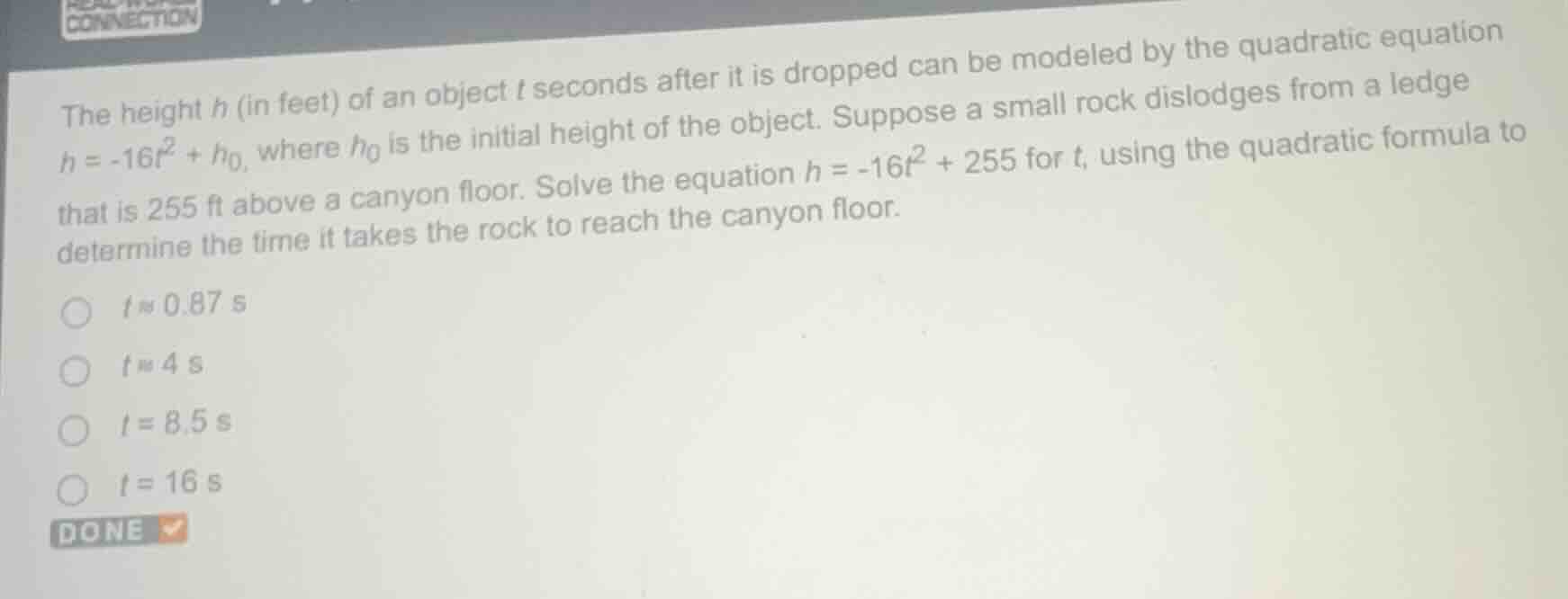
the height ( h ) (in feet) of an object ( t ) seconds after it is dropped can be modeled by the quadratic equation ( h = -16t^2 + h_0 ), where ( h_0 ) is the initial height of the object. suppose a small rock dislodges from a ledge that is 255 ft above a canyon floor. solve the equation ( h = -16t^2 + 255 ) for ( t ), using the quadratic formula to determine the time it takes the rock to reach the canyon floor.
( \bigcirc ) ( t approx 0.87 ) s
( \bigcirc ) ( t approx 4 ) s
( \bigcirc ) ( t = 8.5 ) s
( \bigcirc ) ( t = 16 ) s
Step1: Set height to 0 (canyon floor)
$0 = -16t^2 + 255$
Rearrange to standard quadratic form: $16t^2 - 255 = 0$
Step2: Identify quadratic coefficients
For $at^2 + bt + c = 0$, $a=16$, $b=0$, $c=-255$
Step3: Apply quadratic formula
Quadratic formula: $t = \frac{-b \pm \sqrt{b^2 - 4ac}}{2a}$
Substitute values:
$t = \frac{0 \pm \sqrt{0^2 - 4(16)(-255)}}{2(16)}$
Step4: Simplify the expression
$t = \frac{\pm \sqrt{16320}}{32}$
Calculate $\sqrt{16320} \approx 127.75$
$t = \frac{\pm 127.75}{32}$
Step5: Select positive time
Discard negative value: $t \approx \frac{127.75}{32} \approx 4$

Snap & solve any problem in the app
Get step-by-step solutions on Sovi AI
Photo-based solutions with guided steps
Explore more problems and detailed explanations
B. $t \approx 4$ s