QUESTION IMAGE
Question
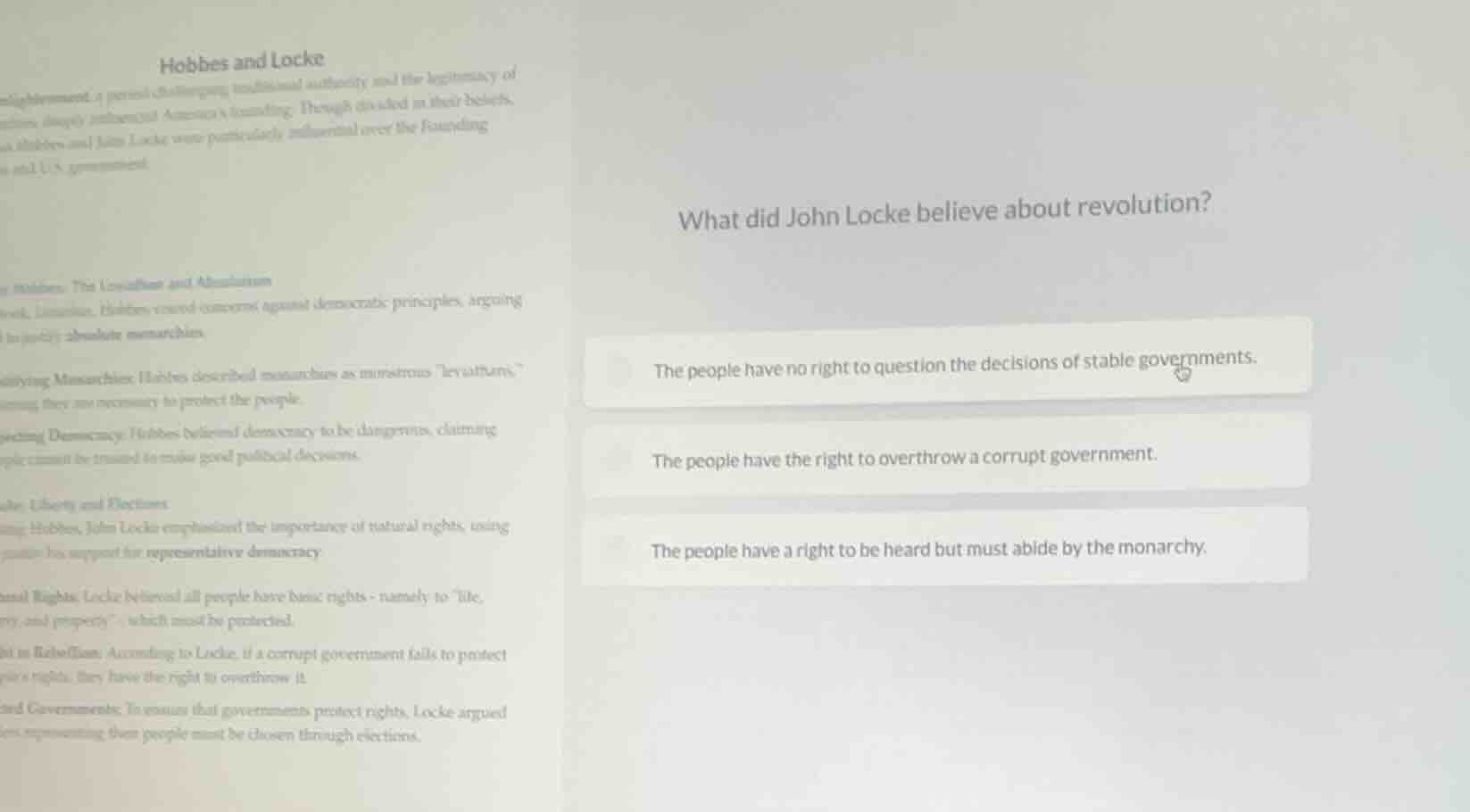
hobbes and locke enlightenment, a period challenging traditional authority and the legitimacy of nations, deeply influenced america’s founding. though divided in their beliefs, as hobbes and john locke were particularly influential over the founding and u.s. government. hobbes: the leviathan and absolutism in his work, leviathan, hobbes voiced concerns against democratic principles, arguing in favor of absolute monarchies. defending monarchies: hobbes described monarchies as monstrous “leviathans,” claiming they are necessary to protect the people. rejecting democracy: hobbes believed democracy to be dangerous, claiming people cannot be trusted to make good political decisions. locke: liberty and elections unlike hobbes, john locke emphasized the importance of natural rights, using them as his support for representative democracy. natural rights: locke believed all people have basic rights - namely to “life, liberty, and property” - which must be protected. right to rebellion: according to locke, if a corrupt government fails to protect people’s rights, they have the right to overthrow it. elected governments: to ensure that governments protect rights, locke argued leaders representing the people must be chosen through elections. what did john locke believe about revolution? the people have no right to question the decisions of stable governments. the people have the right to overthrow a corrupt government. the people have a right to be heard but must abide by the monarchy.
John Locke's political philosophy includes the idea that if a government is corrupt and fails to protect the people's natural rights (life, liberty, property), the people have the right to overthrow it. The first option goes against Locke's views (he believed people could question unjust governments), and the third option also misrepresents his stance as he supported the right to overthrow corrupt rule, not abiding by monarchy unconditionally.

Snap & solve any problem in the app
Get step-by-step solutions on Sovi AI
Photo-based solutions with guided steps
Explore more problems and detailed explanations
The people have the right to overthrow a corrupt government.