QUESTION IMAGE
Question
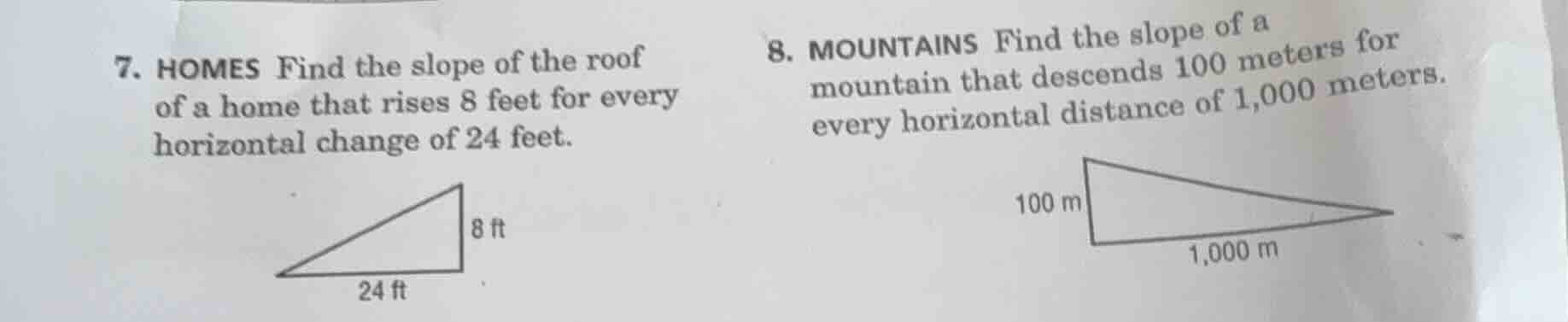
- homes find the slope of the roof of a home that rises 8 feet for every horizontal change of 24 feet.
- mountains find the slope of a mountain that descends 100 meters for every horizontal distance of 1,000 meters.
Problem 7:
Step1: Recall slope formula
The slope \( m \) is defined as the ratio of the vertical change (rise) to the horizontal change (run), so \( m=\frac{\text{rise}}{\text{run}} \).
Step2: Identify rise and run
Here, the rise is 8 feet and the run is 24 feet.
Step3: Calculate slope
Substitute into the formula: \( m = \frac{8}{24} \). Simplify the fraction by dividing numerator and denominator by 8: \( \frac{8\div8}{24\div8}=\frac{1}{3} \).
Step1: Recall slope formula (considering descent)
Slope \( m=\frac{\text{vertical change}}{\text{horizontal change}} \). Since it's a descent, the vertical change is negative (or we can consider the magnitude and note the direction, but for slope value, we use the change). Here, vertical change is - 100 meters (descent) and horizontal change is 1000 meters.
Step2: Calculate slope
Substitute into the formula: \( m=\frac{- 100}{1000} \). Simplify by dividing numerator and denominator by 100: \( \frac{-100\div100}{1000\div100}=\frac{-1}{10} \). The slope can also be expressed as a magnitude with the understanding of descent, but mathematically, using the change, it's \(-\frac{1}{10}\) or \(\frac{100}{1000}=\frac{1}{10}\) if we consider the absolute value of the vertical change (since slope for descent can be represented as negative or just the ratio of the lengths, depending on context. If we take the vertical change as 100 (descent as a positive change in magnitude), then \( m = \frac{100}{1000}=\frac{1}{10} \) (but with the understanding it's a descending slope, the slope is \(-\frac{1}{10}\) in terms of signed slope, or \(\frac{1}{10}\) as the rate of descent).

Snap & solve any problem in the app
Get step-by-step solutions on Sovi AI
Photo-based solutions with guided steps
Explore more problems and detailed explanations
The slope of the roof is \(\frac{1}{3}\).