QUESTION IMAGE
Question
1.1 homework
question 12, 1.1.75
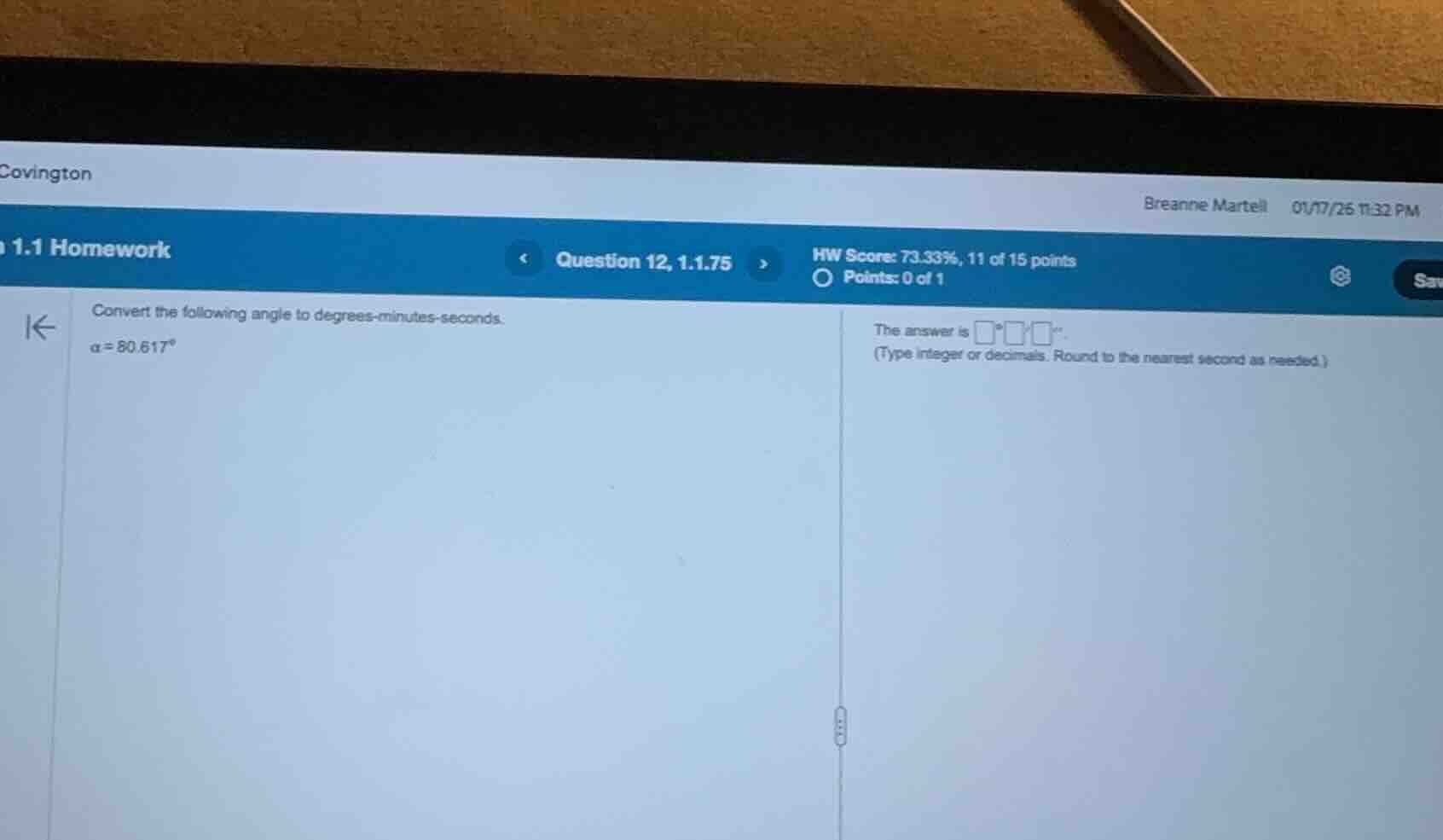
convert the following angle to degrees - minutes - seconds.
α = 80.617°
the answer is \\(\square^{\circ}\square\square\\).
(type integer or decimals. round to the nearest second as needed.)
Step1: Extract the decimal part
The angle is \( 80.617^\circ \). The whole number part is the degrees, so \( 80^\circ \). Now we take the decimal part \( 0.617 \) and convert it to minutes. Since \( 1^\circ = 60' \), we multiply \( 0.617 \) by \( 60 \):
\( 0.617\times60 = 37.02' \)
Step2: Extract the decimal part of minutes
The whole number part of \( 37.02' \) is the minutes, so \( 37' \). Now we take the decimal part \( 0.02 \) of the minutes and convert it to seconds. Since \( 1' = 60'' \), we multiply \( 0.02 \) by \( 60 \):
\( 0.02\times60 = 1.2'' \)
Step3: Round to the nearest second
\( 1.2'' \) rounded to the nearest second is \( 1'' \) (or if we consider more precisely, but in this case, \( 0.02\times60 = 1.2 \), so rounding gives \( 1'' \); however, wait, maybe I made a mistake in Step1. Wait, let's recalculate Step1: \( 0.617\times60 = 37.02' \), correct. Then the decimal part of minutes is \( 0.02 \), so seconds: \( 0.02\times60 = 1.2 \), which rounds to \( 1'' \). Wait, but let's check again. Wait, maybe the initial decimal part was miscalculated? Wait, \( 0.617\times60 \): \( 0.6\times60 = 36 \), \( 0.017\times60 = 1.02 \), so total \( 36 + 1.02 = 37.02' \), correct. Then the decimal part of minutes is \( 0.02 \), so seconds: \( 0.02\times60 = 1.2'' \), so seconds is \( 1.2 \), which rounds to \( 1'' \). So putting it all together, the angle is \( 80^\circ37'1'' \)? Wait, no, wait, maybe I messed up. Wait, \( 0.617\times60 = 37.02' \), so minutes is \( 37' \), and the decimal part is \( 0.02' \), then seconds is \( 0.02\times60 = 1.2'' \), which rounds to \( 1'' \). So the angle is \( 80^\circ37'1'' \)? Wait, but let's check with more precise calculation. Wait, maybe the problem is that when we do \( 0.617\times60 \), let's do it more accurately: \( 0.617\times60 = 37.02 \), so minutes is \( 37 \), and the decimal part is \( 0.02 \) minutes. Then seconds: \( 0.02\times60 = 1.2 \) seconds, which rounds to \( 1 \) second. So the angle is \( 80^\circ37'1'' \)? Wait, but maybe I made a mistake in the decimal part. Wait, let's re-express the angle:
\( \alpha = 80^\circ + 0.617^\circ \)
Convert \( 0.617^\circ \) to minutes: \( 0.617 \times 60' = 37.02' \)
So \( 37.02' = 37' + 0.02' \)
Convert \( 0.02' \) to seconds: \( 0.02 \times 60'' = 1.2'' \approx 1'' \) (since \( 1.2 \) rounded to the nearest second is \( 1'' \))
So putting it all together, \( 80^\circ37'1'' \). Wait, but let's check with a calculator. Let's compute \( 80 + 37/60 + 1/3600 \):
\( 37/60 = 0.616666... \), \( 1/3600 \approx 0.000277... \), so total is \( 80.616944... \), which is close to \( 80.617 \). So that's correct.

Snap & solve any problem in the app
Get step-by-step solutions on Sovi AI
Photo-based solutions with guided steps
Explore more problems and detailed explanations
\( 80^\circ37'1'' \) (Wait, but let's check again. Wait, \( 0.617\times60 = 37.02 \), so minutes is 37, and the decimal part is 0.02 minutes. Then seconds: 0.0260=1.2, which rounds to 1 second. So the answer is \( 80^\circ37'1'' \). Alternatively, if we consider that maybe the initial calculation of the decimal part of minutes was wrong, but no, 0.61760 is indeed 37.02. So the degrees are 80, minutes 37, seconds 1 (rounded).)