QUESTION IMAGE
Question
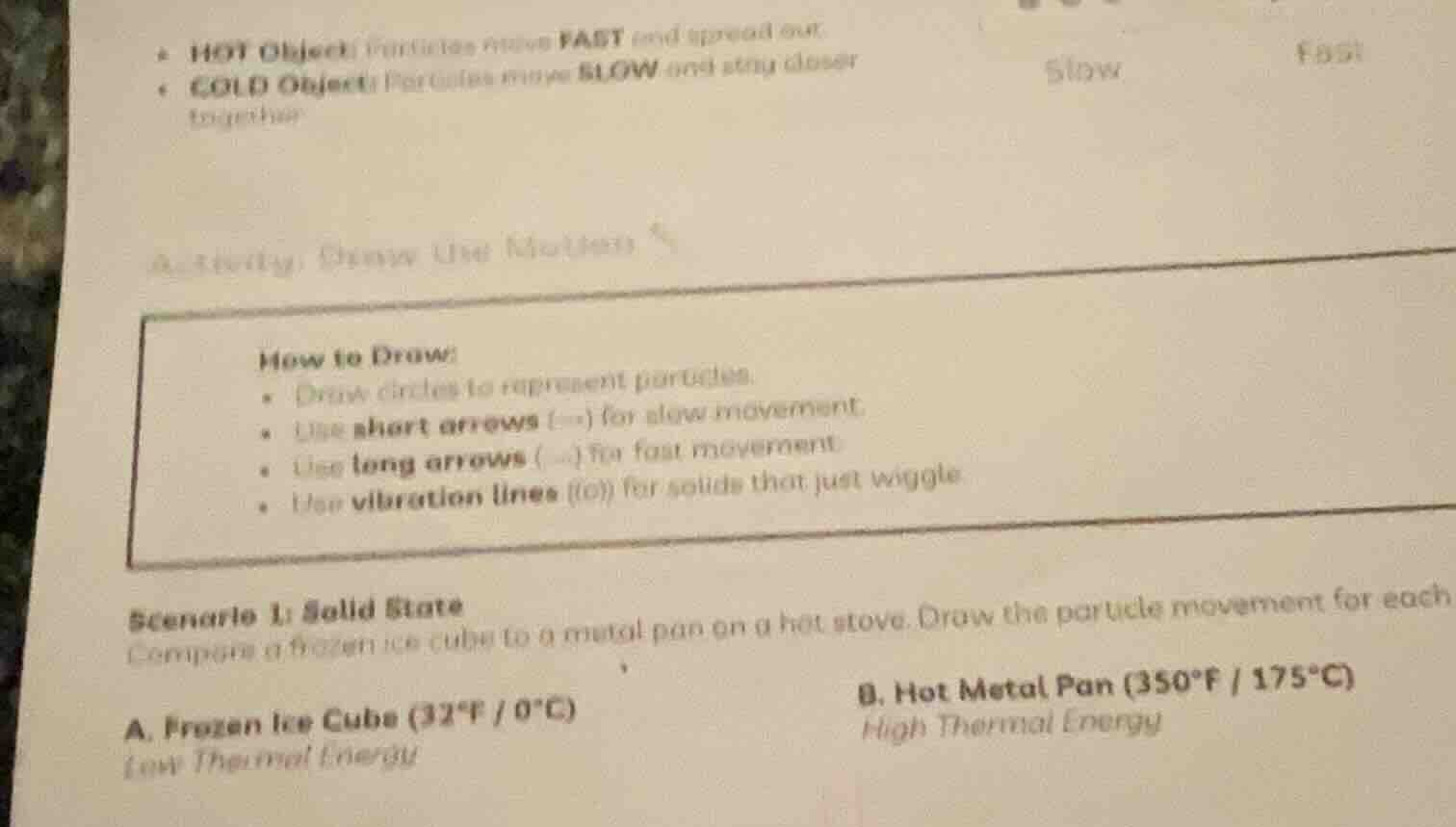
- hot objects particles move fast and spread out.- cold objects particles move slow and stay closer togetheractivity: draw the mattershow to draw:- draw circles to represent particles.- use short arrows (→) for slow movement.- use long arrows (→) for fast movement.- use vibration lines (↔) for solids that just wigglescenario 1: solid statecompare a frozen ice cube to a metal pan on a hot stove. draw the particle movement for eacha. frozen ice cube (32°f / 0°c)low thermal energyb. hot metal pan (350°f / 175°c)high thermal energy
For the frozen ice cube (low thermal energy, cold solid), particles vibrate in place with no large movement. For the hot metal pan (high thermal energy, hot solid), particles vibrate more vigorously but still stay in their fixed solid positions, with more intense vibration than the ice cube.

Snap & solve any problem in the app
Get step-by-step solutions on Sovi AI
Photo-based solutions with guided steps
Explore more problems and detailed explanations
A. Frozen Ice Cube (32°F / 0°C):
Draw closely packed circles (particles) with small vibration lines (~~) around each circle to show slow, wiggling movement in place.
B. Hot Metal Pan (350°F / 175°C):
Draw closely packed circles (particles) with thicker, more prominent vibration lines (~~~~) around each circle to show more vigorous wiggling movement in place (faster vibration than the ice cube, but no large shifting of particles).