QUESTION IMAGE
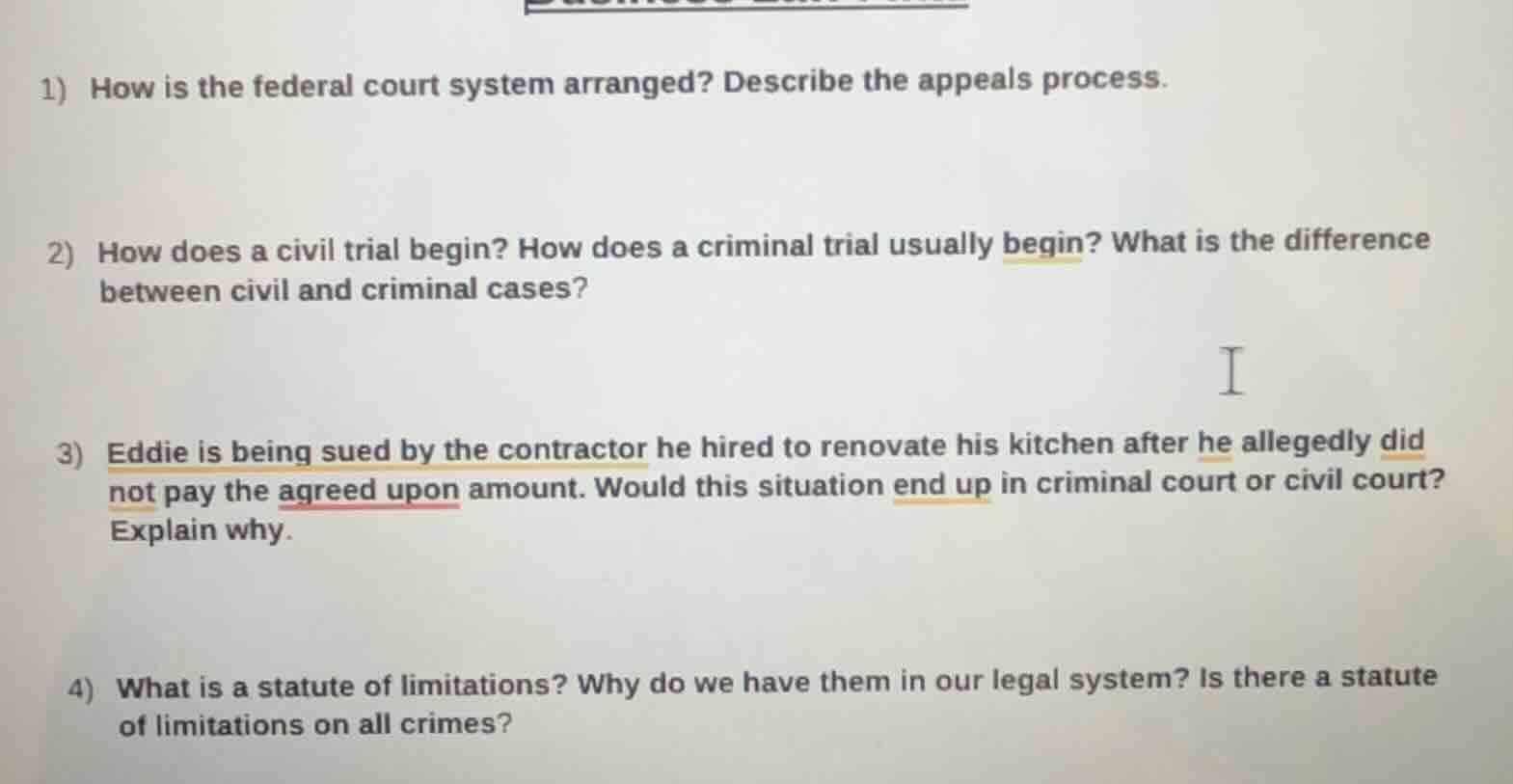
Question
- how is the federal court system arranged? describe the appeals process.
- how does a civil trial begin? how does a criminal trial usually begin? what is the difference between civil and criminal cases?
- eddie is being sued by the contractor he hired to renovate his kitchen after he allegedly did not pay the agreed upon amount. would this situation end up in criminal court or civil court? explain why.
- what is a statute of limitations? why do we have them in our legal system? is there a statute of limitations on all crimes?
Brief Explanations
- For Question 1:
- The federal court system has three main tiers: trial courts (U.S. District Courts), intermediate appellate courts (U.S. Courts of Appeals), and the U.S. Supreme Court. District Courts handle most federal cases first. Appeals go to the relevant Circuit Court of Appeals; if a party is still unsatisfied, they can petition the Supreme Court, which only hears a small number of cases.
- For Question 2:
- Civil trials start when a plaintiff files a complaint against a defendant, who then responds. Criminal trials begin with an arrest, followed by charging (indictment or information), and an arraignment. Civil cases involve disputes between private parties over rights/harms, seeking damages or injunctions. Criminal cases involve the government prosecuting someone for violating criminal laws, with penalties like fines or prison.
- For Question 3:
- This is a civil court matter. It is a private dispute between Eddie (an individual) and a contractor (a business/individual) over a contractual payment, which falls under civil law (contract law) rather than a violation of criminal statutes.
- For Question 4:
- A statute of limitations is a legal time limit to file a lawsuit or bring criminal charges. They exist to ensure cases are brought with fresh evidence, prevent unfair surprise to defendants, and promote legal finality. No, there is no statute of limitations for serious crimes like murder in most jurisdictions.
It is a private contractual dispute between Eddie and the contractor over a failure to pay for services. Civil court handles disputes between private parties over legal rights and obligations, while criminal court deals with violations of criminal laws that harm the public, which this is not.
- - Statute of limitations: A law that sets a strict time limit for filing a civil lawsuit or bringing criminal charges after an alleged offense occurs.
- Purpose: To ensure legal claims are pursued while evidence is still fresh (witnesses are available, documents are intact), prevent defendants from facing unfair surprise or stale claims years after an event, and promote legal finality so individuals/entities can move forward without the threat of old claims.
- No, there is no statute of limitations on all crimes. For example, in the U.S., most jurisdictions have no time limit for prosecuting serious crimes like murder, treason, or some sexual offenses.

Snap & solve any problem in the app
Get step-by-step solutions on Sovi AI
Photo-based solutions with guided steps
Explore more problems and detailed explanations
- The U.S. federal court system is a 3-tier structure:
- Tier 1: U.S. District Courts (94 total, the trial courts where federal cases start, handling both civil and criminal matters with juries or judges).
- Tier 2: U.S. Courts of Appeals (13 circuits, reviewing decisions from district courts in their region; they check for legal errors, not re-hear facts).
- Tier 3: U.S. Supreme Court (the highest court, which chooses to hear a small number of cases each year via a writ of certiorari, usually resolving conflicts in federal law or reviewing constitutional questions).
Appeals process:
- After a district court decision, the losing party can appeal to the relevant U.S. Court of Appeals.
- If dissatisfied with the appeals court ruling, the party can petition the U.S. Supreme Court to review the case. The Supreme Court only grants review in cases of national legal importance or conflicting circuit decisions.
- - Civil trial start: A civil trial begins when a plaintiff (the party claiming harm) files a formal complaint with a court, alleging the defendant violated their legal rights. The defendant then files a response (answer) to the complaint.
- Criminal trial start: A criminal trial usually begins with an arrest for a suspected crime, followed by formal charging (either via a grand jury indictment or a prosecutor's information). The defendant then has an arraignment where they enter a plea (guilty, not guilty, no contest).
- Difference: Civil cases involve private disputes between individuals/entities, seeking compensation (damages) or court orders (injunctions) to resolve harms to personal rights or contracts. Criminal cases involve the government (federal/state) prosecuting a person for violating criminal laws, with penalties like fines, probation, or imprisonment to punish wrongdoing against the public.
- This situation would end up in civil court.