QUESTION IMAGE
Question
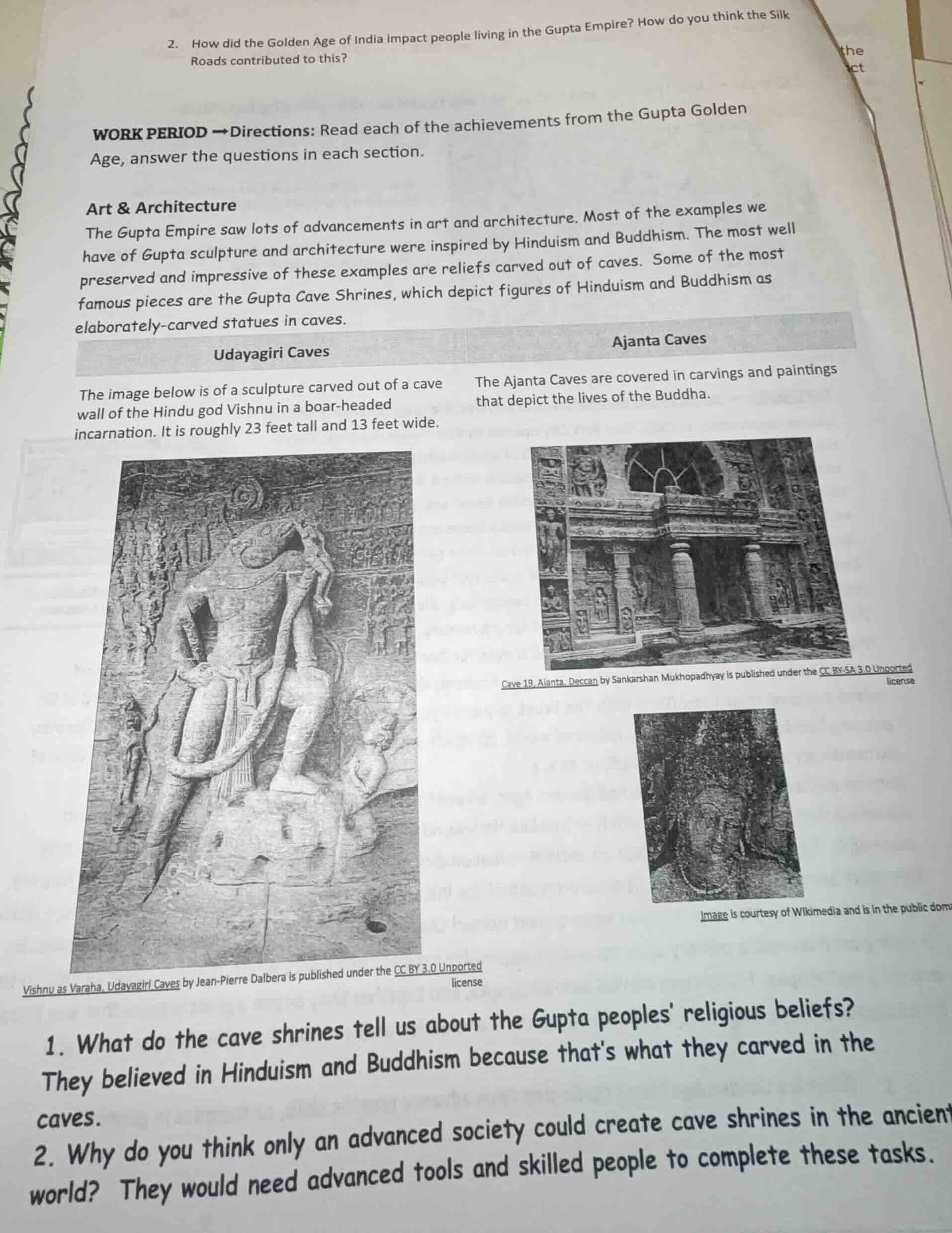
- how did the golden age of india impact people living in the gupta empire? how do you think the silk roads contributed to this? work period →directions: read each of the achievements from the gupta golden age, answer the questions in each section. art & architecture the gupta empire saw lots of advancements in art and architecture. most of the examples we have of gupta sculpture and architecture were inspired by hinduism and buddhism. the most well preserved and impressive of these examples are reliefs carved out of caves. some of the most famous pieces are the gupta cave shrines, which depict figures of hinduism and buddhism as elaborately - carved statues in caves. udayagiri caves the image below is of a sculpture carved out of a cave wall of the hindu god vishnu in a boar - headed incarnation. it is roughly 23 feet tall and 13 feet wide. ajanta caves the ajanta caves are covered in carvings and paintings that depict the lives of the buddha. (images with their respective captions and license information) 1. what do the cave shrines tell us about the gupta peoples religious beliefs? they believed in hinduism and buddhism because thats what they carved in the caves. 2. why do you think only an advanced society could create cave shrines in the ancient world? they would need advanced tools and skilled people to complete these tasks.
For the first question: The cave shrines feature elaborate carvings of Hindu deities (like Vishnu at Udayagiri) and Buddhist figures/scenes (at Ajanta), directly reflecting the Gupta people's adherence to both religions.
For the second question: Creating large, detailed cave shrines required specialized stone-carving tools, skilled artisans with training in religious iconography, organized labor to coordinate large-scale projects, and surplus resources to support workers during the long construction process—all hallmarks of an advanced society.
For the top question about the Golden Age and Silk Roads: The Gupta Golden Age brought advancements in art, architecture, science, and governance, improving quality of life, enabling religious expression, and boosting economic stability. The Silk Roads facilitated trade of Gupta goods (like textiles, metalwork) and ideas, bringing wealth to the empire, spreading its cultural achievements, and connecting it to global networks, which further supported the prosperity of the Golden Age.

Snap & solve any problem in the app
Get step-by-step solutions on Sovi AI
Photo-based solutions with guided steps
Explore more problems and detailed explanations
- The cave shrines show that the Gupta people practiced both Hinduism and Buddhism, as they created detailed religious art dedicated to both faiths (Hindu deities at Udayagiri, Buddhist scenes at Ajanta).
- Advanced societies have the specialized tools, trained skilled artisans, organized labor systems, and surplus resources needed to undertake the massive, detailed work of carving and decorating cave shrines over long periods.
- The Golden Age of India brought widespread prosperity, cultural flourishing (like the art/architecture seen in the caves), advancements in science and governance, and religious tolerance to people in the Gupta Empire, raising their quality of life and creating a stable, thriving society. The Silk Roads contributed by enabling long-distance trade of Gupta goods, bringing wealth into the empire, spreading Gupta cultural and artistic achievements across Eurasia, and facilitating the exchange of ideas, technologies, and religious beliefs that further supported the empire's golden age growth.