QUESTION IMAGE
Question
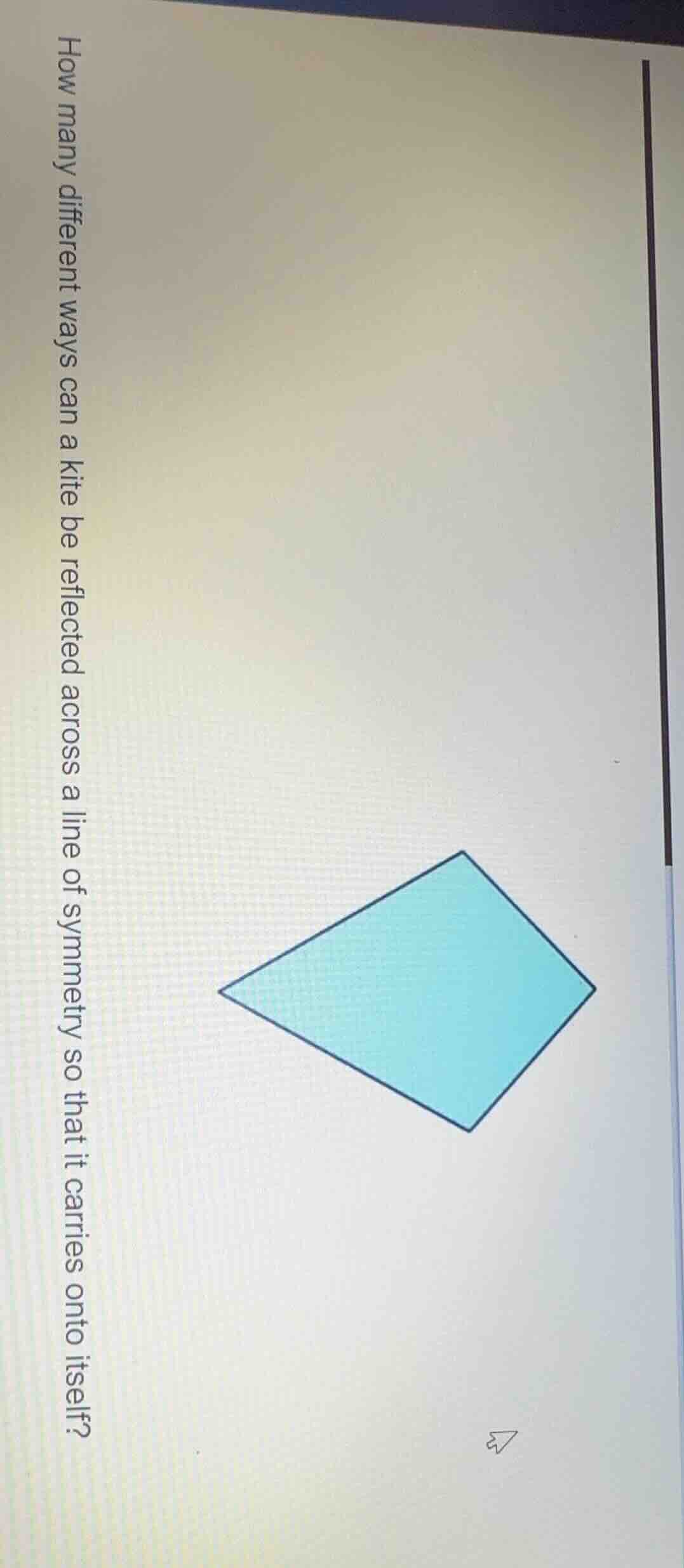
how many different ways can a kite be reflected across a line of symmetry so that it carries onto itself?
Step1: Recall kite symmetry properties
A kite has 1 pair of opposite congruent angles, and its lines of symmetry are the lines that pass through the vertex of the non-congruent angles and bisect the opposite angles, or equivalently, the lines connecting the midpoints of the non-congruent sides? No, correction: A standard kite (convex) has exactly 2 distinct lines of symmetry? No, correction: A convex kite has 1 line of symmetry that runs through the vertex angles (the angles between the pairs of adjacent congruent sides), reflecting the kite onto itself. Wait, no—wait, a kite is defined as a quadrilateral with two distinct pairs of adjacent congruent sides. The line of symmetry is the one that goes through the two vertices where the congruent sides meet (the "top" and "bottom" vertices in the diagram), reflecting one side onto the other. Is there a second line? No, because the other two sides are not congruent to each other, so a line through the other two vertices would not reflect the kite onto itself.
Wait, let's confirm: For a convex kite, there is 1 line of symmetry that maps the kite to itself via reflection.
Step2: Count valid reflection lines
The only line that works is the line passing through the vertex of the two congruent angle pairs, which reflects the kite onto itself. There are no other lines of symmetry for a non-rhombus kite (a rhombus is a special case of a kite, but the diagram shows a non-rhombus kite).

Snap & solve any problem in the app
Get step-by-step solutions on Sovi AI
Photo-based solutions with guided steps
Explore more problems and detailed explanations
1