QUESTION IMAGE
Question
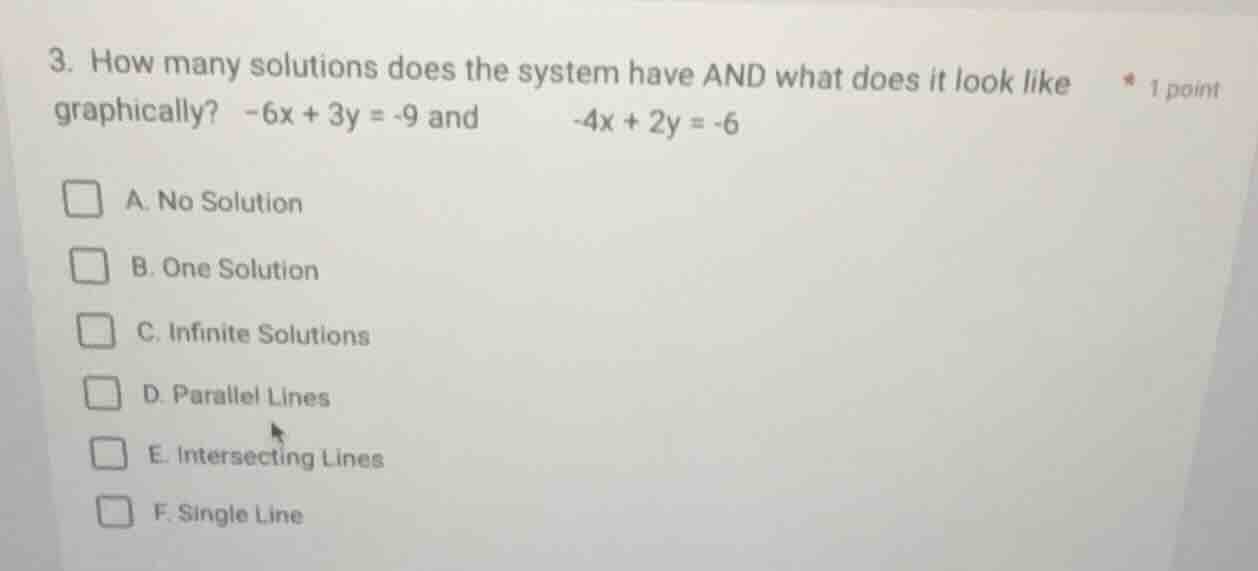
- how many solutions does the system have and what does it look like graphically? $-6x + 3y = -9$ and $-4x + 2y = -6$
a. no solution
b. one solution
c. infinite solutions
d. parallel lines
e. intersecting lines
f. single line
Step1: Simplify the first equation
Given \(-6x + 3y=-9\), divide both sides by 3:
\(\frac{-6x}{3}+\frac{3y}{3}=\frac{-9}{3}\)
\(-2x + y=-3\), which can be rewritten as \(y = 2x-3\).
Step2: Simplify the second equation
Given \(-4x + 2y=-6\), divide both sides by 2:
\(\frac{-4x}{2}+\frac{2y}{2}=\frac{-6}{2}\)
\(-2x + y=-3\), which can be rewritten as \(y = 2x-3\).
Step3: Analyze the equations
Both equations simplify to the same linear equation \(y = 2x - 3\). This means the two original equations represent the same line. So, the system has infinite solutions, and graphically, it is a single line (since both equations are the same line). Also, when two equations represent the same line, they are not parallel (parallel lines have the same slope but different y - intercepts, here they are identical) and not just intersecting (intersecting would be two different lines meeting at a point), but a single line. So the system has infinite solutions (option C) and is a single line (option F). Also, since they are the same line, they are not parallel (so D is wrong) and not just intersecting (E is wrong in the sense of two different lines intersecting), and it's not no solution (A is wrong) or one solution (B is wrong).

Snap & solve any problem in the app
Get step-by-step solutions on Sovi AI
Photo-based solutions with guided steps
Explore more problems and detailed explanations
C. Infinite Solutions
F. Single Line