QUESTION IMAGE
Question
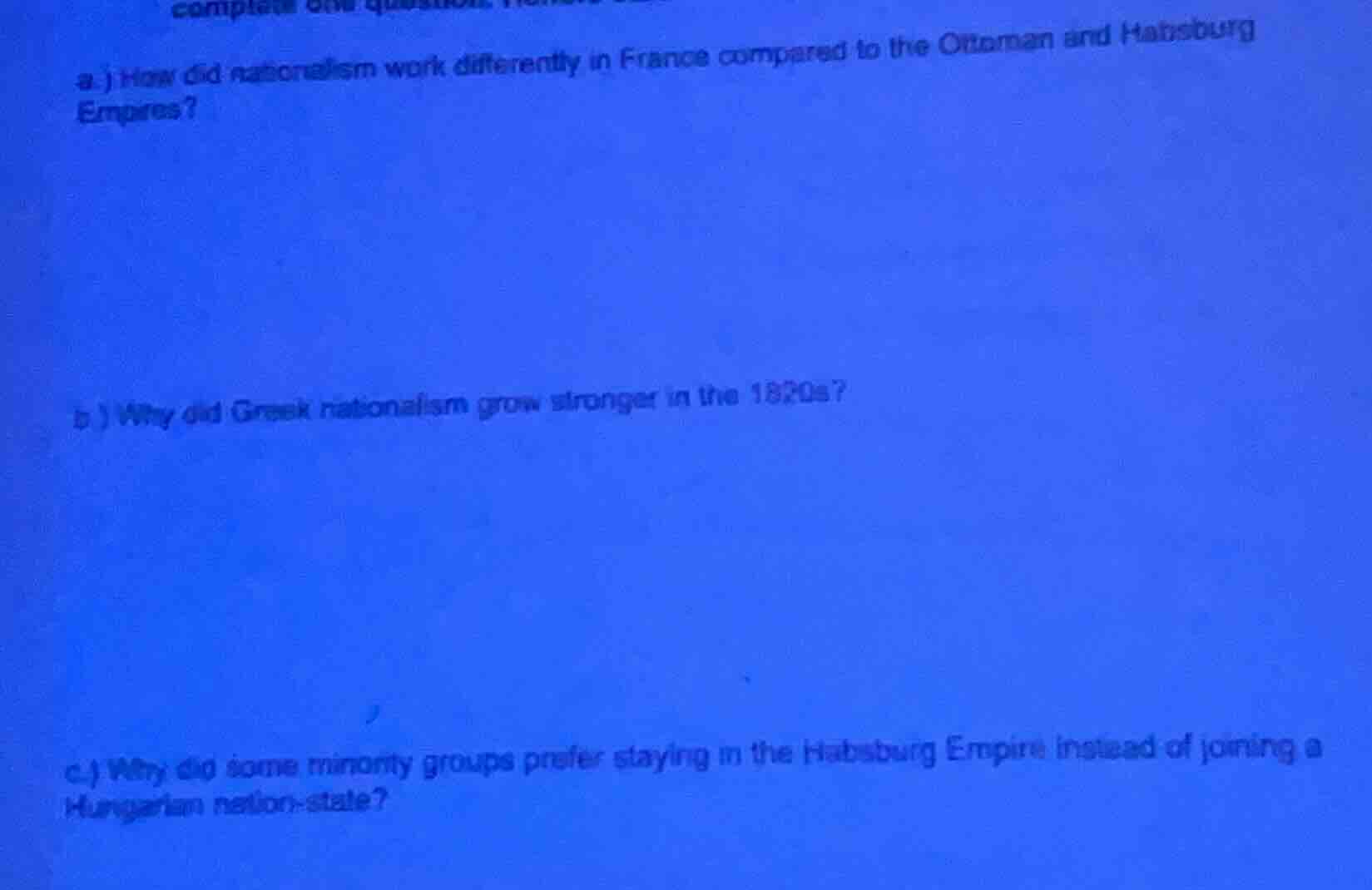
a.) how did nationalism work differently in france compared to the ottoman and habsburg empires?
b.) why did greek nationalism grow stronger in the 1820s?
c.) why do some minority groups prefer staying in the habsburg empire instead of joining a hungarian nation - state?
For a.)
France was a relatively homogeneous nation-state, where nationalism was tied to a shared language (French), culture, and a centralized state that fostered a unified national identity, often rooted in the revolutionary ideals of citizenship and shared sovereignty. In contrast, the Ottoman and Habsburg Empires were multi-ethnic, multi-lingual dynastic empires. Nationalism here was a disruptive force: ethnic and linguistic minority groups (such as Serbs, Greeks in the Ottoman Empire; Czechs, Hungarians in the Habsburg Empire) used nationalist ideals to push for autonomy or independence against the imperial state, rather than unifying around a single imperial national identity.
For b.)
Greek nationalism grew stronger in the 1820s due to several factors: first, the influence of European Romanticism, which glorified ancient Greek culture and sparked sympathy across Europe for Greek self-rule. Second, long-standing Ottoman misrule, including economic exploitation and religious repression of Orthodox Christians, fueled discontent. Third, secret Greek nationalist societies (like the Filiki Eteria) organized resistance, and the outbreak of open rebellion in 1821 galvanized support both locally and from European powers (who later intervened militarily to aid Greek independence).
For c.)
Some minority groups (like Slovaks, Romanians, and Serbs in Hungarian-inhabited regions of the Habsburg Empire) preferred the Habsburg state over a Hungarian nation-state because the Habsburg Empire offered a degree of imperial pluralism and protection. The Hungarian national movement pushed for Magyarization—forcing the use of the Hungarian language in government, education, and public life—which threatened the cultural and political autonomy of these smaller minority groups. The Habsburg monarchy, by contrast, maintained a more decentralized, multi-ethnic administrative structure that allowed these groups to retain some of their cultural identity without being dominated by the Hungarian majority.

Snap & solve any problem in the app
Get step-by-step solutions on Sovi AI
Photo-based solutions with guided steps
Explore more problems and detailed explanations
a.) In France, nationalism unified a homogeneous population around shared culture, language, and revolutionary ideals to strengthen a centralized nation-state. In the Ottoman and Habsburg Empires, nationalism was a divisive force used by ethnic/linguistic minorities to demand autonomy or independence from the multi-ethnic dynastic rulers.
b.) Greek nationalism grew stronger in the 1820s due to European Romantic sympathy for ancient Greek culture, Ottoman repression of Greek Orthodox Christians, organizing by secret nationalist societies, and the 1821 rebellion that drew international support.
c.) Some minority groups preferred the Habsburg Empire because the Hungarian nation-state pushed for Magyarization (cultural and linguistic domination), while the Habsburg monarchy offered a more pluralistic, multi-ethnic system that protected minority cultural identities from Hungarian majority rule.