QUESTION IMAGE
Question
- how do the points of a figure move in a translation?
a same distance and different direction
b same distance and same direction
c different distance and different direction
d different distance and same direction
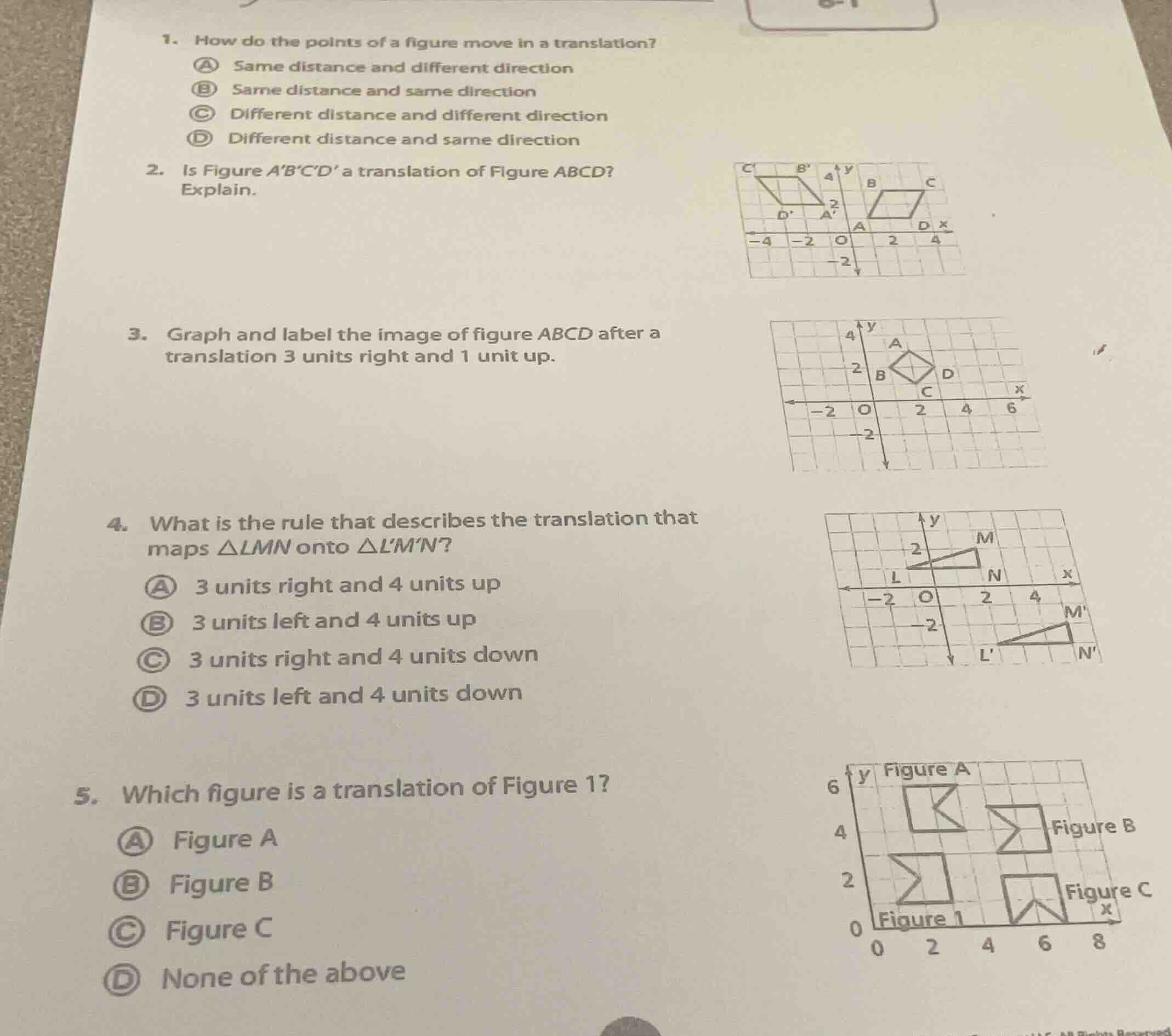
- is figure abcd a translation of figure abcd?
explain.
- graph and label the image of figure abcd after a
translation 3 units right and 1 unit up.
- what is the rule that describes the translation that
maps △lmn onto △lmn?
a 3 units right and 4 units up
b 3 units left and 4 units up
c 3 units right and 4 units down
d 3 units left and 4 units down
- which figure is a translation of figure 1?
a figure a
b figure b
c figure c
d none of the above
Step1: Recall translation definition
Translation requires all points of a figure to move the same distance in the same direction.
Step2: Answer question 1
Match definition to options.
Step3: Analyze figure for question 2
Check if all points of ABCD move same distance/direction to A'B'C'D'.
Step4: Apply translation rule for question3
For each point $(x,y)$ of ABCD, new point is $(x+3, y+1)$.
Step5: Identify translation for question4
Track a vertex of $\triangle LMN$ to $\triangle L'M'N'$ (e.g., $L(-1,1)\to L'(2,-3)$: $-1+3=2$, $1-4=-3$).
Step6: Check translation for question5
Verify if any figure matches Figure1's shape/orientation after sliding.

Snap & solve any problem in the app
Get step-by-step solutions on Sovi AI
Photo-based solutions with guided steps
Explore more problems and detailed explanations
- B. Same distance and same direction
- Yes. Each vertex of ABCD is moved 4 units left and 2 units up to form A'B'C'D', so all points move the same distance and direction, which fits the definition of a translation.
- (Graph instructions: For each vertex of ABCD:
- $A(1,3)\to A'(4,4)$
- $B(0,2)\to B'(3,3)$
- $C(2,1)\to C'(5,2)$
- $D(3,2)\to D'(6,3)$
Connect A', B', C', D' to form the translated figure.)
- C. 3 units right and 4 units down
- D. None of the above