QUESTION IMAGE
Question
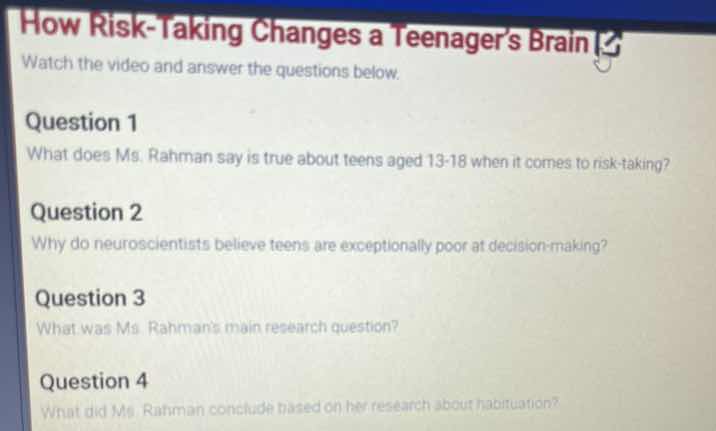
how risk - taking changes a teenagers brain
watch the video and answer the questions below.
question 1
what does ms. rahman say is true about teens aged 13 - 18 when it comes to risk - taking?
question 2
why do neuroscientists believe teens are exceptionally poor at decision - making?
question 3
what was ms. rahmans main research question?
question 4
what did ms. rahman conclude based on her research about habituation?
To answer these questions, you would first need to watch the video titled "How Risk - Taking Changes a Teenager’s Brain" and then extract the relevant information for each question:
Question 1
- Brief Explanations: Watch the video segment where Ms. Rahman talks about teens aged 13 - 18 and risk - taking. Listen for statements about their risk - taking behavior, such as whether they take more risks, under what circumstances, etc.
- Answer: (To be filled after watching the video. For example, if the video says "Ms. Rahman says that teens aged 13 - 18 are more likely to take risks in the presence of their peers when it comes to risk - taking", then the answer would be that teens aged 13 - 18 are more likely to take risks in the presence of their peers (or other relevant information from the video).)
Question 2
- Brief Explanations: Find the part of the video where neuroscientists' views on teens' decision - making are discussed. It may relate to brain development, like the prefrontal cortex not being fully developed, or other neural factors.
- Answer: (To be filled after watching the video. For example, if the video states "Neuroscientists believe teens are exceptionally poor at decision - making because their prefrontal cortex, which is responsible for rational decision - making, is not fully developed", then the answer would be that teens' prefrontal cortex (responsible for rational decision - making) is not fully developed (or other relevant neural/developmental reason from the video).)
Question 3
- Brief Explanations: Listen for the part where Ms. Rahman's main research question is presented. It could be about how risk - taking affects the teen brain, or how teen brain development relates to risk - taking behavior, etc.
- Answer: (To be filled after watching the video. For example, if the video says "Ms. Rahman's main research question was 'How does risk - taking behavior impact the development of a teenager’s brain?'", then the answer would be that Ms. Rahman's main research question was how risk - taking behavior impacts the development of a teenager’s brain (or the actual research question from the video).)
Question 4
- Brief Explanations: Locate the section of the video where Ms. Rahman presents her conclusions about habituation in the context of her research. Habituation is the decrease in response to a repeated stimulus. Her conclusion could be about how teens habituate to risk - related stimuli compared to adults, or how habituation relates to teen risk - taking.
- Answer: (To be filled after watching the video. For example, if the video states "Ms. Rahman concluded that teens habituate to risky stimuli more slowly than adults, which may contribute to their increased risk - taking behavior", then the answer would be that teens habituate to risky stimuli more slowly than adults (or other relevant conclusion from the video about habituation).)

Snap & solve any problem in the app
Get step-by-step solutions on Sovi AI
Photo-based solutions with guided steps
Explore more problems and detailed explanations
To answer these questions, you would first need to watch the video titled "How Risk - Taking Changes a Teenager’s Brain" and then extract the relevant information for each question:
Question 1
- Brief Explanations: Watch the video segment where Ms. Rahman talks about teens aged 13 - 18 and risk - taking. Listen for statements about their risk - taking behavior, such as whether they take more risks, under what circumstances, etc.
- Answer: (To be filled after watching the video. For example, if the video says "Ms. Rahman says that teens aged 13 - 18 are more likely to take risks in the presence of their peers when it comes to risk - taking", then the answer would be that teens aged 13 - 18 are more likely to take risks in the presence of their peers (or other relevant information from the video).)
Question 2
- Brief Explanations: Find the part of the video where neuroscientists' views on teens' decision - making are discussed. It may relate to brain development, like the prefrontal cortex not being fully developed, or other neural factors.
- Answer: (To be filled after watching the video. For example, if the video states "Neuroscientists believe teens are exceptionally poor at decision - making because their prefrontal cortex, which is responsible for rational decision - making, is not fully developed", then the answer would be that teens' prefrontal cortex (responsible for rational decision - making) is not fully developed (or other relevant neural/developmental reason from the video).)
Question 3
- Brief Explanations: Listen for the part where Ms. Rahman's main research question is presented. It could be about how risk - taking affects the teen brain, or how teen brain development relates to risk - taking behavior, etc.
- Answer: (To be filled after watching the video. For example, if the video says "Ms. Rahman's main research question was 'How does risk - taking behavior impact the development of a teenager’s brain?'", then the answer would be that Ms. Rahman's main research question was how risk - taking behavior impacts the development of a teenager’s brain (or the actual research question from the video).)
Question 4
- Brief Explanations: Locate the section of the video where Ms. Rahman presents her conclusions about habituation in the context of her research. Habituation is the decrease in response to a repeated stimulus. Her conclusion could be about how teens habituate to risk - related stimuli compared to adults, or how habituation relates to teen risk - taking.
- Answer: (To be filled after watching the video. For example, if the video states "Ms. Rahman concluded that teens habituate to risky stimuli more slowly than adults, which may contribute to their increased risk - taking behavior", then the answer would be that teens habituate to risky stimuli more slowly than adults (or other relevant conclusion from the video about habituation).)