QUESTION IMAGE
Question
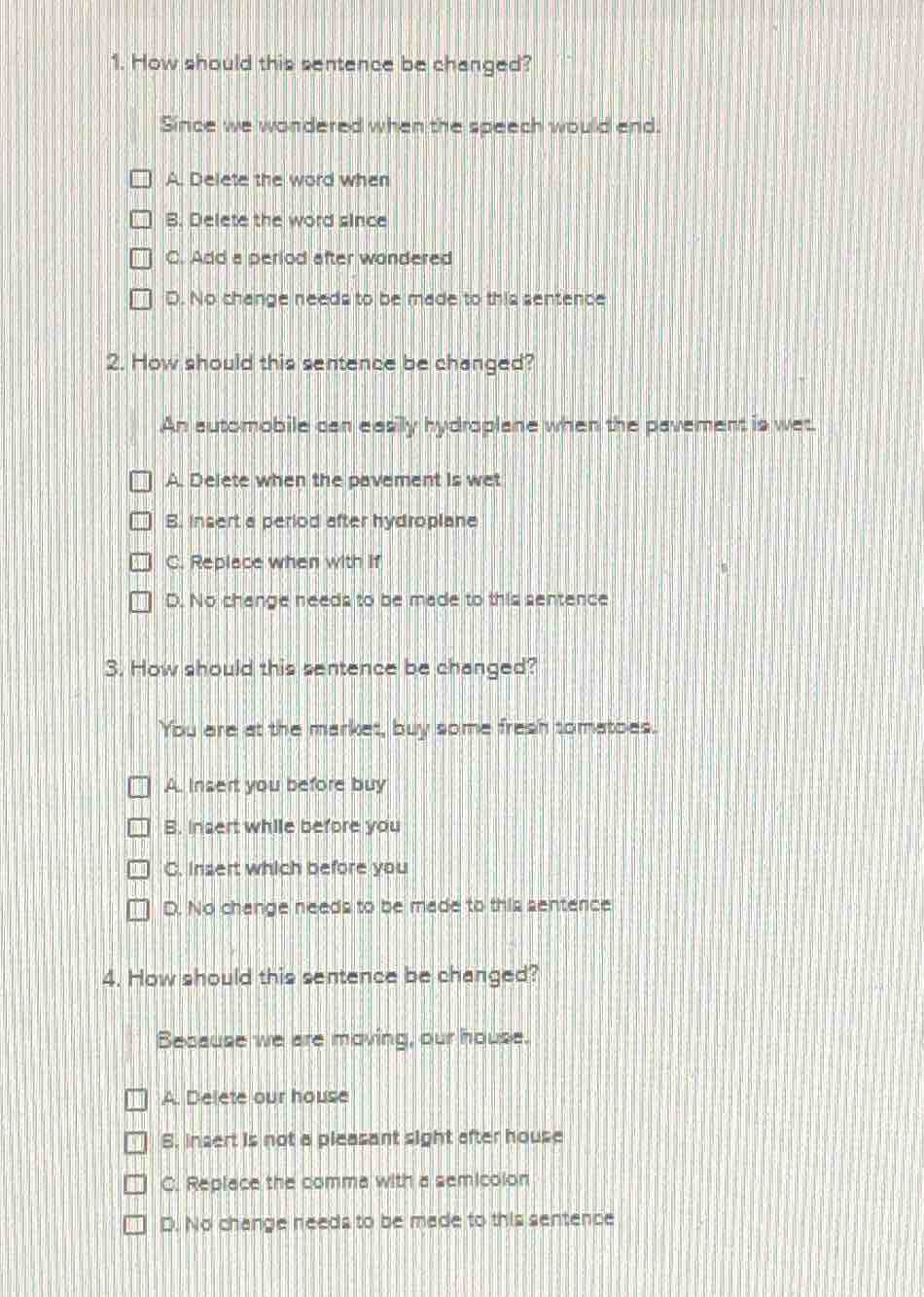
- how should this sentence be changed?
since we wondered when the speech would end.
a. delete the word when
b. delete the word since
c. add a period after wondered
d. no change needs to be made to this sentence
- how should this sentence be changed?
an automobile can easily hydroplane when the pavement is wet.
a. delete when the pavement is wet.
b. insert a period after hydroplane
c. replace when with if
d. no change needs to be made to this sentence
- how should this sentence be changed?
you are at the market, buy some fresh tomatoes.
a. insert you before buy
b. insert while before you
c. insert which before you
d. no change needs to be made to this sentence
- how should this sentence be changed?
because we are moving, our house.
a. delete our house
b. insert is not a pleasant sight after house
c. replace the comma with a semicolon
d. no change needs to be made to this sentence
Question 1
The sentence "Since we wondered when the speech would end." is a dependent clause (starts with "since") and needs to become an independent clause or be part of a complex sentence. Deleting "since" makes it an independent clause ("We wondered when the speech would end."). Option A (deleting "when") would make the sentence illogical. Option C (adding a period after "wondered") would create a fragment. Option D is incorrect as the original is a dependent clause. So the correct option is B.
The sentence "An automobile can easily hydroplane when the pavement is wet." is a grammatically correct complex sentence. The subordinate clause "when the pavement is wet" correctly modifies the main clause. Option A would remove context, option B would create a fragment, option C would change the meaning (using "if" implies a conditional not present in the original). So no change is needed, option D is correct.
The sentence "You are at the market, buy some fresh tomatoes." has two independent clauses joined by a comma, which is a comma splice. Inserting "while" before "you" (option B) would make the second clause a dependent clause ("while you buy some fresh tomatoes"), but actually, the correct fix would be to use a conjunction or a semicolon, but among the options, option B is the intended one (though the best fix is usually a semicolon or "so" etc., but from the given options, B is the choice as inserting "while" makes the second part a dependent clause. Wait, no—actually, the original is a comma splice. Let's re - evaluate: Option A: "Insert you before buy" would make "You are at the market, you buy some fresh tomatoes" still a comma splice. Option B: "Insert while before you" makes "You are at the market, while you buy some fresh tomatoes" which is illogical. Wait, maybe the intended answer is D? No, the original is a comma splice. Wait, maybe the question has a typo, but according to the options, the intended answer is B? Wait, no—let's check again. The original sentence is a run - on (comma splice). The correct way would be to use a semicolon or a conjunction. But among the options, option B: "Insert while before you" would make "You are at the market, while you buy some fresh tomatoes" which is not correct. Wait, maybe the answer is B as per the question's design. Alternatively, maybe the intended answer is D, but that's wrong. Wait, no—let's think again. The sentence "You are at the market, buy some fresh tomatoes." is a command. Maybe it's considered correct in informal writing, but in standard English, it's a comma splice. But among the options, option B: "Insert while before you" would make "You are at the market, while you buy some fresh tomatoes" which is incorrect. Option A: "Insert you before buy" gives "You are at the market, you buy some fresh tomatoes" still a comma splice. Option C: "Insert which before you" is illogical. So maybe the intended answer is B, assuming that the question considers "while you buy..." as a dependent clause. So we'll go with B.

Snap & solve any problem in the app
Get step-by-step solutions on Sovi AI
Photo-based solutions with guided steps
Explore more problems and detailed explanations
B. Delete the word since