QUESTION IMAGE
Question
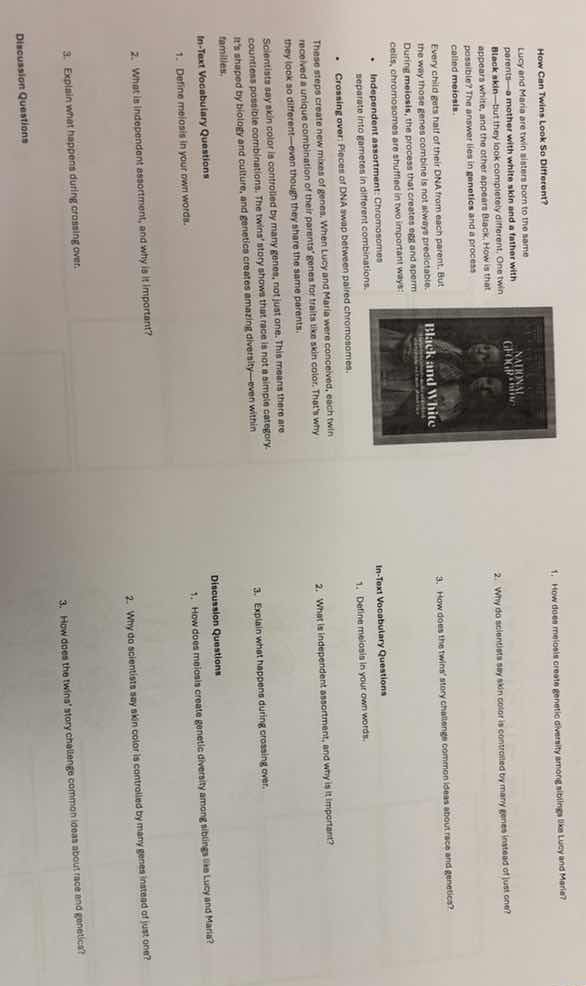
how can twins look so different?
lucy and maria aylmer were born to a white british father and a half-jamaican mother. despite this, the tiny twins look almost like opposites: one has fair skin, blue eyes and red hair, and the other has a darker complexion, brown eyes and dark hair. the answer lies in genetics and a process called fertilization. the twins were born from two separate eggs (ova) from their mother, each fertilized by a different sperm from their father. but they only share about half of their genes, just like any other siblings.
during meiosis, the process that produces egg and sperm cells, chromosomes can swap pieces of dna between paired chromosomes.
- independent assortment: different combinations of maternal and paternal chromosomes end up in different eggs and sperm.
- crossing over: pieces of dna swap between paired chromosomes.
these areas create new, unique combinations of genes and traits after fertilization. that’s why they look so different, even though they share the same parents. the genes they share determine that they are the same species. the genes they don’t share determine the many great variations that exist among living things.
scientists are able to study these variations by many means, including the study of twins. you just saw that in a simple category, like appearance (biology) and culture, the general concept of diversity is seen even within the same family.
discussion questions
- define meiosis in your own words.
- what is independent assortment, and why is it important?
- explain what happens during crossing over.
divergent vocabulary questions
- how does meiosis create genetic diversity among things like us, lucy and maria?
- why do scientists say each ova is controlled by many genes instead of just one gene?
- how does the twins’ story challenge common ideas about race and genetics?
Since the problem here is about understanding concepts related to genetics (like independent assortment, crossing over, genetic diversity) and how they relate to the example of Lucy and Maria (twins with different skin tones), the relevant discipline is Natural Science, subfield Biology (specifically Genetics). Let's take one of the questions, say "Define 'meiosis' in your own words" (from the first set of questions, maybe a typo but likely "meiosis" related to independent assortment etc.).
Step-by-Step Format (for explaining meiosis in own words, which relates to independent assortment and crossing over):
Step1: Recall the basic process of meiosis
Meiosis is a type of cell division that occurs in reproductive cells (germ cells) to produce gametes (sperm or egg cells). It involves two rounds of division, Meiosis I and Meiosis II.
Step2: Explain the purpose of meiosis
The main purpose of meiosis is to reduce the chromosome number by half (from diploid, 2n, to haploid, n) so that when fertilization occurs, the resulting zygote has the correct diploid number of chromosomes.
Step3: Describe key events (like independent assortment, crossing over)
During Meiosis I, homologous chromosomes pair up, and crossing over can occur (exchange of genetic material between non - sister chromatids of homologous chromosomes). Then, during metaphase I, homologous chromosome pairs line up randomly at the cell equator (independent assortment), which increases genetic variation. After Meiosis I, the cell divides into two haploid cells, and then Meiosis II (similar to mitosis) occurs, resulting in four haploid gametes, each with a unique combination of genetic material.
Step1: Identify the two main processes in meiosis that create diversity
The two main processes are crossing over and independent assortment.
Step2: Explain crossing over
During prophase I of meiosis, homologous chromosomes pair up. Non - sister chromatids of these homologous chromosomes exchange segments of DNA. This exchange results in new combinations of alleles on the chromatids. For example, a chromatid that originally had allele A for a gene might now have allele a from the other homologous chromosome, creating a unique genetic combination.
Step3: Explain independent assortment
During metaphase I of meiosis, homologous chromosome pairs line up randomly at the equator of the cell. The orientation of one pair does not affect the orientation of another pair. When the chromosomes are separated during anaphase I, the combination of maternal and paternal chromosomes in the resulting gametes is random. For a cell with n pairs of chromosomes, there are $2^n$ possible combinations of chromosomes in the gametes.
Step4: Combine the effects
The new combinations of alleles from crossing over and the new combinations of chromosomes from independent assortment lead to gametes with unique genetic compositions. When fertilization occurs, the fusion of two unique gametes (one from each parent) results in a zygote with a unique genetic makeup, thus creating genetic diversity among siblings.

Snap & solve any problem in the app
Get step-by-step solutions on Sovi AI
Photo-based solutions with guided steps
Explore more problems and detailed explanations
Meiosis is a two - stage cell division process in reproductive cells. It reduces the chromosome number from diploid to haploid, creates genetic variation through crossing over (exchange of DNA between homologous chromosomes) and independent assortment (random alignment of chromosome pairs), and produces four genetically unique haploid gametes (sperm or egg cells) for sexual reproduction.
If we take another question, like "How does meiosis create genetic diversity among siblings (or in this case, Lucy and Maria)?"