QUESTION IMAGE
Question
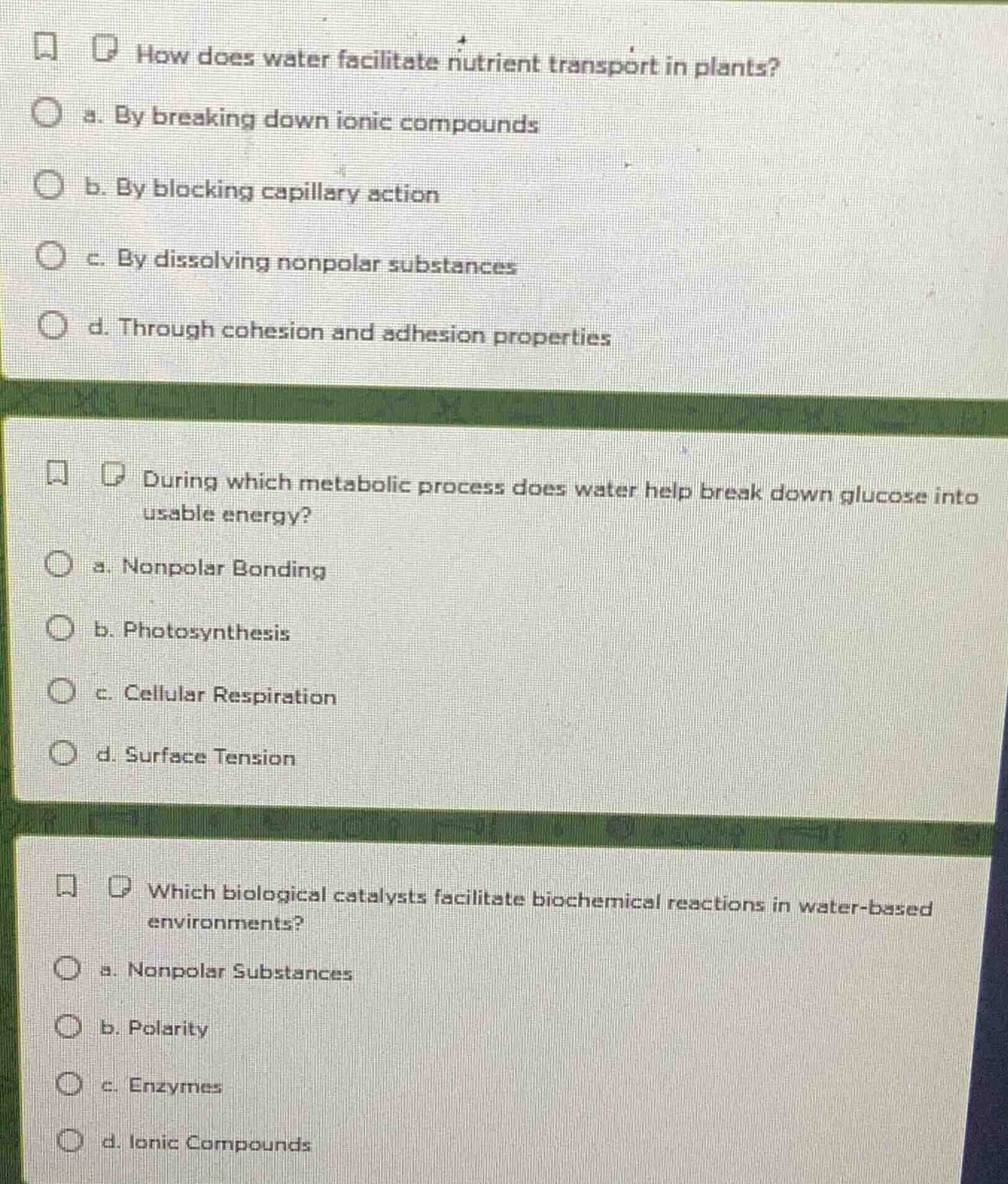
how does water facilitate nutrient transport in plants?
a. by breaking down ionic compounds
b. by blocking capillary action
c. by dissolving nonpolar substances
d. through cohesion and adhesion properties
during which metabolic process does water help break down glucose into usable energy?
a. nonpolar bonding
b. photosynthesis
c. cellular respiration
d. surface tension
which biological catalysts facilitate biochemical reactions in water - based environments?
a. nonpolar substances
b. polarity
c. enzymes
d. ionic compounds
Response
First Question: How does water facilitate nutrient transport in plants?
Brief Explanations
- Option a: Water doesn't break down ionic compounds for nutrient transport in plants. Ionic compounds dissolve in water.
- Option b: Water enables capillary action (adhesion and cohesion), not block it. Capillary action helps in nutrient transport.
- Option c: Water is polar and dissolves polar substances, not nonpolar.
- Option d: Water's cohesion (attraction between water molecules) and adhesion (attraction to plant cell walls) allow capillary action, which helps in pulling water (and dissolved nutrients) up the plant. So this is correct.
Brief Explanations
- Option a: Nonpolar bonding is not a metabolic process that breaks down glucose.
- Option b: Photosynthesis produces glucose, it doesn't break it down for energy.
- Option c: Cellular respiration is the process where glucose is broken down (in the presence of water in some steps like glycolysis) to release energy (ATP).
- Option d: Surface tension is a property of water, not a metabolic process.
Brief Explanations
- Option a: Nonpolar substances don't act as catalysts for biochemical reactions.
- Option b: Polarity is a property of molecules (like water), not a catalyst.
- Option c: Enzymes are biological catalysts (proteins, sometimes RNA) that speed up biochemical reactions, and most biochemical reactions in cells (water - based environments) are facilitated by enzymes.
- Option d: Ionic compounds are substances that can dissolve in water, but they don't act as biological catalysts.

Snap & solve any problem in the app
Get step-by-step solutions on Sovi AI
Photo-based solutions with guided steps
Explore more problems and detailed explanations
d. Through cohesion and adhesion properties