QUESTION IMAGE
Question
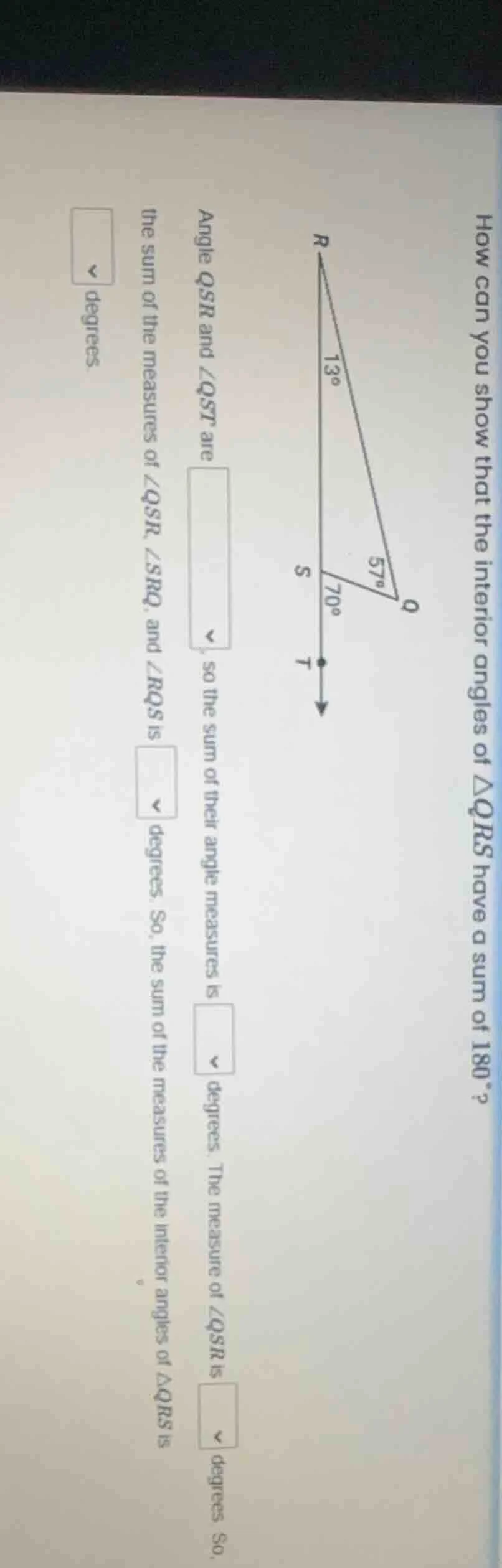
how can you show that the interior angles of $\triangle qrs$ have a sum of $180^\circ$?
angle $qsr$ and $\angle qst$ are \\(\boxed{}\\) , so the sum of their angle measures is \\(\boxed{}\\) degrees. the measure of $\angle qsr$ is \\(\boxed{}\\) degrees. so, the sum of the measures of $\angle qsr$, $\angle srq$, and $\angle rqs$ is \\(\boxed{}\\) degrees. so, the sum of the measures of the interior angles of $\triangle qrs$ is \\(\boxed{}\\) degrees
Step1: Identify angle relationship (linear pair)
∠QSR and ∠QST are a linear pair, so they are supplementary.
Step2: Calculate sum of ∠QSR and ∠QST
Since ∠QST = 70°, then ∠QSR + 70° = 180° (supplementary angles sum to 180°), so ∠QSR = 180° - 70° = 110°? Wait, no, wait. Wait, the triangle angles: ∠SRQ is 13°, ∠RQS is 57°, let's check. Wait, first, ∠QSR and ∠QST: linear pair, so ∠QSR + ∠QST = 180°, so they are supplementary (sum to 180°). Then, in triangle QRS, angles are ∠QSR, ∠SRQ (13°), and ∠RQS (57°). Let's sum them: ∠QSR + 13° + 57° = ∠QSR + 70°. But since ∠QSR + ∠QST = 180°, and ∠QST is 70°, so ∠QSR = 110°? Wait, no, wait, maybe I messed up. Wait, the problem is to show the sum of interior angles of triangle QRS is 180°. Let's re-express:
- ∠QSR and ∠QST are supplementary (linear pair), so their sum is 180° (since a linear pair of angles is supplementary).
- Now, ∠QST is given as 70°, so ∠QSR = 180° - 70° = 110°? Wait, no, wait, the triangle has angles at R: 13°, at Q: 57°, and at S: ∠QSR. Wait, but ∠QST is 70°, which is adjacent to ∠QSR, so ∠QSR + 70° = 180° (linear pair), so ∠QSR = 110°. Then, sum of triangle angles: 110° (∠QSR) + 13° (∠SRQ) + 57° (∠RQS) = 110 + 13 + 57 = 180°. So:
- Angle QSR and ∠QST are supplementary (so their sum is 180°).
- Then, in triangle QRS, sum of ∠QSR, ∠SRQ (13°), and ∠RQS (57°): ∠QSR + 13° + 57° = (180° - 70°) + 13° + 57° = 110° + 70° = 180°. Wait, let's do step by step:
Step1: ∠QSR and ∠QST are supplementary (linear pair)
So ∠QSR + ∠QST = 180° (sum is 180 degrees).
Step2: Sum of ∠QSR, ∠SRQ, ∠RQS
∠SRQ = 13°, ∠RQS = 57°, ∠QSR = 180° - ∠QST (from step1). ∠QST = 70°, so ∠QSR = 180° - 70° = 110°. Then sum: 110° + 13° + 57° = 110 + 70 = 180°. So:
- ∠QSR and ∠QST are supplementary (so their sum is 180°).
- Then, sum of ∠QSR, ∠SRQ, ∠RQS: 110° + 13° + 57° = 180°.
Wait, let's fill the blanks:
- Angle QSR and ∠QST are supplementary, so the sum of their angle measures is $\boldsymbol{180}$ degrees.
- The measure of ∠QSR: since ∠QST = 70°, ∠QSR = 180° - 70° = 110°? Wait, no, wait, maybe the problem is structured as:
First blank: "supplementary" (relationship between ∠QSR and ∠QST)
Second blank: sum of ∠QSR and ∠QST is 180 degrees.
Then, sum of ∠QSR, ∠SRQ (13°), ∠RQS (57°): 110° + 13° + 57° = 180°? Wait, no, 110 + 13 is 123, 123 + 57 is 180. Yes.
Wait, let's re-express the steps as per the problem's blanks:
- Angle QSR and ∠QST are supplementary (so the first blank is "supplementary", their sum is 180 degrees (second blank: 180)).
- The measure of ∠QSR: since ∠QST is 70°, ∠QSR = 180° - 70° = 110°? Wait, no, wait, the triangle's interior angles: ∠SRQ is 13°, ∠RQS is 57°, and ∠QSR. Then, sum of ∠QSR + 13° + 57° = ∠QSR + 70°. But since ∠QSR + ∠QST = 180°, and ∠QST is 70°, then ∠QSR + 70° = 180°? Wait, no, that would mean ∠QSR + 70° (from triangle) = 180° (from linear pair), so the sum of the triangle's interior angles (∠QSR + 13° + 57°) is equal to (180° - ∠QST) + 13° + 57° = 180° - 70° + 70° = 180°. Ah, that's the key. So:
- ∠QSR and ∠QST are supplementary (sum to 180°).
- Sum of triangle angles: ∠QSR + ∠SRQ + ∠RQS = (180° - ∠QST) + ∠SRQ + ∠RQS.
- Substitute ∠QST = 70°, ∠SRQ = 13°, ∠RQS = 57°: (180 - 70) + 13 + 57 = 110 + 70 = 180°.
So filling the blanks:
- Angle QSR and ∠QST are supplementary, so the sum of their angle measures is $\boldsymbol{180}$ degrees.
- The measure of ∠QSR: Wait, no, the next part: "the sum of the measures of ∠QSR, ∠SRQ, and ∠RQS is $\boldsymbol{180}$ degrees". Because ∠QSR + 13° + 57° = (180° - 70°) + 70° = 180°.
So to summarize:…

Snap & solve any problem in the app
Get step-by-step solutions on Sovi AI
Photo-based solutions with guided steps
Explore more problems and detailed explanations
- Angle QSR and ∠QST are \boxed{supplementary}, so the sum of their angle measures is \boxed{180} degrees. The measure of ∠QSR is \boxed{110} degrees. So, the sum of the measures of ∠QSR, ∠SRQ, and ∠RQS is \boxed{180} degrees. So, the sum of the measures of the interior angles of △QRS is \boxed{180} degrees.