QUESTION IMAGE
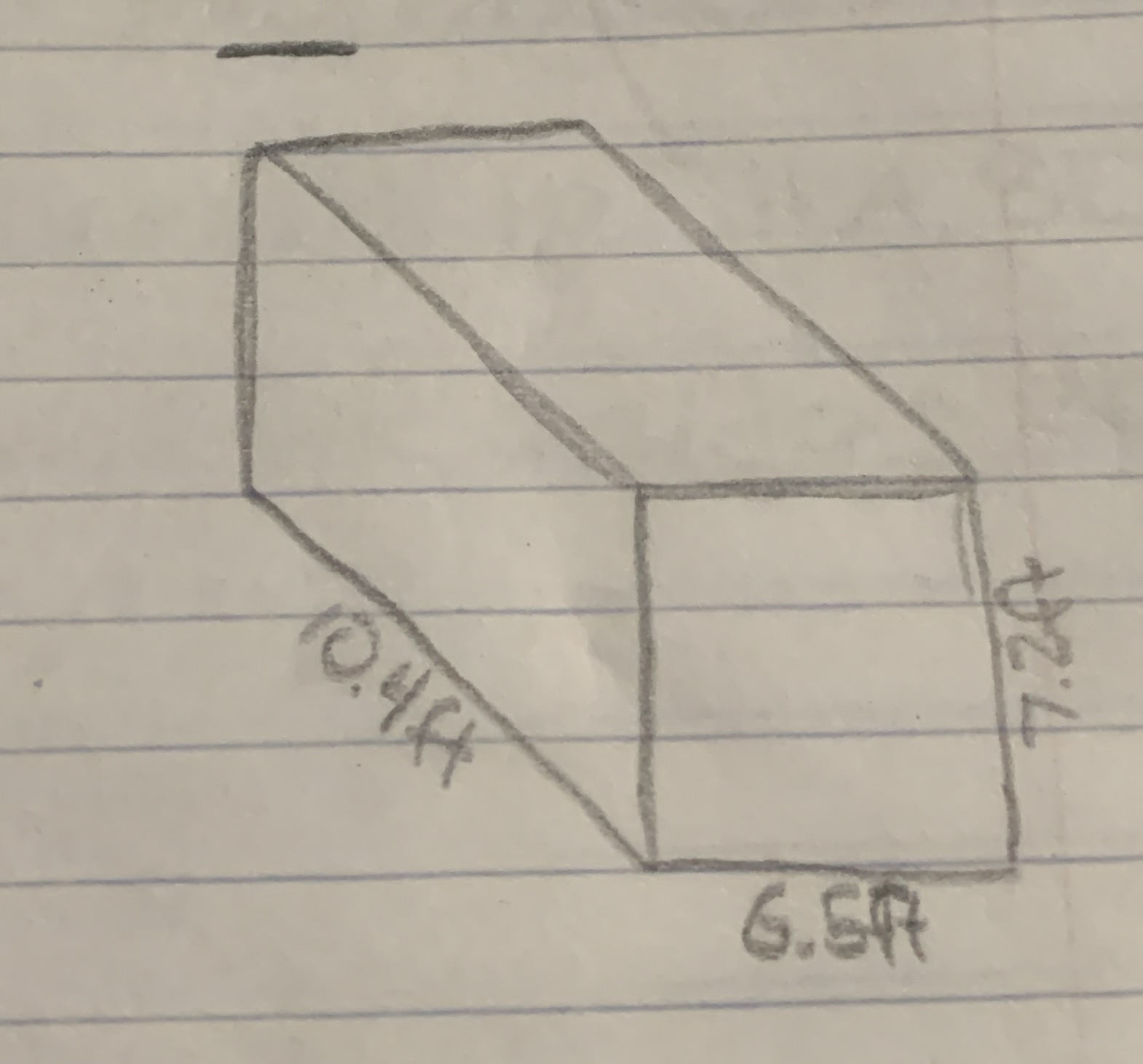
Question
Question was provided via image upload.
Step1: Identify the shape
The figure is a triangular prism. The volume \( V \) of a triangular prism is given by the formula \( V = \text{Area of the triangular base} \times \text{length of the prism} \). First, we need to find the area of the triangular base. The triangle has a base of \( 7.2x \) and a height of \( 6.5x \)? Wait, no, looking at the diagram, the triangular face: wait, maybe the base of the triangle is \( 7.2x \) and the height? Wait, no, the sides: the triangular base has a base (let's say) \( b = 7.2x \), height \( h = 6.5x \)? Wait, no, the length of the prism (the distance along the direction perpendicular to the triangular face) is \( 10.4x \). Wait, actually, the formula for the volume of a triangular prism is \( V=\frac{1}{2}\times \text{base of triangle}\times \text{height of triangle}\times \text{length of prism} \). Wait, maybe the triangular base has base \( 7.2x \) and height \( 6.5x \), and the length of the prism (the depth) is \( 10.4x \). Wait, let's confirm:
Wait, the triangular face: the two legs of the right triangle? Wait, maybe the triangle is a right triangle with legs \( 7.2x \) and \( 6.5x \), and the length of the prism (the hypotenuse direction) is \( 10.4x \). Wait, no, the volume of a triangular prism is \( V = \text{Area of triangle} \times \text{length} \), where the length is the distance between the two triangular faces.
So, Area of triangle \( A=\frac{1}{2}\times \text{base}\times \text{height} \). Let's assume the base of the triangle is \( 7.2x \) and the height is \( 6.5x \), and the length of the prism (the side connecting the two triangles) is \( 10.4x \). Wait, maybe the base of the triangle is \( 7.2x \), height is \( 6.5x \), and the length of the prism is \( 10.4x \). Then:
Step2: Calculate the area of the triangular base
\( A=\frac{1}{2}\times7.2x\times6.5x \)
First, calculate \( 7.2\times6.5 = 46.8 \), so \( A=\frac{1}{2}\times46.8x^{2}=23.4x^{2} \)
Step3: Calculate the volume
Now, the volume \( V = A\times \text{length} \), where the length is \( 10.4x \)
So, \( V = 23.4x^{2}\times10.4x \)
Multiply the coefficients: \( 23.4\times10.4 \)
\( 23.4\times10 = 234 \), \( 23.4\times0.4 = 9.36 \), so \( 234 + 9.36 = 243.36 \)
Multiply the variables: \( x^{2}\times x = x^{3} \)
So, \( V = 243.36x^{3} \)
Wait, but maybe I made a mistake in identifying the base and height. Wait, maybe the triangular base has base \( 7.2x \) and height \( 10.4x \), and the length is \( 6.5x \)? No, the diagram shows \( 7.2x \), \( 10.4x \), and \( 6.5x \)? Wait, maybe the triangle is a right triangle with legs \( 7.2x \) and \( 6.5x \), and the hypotenuse is \( 10.4x \)? Let's check: \( 7.2^{2}+6.5^{2}=51.84 + 42.25 = 94.09 \), and \( 10.4^{2}=108.16 \), which is not equal, so it's not a right triangle. Wait, maybe the base of the triangle is \( 7.2x \), height is \( h \), and the length of the prism is \( 10.4x \), and the other side is \( 6.5x \). Wait, perhaps the problem is to find the volume, so let's proceed with the formula.
Wait, maybe the triangular base has base \( b = 7.2x \), height \( h = 6.5x \), and the length of the prism (the distance between the two triangles) is \( 10.4x \). Then:
Area of triangle \( A=\frac{1}{2}\times7.2x\times6.5x = \frac{1}{2}\times46.8x^{2}=23.4x^{2} \)
Volume \( V = A\times \text{length} = 23.4x^{2}\times10.4x = 23.4\times10.4x^{3} \)
Calculate \( 23.4\times10.4 \):
\( 23.4\times10 = 234 \)
\( 23.4\times0.4 = 9.36 \)
\( 234 + 9.36 = 243.36 \)
So, \( V = 243.36x^{3} \)
Wait, but maybe the base of the triangle is \( 6.5x \) and height \( 7.…

Snap & solve any problem in the app
Get step-by-step solutions on Sovi AI
Photo-based solutions with guided steps
Explore more problems and detailed explanations
The volume of the triangular prism is \(\boxed{243.36x^3}\)