QUESTION IMAGE
Question
Question was provided via image upload.
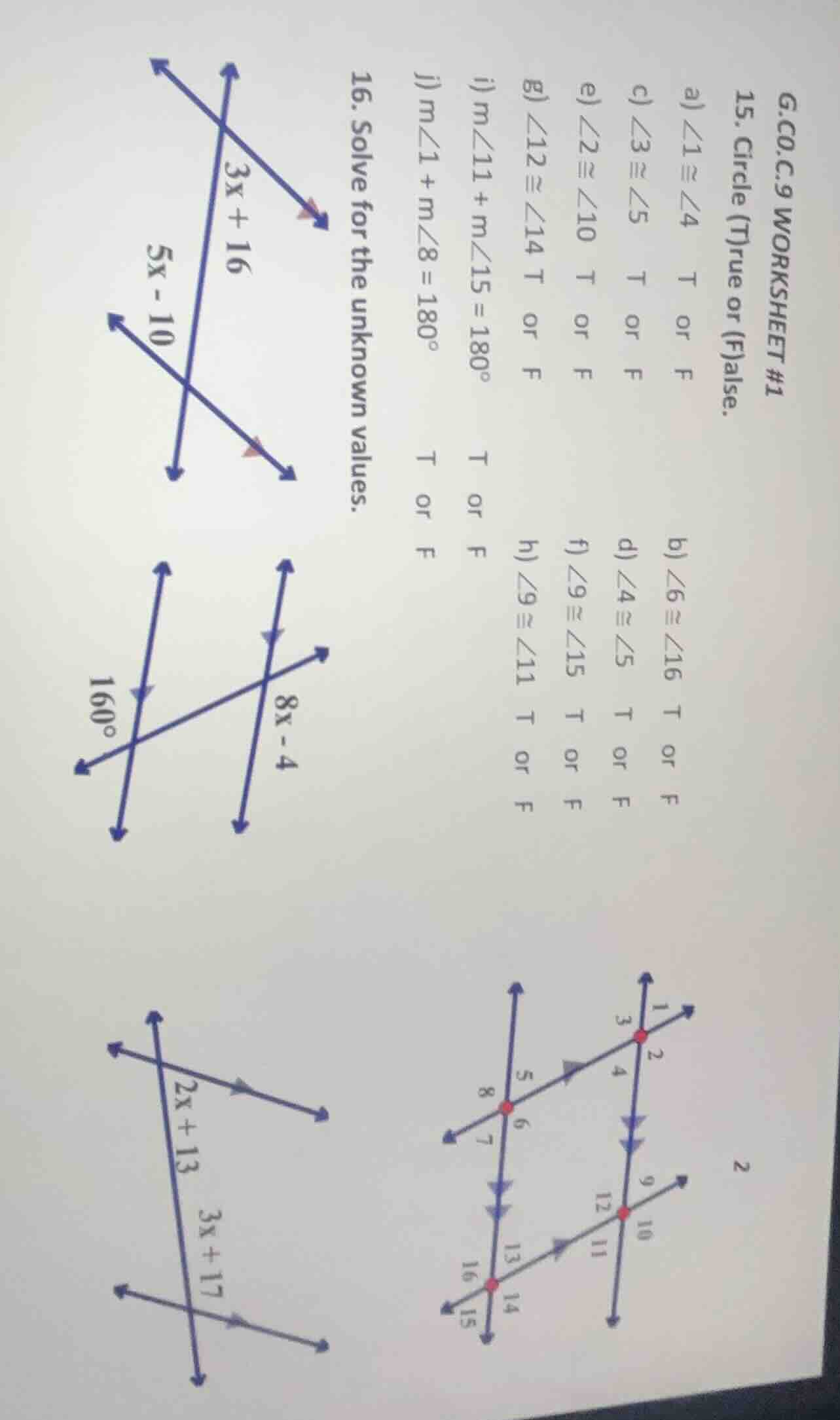
First Diagram (Top - Parallel Lines, Congruent Angles)
Step1: Identify Relationship
The two angles \(3x + 16\) and \(5x - 10\) are equal (corresponding angles, since lines are parallel). So, set them equal: \(3x + 16 = 5x - 10\).
Step2: Solve for \(x\)
Subtract \(3x\) from both sides: \(16 = 2x - 10\).
Add 10 to both sides: \(26 = 2x\).
Divide by 2: \(x = 13\).
Second Diagram (Middle - Parallel Lines, Supplementary Angles)
Step1: Identify Relationship
The angle \(8x - 4\) and \(160^\circ\) are supplementary (same - side interior angles, lines are parallel), so \(8x - 4 + 160 = 180\).
Step2: Simplify Equation
Simplify: \(8x + 156 = 180\).
Subtract 156: \(8x = 24\).
Divide by 8: \(x = 3\).
Third Diagram (Bottom - Parallel Lines, Congruent Angles)
Step1: Identify Relationship
The angles \(2x + 13\) and \(3x + 17\) are equal (alternate interior angles, lines are parallel), so \(2x + 13 = 3x + 17\).
Step2: Solve for \(x\)
Subtract \(2x\) from both sides: \(13 = x + 17\).
Subtract 17: \(x = - 4\).

Snap & solve any problem in the app
Get step-by-step solutions on Sovi AI
Photo-based solutions with guided steps
Explore more problems and detailed explanations
s:
- For the first diagram: \(x = \boldsymbol{13}\)
- For the second diagram: \(x = \boldsymbol{3}\)
- For the third diagram: \(x = \boldsymbol{-4}\)