QUESTION IMAGE
Question
Question was provided via image upload.
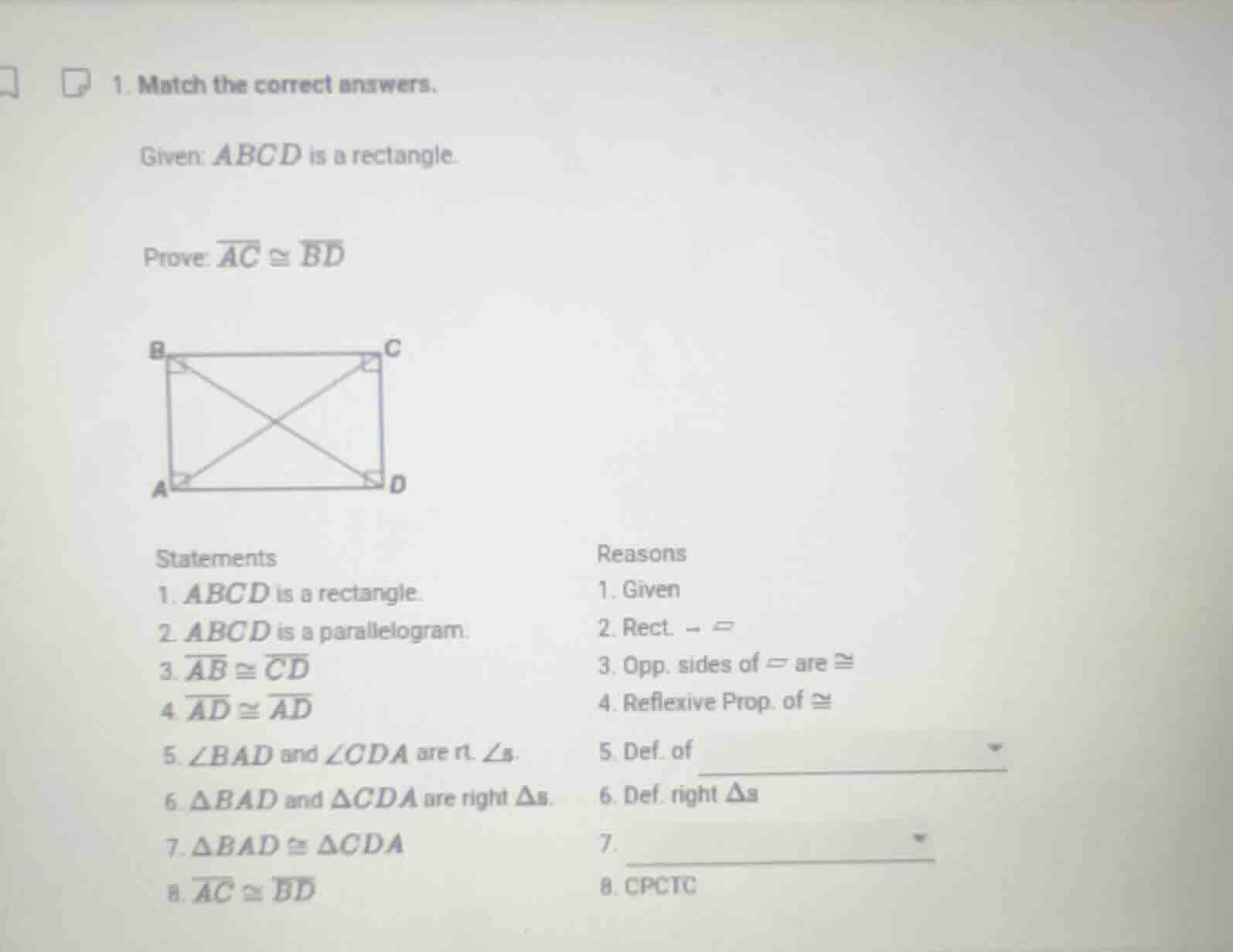
Step1: Analyze Reason 5
A rectangle has four right angles by definition. So the reason for statement 5 (∠BAD and ∠CDA are rt. ∠s) is the definition of a rectangle. So we fill "rectangle" here.
Step2: Analyze Reason 7
We have two right triangles (ΔBAD and ΔCDA) with \( \overline{AB} \cong \overline{CD} \) (from step 3), \( \overline{AD} \cong \overline{AD} \) (from step 4), and both are right triangles. So by the Hypotenuse - Leg (HL) Congruence Theorem (which states that if the hypotenuse and one leg of a right triangle are congruent to the hypotenuse and one leg of another right triangle, then the triangles are congruent), or also we can use SAS (since we have a right angle, a leg, and the hypotenuse? Wait, no, in right triangles, HL is specific. Wait, \( \overline{AB} \cong \overline{CD} \) (leg), \( \overline{AD} \cong \overline{AD} \) (leg? Wait no, in ΔBAD and ΔCDA, \( \overline{AD} \) is a leg for both, and \( \overline{AB} \) and \( \overline{CD} \) are legs, and the hypotenuses are \( \overline{BD} \) and \( \overline{AC} \) respectively. Wait, actually, in right triangles, if we have two legs congruent, then by SAS (since the right angle is included between the two legs). Wait, the right angle is ∠BAD and ∠CDA, so in ΔBAD, we have right angle at A, legs \( \overline{AB} \) and \( \overline{AD} \), and in ΔCDA, right angle at D, legs \( \overline{CD} \) and \( \overline{AD} \). Since \( \overline{AB} \cong \overline{CD} \) (step 3), \( \overline{AD} \cong \overline{AD} \) (step 4), and ∠BAD ≅ ∠CDA (both right angles), so by SAS Congruence Postulate, ΔBAD ≅ ΔCDA. Alternatively, HL: but HL requires hypotenuse and one leg. Wait, maybe SAS is more appropriate here. But the common congruence for right triangles with two legs congruent is SAS (since the right angle is the included angle between the two legs). So the reason for step 7 (ΔBAD ≅ ΔCDA) is either SAS or HL. But since we have two legs and the included right angle, SAS is correct. So the reason is "HL (or SAS) Congruence Theorem" (HL is for right triangles: hypotenuse - leg, but here we have two legs, so SAS is also correct. Wait, maybe the problem expects HL? Wait, no, let's re - check. In ΔBAD and ΔCDA:
- ∠BAD ≅ ∠CDA (right angles, so congruent)
- \( \overline{AB} \cong \overline{CD} \) (step 3)
- \( \overline{AD} \cong \overline{AD} \) (step 4)
So by SAS (Side - Angle - Side) Congruence Postulate, the triangles are congruent. Alternatively, since they are right triangles, and we have a leg and the hypotenuse? Wait, no, \( \overline{AD} \) is a leg, \( \overline{AB} \) is a leg, and the hypotenuse would be \( \overline{BD} \) and \( \overline{AC} \). Wait, maybe I made a mistake. Let's see: in a rectangle, opposite sides are equal, and all angles are right angles. So AB = CD, AD = BC, and angles at A, B, C, D are 90 degrees. So in ΔBAD and ΔCDA:
- AB = CD (given by step 3)
- ∠BAD = ∠CDA = 90° (step 5)
- AD = AD (reflexive)
So by SAS, ΔBAD ≅ ΔCDA. So the reason for step 7 is "SAS Congruence Postulate" (or "HL Congruence Theorem" but SAS is more accurate here as we are using two legs and the included angle).
For reason 5: The definition of a rectangle is a quadrilateral with four right angles, so the reason for statement 5 (∠BAD and ∠CDA are rt. ∠s) is "rectangle" (since a rectangle has four right angles by definition).

Snap & solve any problem in the app
Get step-by-step solutions on Sovi AI
Photo-based solutions with guided steps
Explore more problems and detailed explanations
- For reason 5: rectangle
- For reason 7: SAS (or HL) Congruence Theorem (more precisely SAS as per the sides and angle we have)