QUESTION IMAGE
Question
Question was provided via image upload.
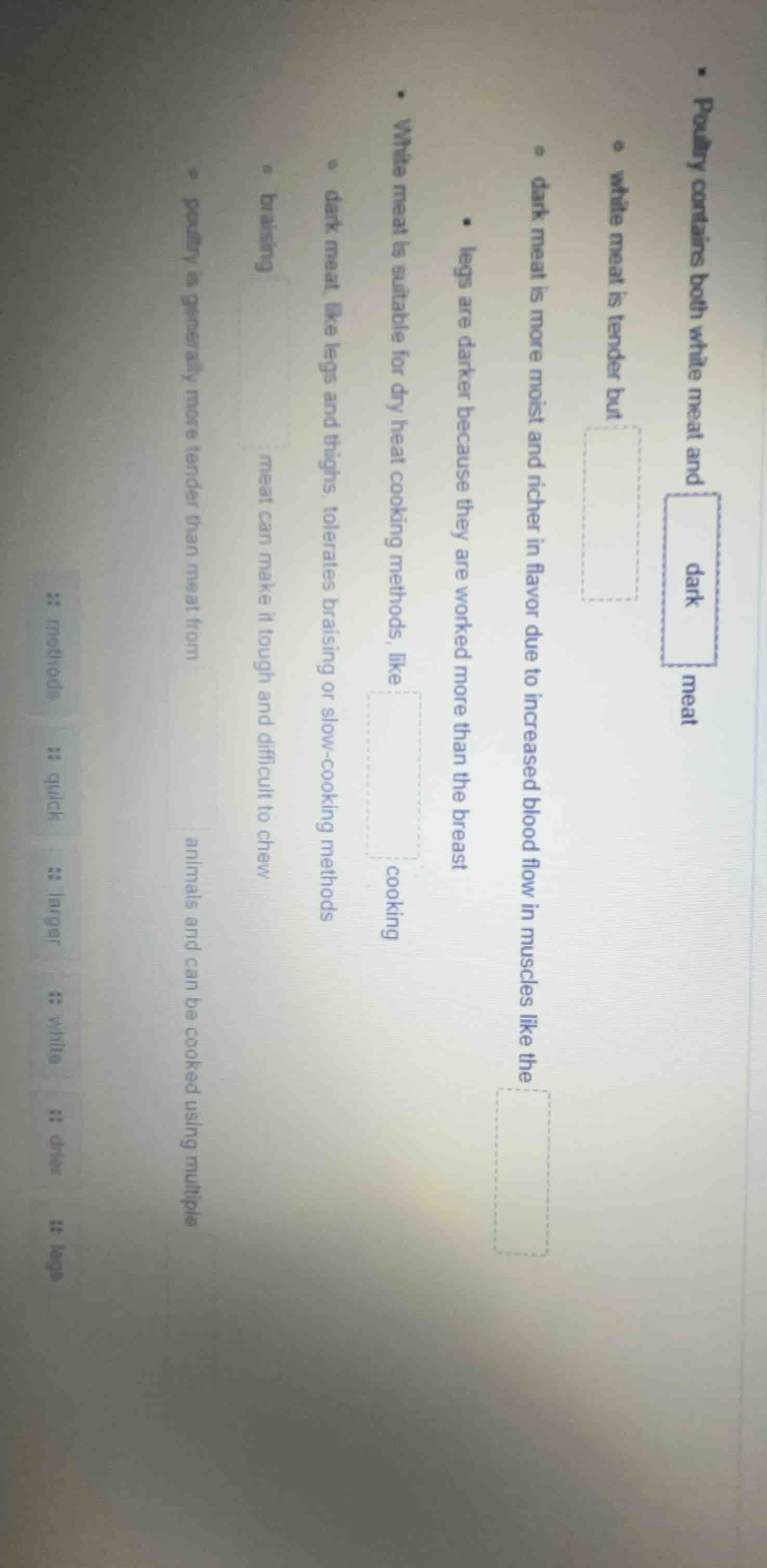
To solve the fill - in - the - blank questions in this text about poultry meat (white and dark meat) and cooking methods, we analyze the context:
1. First blank (after "white meat is tender but")
The text is comparing white meat and dark meat. Since dark meat is described as "more moist and richer in flavor", and white meat is tender, the contrast here should be about the quantity or another characteristic. From the word bank (even though not fully visible, based on context), the word "less" (or a similar contrasting term) would fit, but looking at the overall context and the structure, the likely word is "less" (but if we consider the given word bank options, maybe "drier" but the first part says "tender but...". Wait, re - reading: "white meat is tender but ____", and then "dark meat is more moist and richer in flavor". So the contrast is that white meat, though tender, is less moist or has less flavor? But from the structure, maybe the first blank is "drier" (but let's check the second part).
2. Second blank (in "white meat is suitable for dry heat cooking methods, like ____ cooking")
Dry heat cooking methods include roasting, baking, grilling etc. If we assume from the word bank (the left side has "methods", "quick", "larger", "white", "other", "hope" – maybe a typo, but likely "roasting" or "quick"? Wait, dry heat cooking methods that are quick? No, dry heat methods can be quick (like grilling) or slow (like roasting). But the context says "white meat is suitable for dry heat cooking methods, like __ cooking". From common knowledge, white meat is good for roasting (a dry heat method). But if we look at the word bank on the left, "quick" is an option. Wait, maybe "quick" cooking? No, dry heat methods like pan - frying (quick) or roasting (slow). But the text says "dry heat cooking methods, like __ cooking". Let's re - evaluate the context.
3. Third blank (in "dark meat, like legs and thighs, tolerates braising or slow - cooking methods. ____ meat can make it tough and difficult to chew")
If we overcook white meat, it can become tough. So the blank here should be "Overcooking" or from the word bank, maybe "white" (but that doesn't make sense). Wait, the word bank on the left has "poultry", "braising", "dark", "white", "other", "hope", "larger". Wait, maybe "overcooking" is not in the bank, but "white" meat if overcooked? No, the sentence is "____ meat can make it tough...". If we cook white meat incorrectly (overcook), it becomes tough. So the blank is "Overcooking" but if from the word bank, maybe "white" (but that's not right). Wait, maybe the third blank is "overcooking" (but since we have to use the given words, maybe "white" is not, maybe "other"? No.
Wait, maybe I misread. Let's start over with the visible text:
- "Poultry contains both white meat and dark meat"
- "white meat is tender but ____"
- "dark meat is more moist and richer in flavor due to increased blood flow in muscles like the __" (wait, the second blank in the dark meat part: "muscles like the __" – maybe "legs" but legs are already mentioned. No, the dark meat is in legs and thighs, so maybe "thighs"? No.
Wait, perhaps the correct answers are:
- "drier" (for the first blank: white meat is tender but drier)
- "roasting" (for the second blank: dry heat method like roasting)
- "Overcooking" (for the third blank: Overcooking meat can make it tough)
But since this is a fill - in - the - blank with a word bank (partially visible), and assuming the word bank has "quick", "white", "other" etc., maybe the intended answers are:
- drier
2…

Snap & solve any problem in the app
Get step-by-step solutions on Sovi AI
Photo-based solutions with guided steps
Explore more problems and detailed explanations
s:
- drier
- roasting
- Overcooking
(Note: If the word bank has different options, the answers may vary slightly, but based on culinary knowledge and the context, these are the most logical answers.)