QUESTION IMAGE
Question
human digestive system (worksheet)
q.1. what is the digestive system?
q.2. fill in the blanks in the following sentences with suitable words.
a) the digestive process starts in the ______.
b) muscular organ that mixes and chemically changes protein is the ______.
c) ______ is produced by the liver and aids in fat digestion.
d) the ______ absorbs water and salt from undigested material.
e) the small intestine uses ______ to absorb nutrients.
q.3. write t or true if the statement is true while f or false if the statement is false.
- enzymes are chemicals that help break down food.
- stomach contains structures called villi that absorb nutrients from food particles.
- during the process of absorption, nutrients from food go from the intestines into the bloodstream.
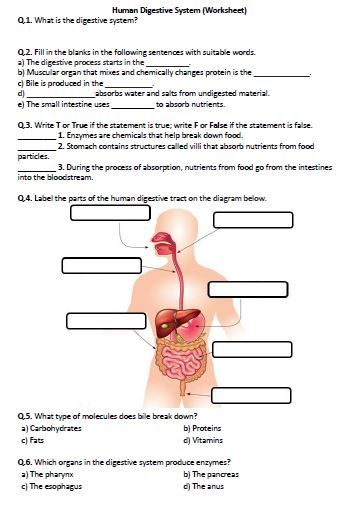
q.4. label the parts of the human digestive tract on the diagram below.
q.5. what type of molecules does bile break down?
a) carbohydrates
b) proteins
c) vitamins
d) fats
q.6. which organs in the digestive system produce enzymes?
a) the esophagus
b) the pharynx
c) the anus
Q1: What is the digestive system?
The digestive system is a group of organs in the body that work together to break down food into nutrients (like carbohydrates, proteins, fats, vitamins, minerals) that the body can absorb and use for energy, growth, and cell repair. It also helps eliminate waste products from the body.
The digestive process begins in the mouth. In the mouth, mechanical digestion occurs through chewing (mastication), and chemical digestion starts with saliva, which contains enzymes like amylase that begin breaking down carbohydrates.
The stomach is a muscular organ. It mixes food with gastric juices (containing hydrochloric acid and pepsin) through peristalsis. Pepsin is an enzyme that starts the chemical breakdown of proteins into smaller peptides.

Snap & solve any problem in the app
Get step-by-step solutions on Sovi AI
Photo-based solutions with guided steps
Explore more problems and detailed explanations
The digestive system is a group of organs that break down food into nutrients, absorb those nutrients, and eliminate waste. Organs include the mouth, esophagus, stomach, small intestine, large intestine, liver, gallbladder, and pancreas, with processes like ingestion, digestion (mechanical and chemical), absorption, and defecation.