QUESTION IMAGE
Question
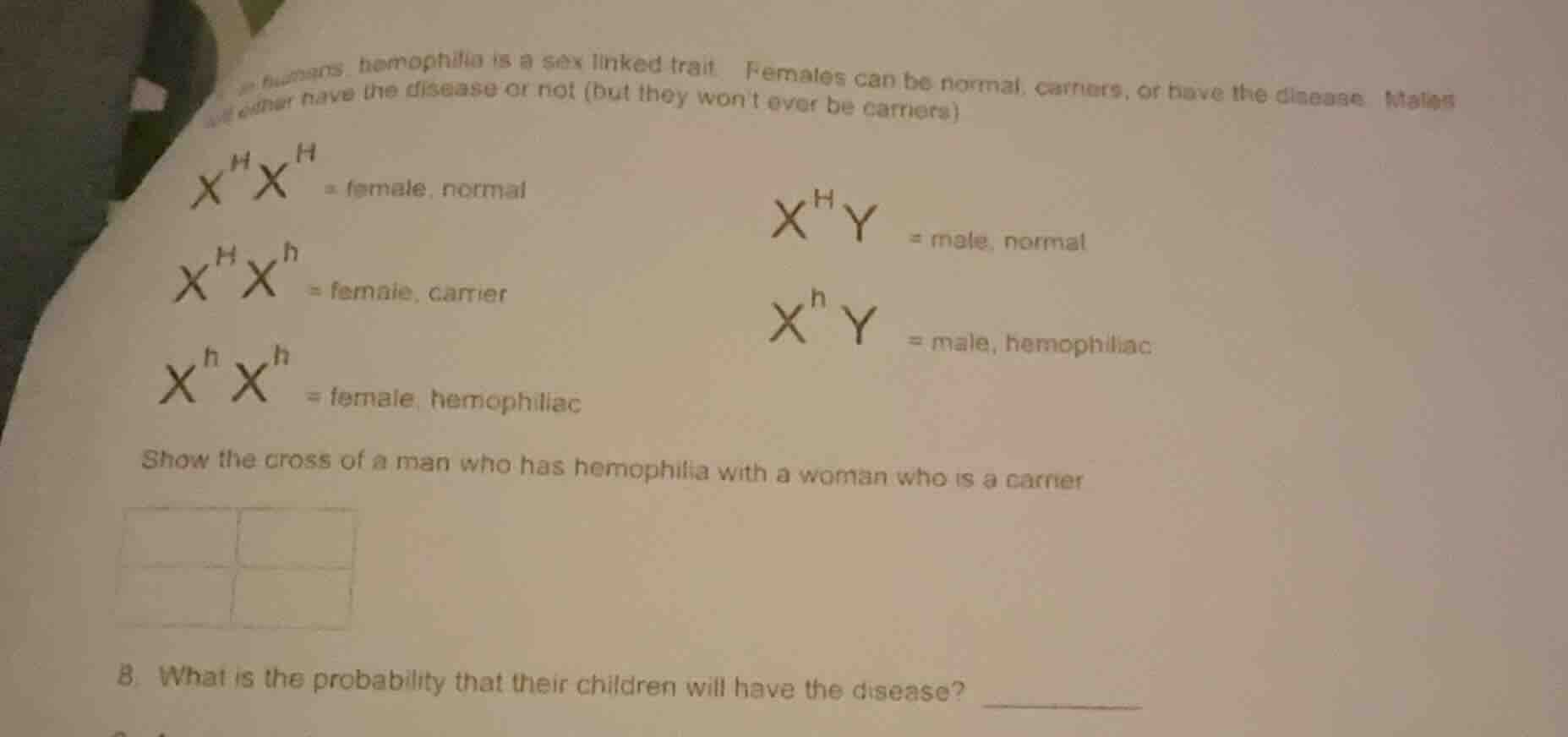
in humans, hemophilia is a sex linked trait. females can be normal, carriers, or have the disease. males will either have the disease or not (but they wont ever be carriers)
$x^h x^h$ = female, normal
$x^h x^h$ = female, carrier
$x^h x^h$ = female, hemophiliac
$x^h y$ = male, normal
$x^h y$ = male, hemophiliac
show the cross of a man who has hemophilia with a woman who is a carrier
- what is the probability that their children will have the disease? ______
Part 1: Show the cross (Punnett Square)
Step 1: Determine the genotypes of parents
- Man with hemophilia: Genotype is $X^hY$ (since males with hemophilia have $X^h$ and $Y$).
- Woman who is a carrier: Genotype is $X^HX^h$ (carrier females have one normal $X^H$ and one hemophilia - causing $X^h$).
Step 2: Determine the gametes
- Gametes from the man ($X^hY$):
- He can produce two types of gametes: $X^h$ and $Y$.
- Gametes from the woman ($X^HX^h$):
- She can produce two types of gametes: $X^H$ and $X^h$.
Step 3: Construct the Punnett Square
| $X^h$ (from man) | $Y$ (from man) | |
|---|---|---|
| $X^h$ (from woman) | $X^hX^h$ (female, hemophiliac) | $X^hY$ (male, hemophiliac) |
Part 2: Probability that their children will have the disease
Step 1: Count the total number of possible offspring genotypes
From the Punnett Square, we have 4 possible genotypes of offspring: $X^HX^h$, $X^HY$, $X^hX^h$, $X^hY$.
Step 2: Count the number of offspring with the disease
- Offspring with hemophilia (disease) have genotypes $X^hX^h$ (female) and $X^hY$ (male). So there are 2 out of 4 offspring with the disease.
Step 3: Calculate the probability
The probability is calculated as the number of favorable outcomes (offspring with disease) divided by the total number of outcomes (total offspring). So the probability $P=\frac{2}{4}=\frac{1}{2}$ or 50%.

Snap & solve any problem in the app
Get step-by-step solutions on Sovi AI
Photo-based solutions with guided steps
Explore more problems and detailed explanations
for Punnett Square:
| $X^h$ | $Y$ | |
|---|---|---|
| $X^h$ | $X^hX^h$ | $X^hY$ |