QUESTION IMAGE
Question
hw 2.3 functions and relations
question 13 of 15 (2 points) | question attempt 1 of unlimited
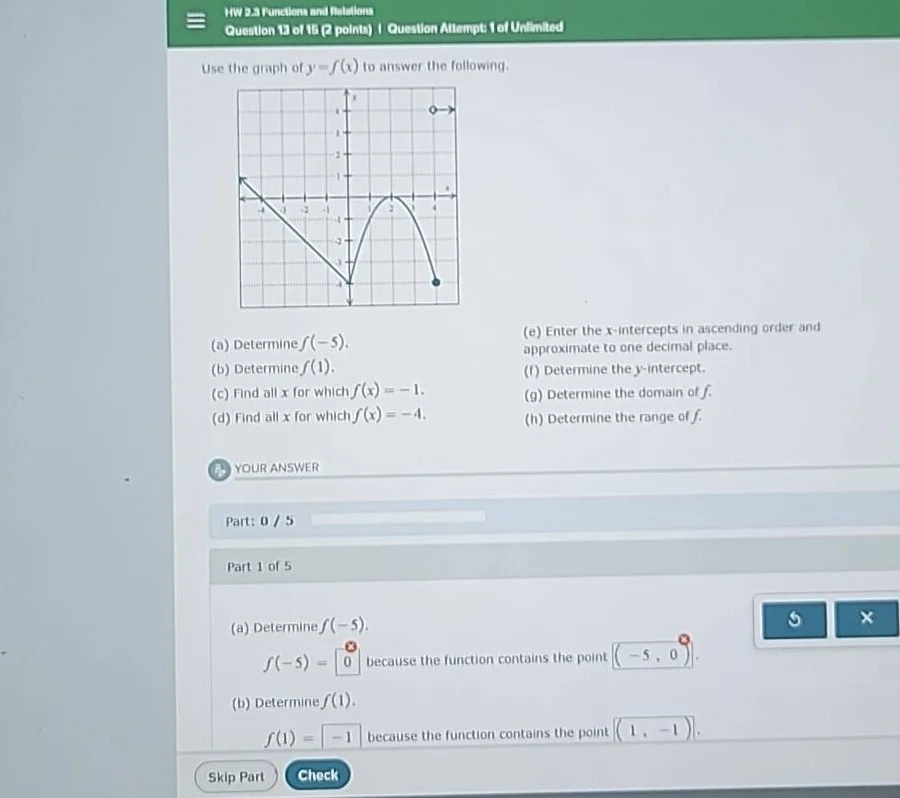
use the graph of ( y = f(x) ) to answer the following.
(a) determine ( f(-5) ).
(b) determine ( f(1) ).
(c) find all ( x ) for which ( f(x) = -1 ).
(d) find all ( x ) for which ( f(x) = -4 ).
(e) enter the ( x )-intercepts in ascending order and approximate to one decimal place.
(f) determine the ( y )-intercept.
(g) determine the domain of ( f ).
(h) determine the range of ( f ).
your answer
part: 0 / 5
part 1 of 5
(a) determine ( f(-5) ).
( f(-5) = ) ( 0 ) because the function contains the point ( (-5, 0) ).
(b) determine ( f(1) ).
( f(1) = ) ( -1 ) because the function contains the point ( (1, -1) ).
skip part check
Part (a): Determine \( f(-5) \)
Step 1: Identify the point on the graph
We look for the point with \( x = -5 \) on the graph of \( y = f(x) \). From the graph, the point \( (-5, 0) \) lies on the function.
Step 2: Recall the definition of a function
For a function \( y = f(x) \), if the point \( (a, b) \) is on the graph, then \( f(a) = b \). Here, \( a = -5 \) and \( b = 0 \), so \( f(-5) = 0 \).
Part (b): Determine \( f(1) \)
Step 1: Identify the point on the graph
We look for the point with \( x = 1 \) on the graph of \( y = f(x) \). From the graph, the point \( (1, -1) \) lies on the function.
Step 2: Recall the definition of a function
For a function \( y = f(x) \), if the point \( (a, b) \) is on the graph, then \( f(a) = b \). Here, \( a = 1 \) and \( b = -1 \), so \( f(1) = -1 \).
Part (c): Find all \( x \) for which \( f(x) = -1 \)
Step 1: Understand the problem
We need to find all \( x \)-values such that the \( y \)-value (i.e., \( f(x) \)) is \( -1 \). This means we look for all points on the graph where \( y = -1 \) and find their corresponding \( x \)-coordinates.
Step 2: Analyze the graph
Looking at the graph, we can see that the points where \( y = -1 \) are \( (1, -1) \) and we need to check if there are other points. From the graph, we observe that another point with \( y = -1 \) is \( (3, -1) \)? Wait, no, let's re - examine. Wait, the graph: the left - hand line and the parabola - like part. Wait, when \( y=-1\), we have two points? Wait, no, let's do it properly. The function is composed of a line segment on the left and a parabola - like curve on the right? Wait, from the given graph, when \( f(x)=-1\), we can see that \( x = 1 \) and \( x = 3 \)? Wait, no, let's check the graph again. Wait, the point \( (1, -1) \) is on the graph, and also, looking at the parabola - like part, when \( y=-1\), we can solve for \( x \). Wait, maybe the graph has a line from \( (-5,0) \) to \( (0, - 4) \) (since at \( x = 0 \), \( y=-4 \)) and then a parabola from \( (0, - 4) \) to \( (4, - 4) \)? Wait, no, the right - hand end is a closed dot at \( (4, - 4) \)? Wait, no, the closed dot is at \( (4, - 4) \)? Wait, the original graph: the left part is a line from \( (-5,0) \) (open or closed? Wait, the left - hand end is an arrow? No, the left - hand end is a closed dot? Wait, the first part: from \( x=-5 \) (closed dot at \( (-5,0) \)) to \( x = 0 \) (closed dot at \( (0, - 4) \))? Wait, no, the point at \( x = 0 \) is a closed dot with \( y=-4 \). Then the right part is a parabola - like curve from \( (0, - 4) \) up to a peak at \( (2,0) \) and then down to \( (4, - 4) \) (closed dot). Wait, when \( f(x)=-1 \), on the left - hand line: the equation of the left - hand line. The left - hand line goes from \( (-5,0) \) to \( (0, - 4) \). The slope of the left - hand line is \( m=\frac{-4 - 0}{0-(-5)}=\frac{-4}{5}=-0.8 \). The equation of the left - hand line is \( y-0=-0.8(x + 5) \), so \( y=-0.8x-4 \). When \( y=-1 \), we have \( -1=-0.8x - 4 \), then \( 0.8x=-4 + 1=-3 \), \( x=\frac{-3}{0.8}=-3.75 \). On the right - hand parabola: the vertex of the parabola is at \( (2,0) \) and it passes through \( (0, - 4) \) and \( (4, - 4) \). The equation of the parabola with vertex \( (h,k)=(2,0) \) is \( y=a(x - 2)^2+0 \). Since it passes through \( (0, - 4) \), we substitute \( x = 0 \), \( y=-4 \): \( -4=a(0 - 2)^2\), \( -4 = 4a \), \( a=-1 \). So the equation of the parabola is \( y=-(x - 2)^2=-x^{2}+4x - 4 \). When \( y=-1 \), we have \( -1=-x^{2}+4x - 4 \), \( x^{2}-4x - 3 = 0 \). Using the quadratic for…

Snap & solve any problem in the app
Get step-by-step solutions on Sovi AI
Photo-based solutions with guided steps
Explore more problems and detailed explanations
Part (a): Determine \( f(-5) \)
Step 1: Identify the point on the graph
We look for the point with \( x = -5 \) on the graph of \( y = f(x) \). From the graph, the point \( (-5, 0) \) lies on the function.
Step 2: Recall the definition of a function
For a function \( y = f(x) \), if the point \( (a, b) \) is on the graph, then \( f(a) = b \). Here, \( a = -5 \) and \( b = 0 \), so \( f(-5) = 0 \).
Part (b): Determine \( f(1) \)
Step 1: Identify the point on the graph
We look for the point with \( x = 1 \) on the graph of \( y = f(x) \). From the graph, the point \( (1, -1) \) lies on the function.
Step 2: Recall the definition of a function
For a function \( y = f(x) \), if the point \( (a, b) \) is on the graph, then \( f(a) = b \). Here, \( a = 1 \) and \( b = -1 \), so \( f(1) = -1 \).
Part (c): Find all \( x \) for which \( f(x) = -1 \)
Step 1: Understand the problem
We need to find all \( x \)-values such that the \( y \)-value (i.e., \( f(x) \)) is \( -1 \). This means we look for all points on the graph where \( y = -1 \) and find their corresponding \( x \)-coordinates.
Step 2: Analyze the graph
Looking at the graph, we can see that the points where \( y = -1 \) are \( (1, -1) \) and we need to check if there are other points. From the graph, we observe that another point with \( y = -1 \) is \( (3, -1) \)? Wait, no, let's re - examine. Wait, the graph: the left - hand line and the parabola - like part. Wait, when \( y=-1\), we have two points? Wait, no, let's do it properly. The function is composed of a line segment on the left and a parabola - like curve on the right? Wait, from the given graph, when \( f(x)=-1\), we can see that \( x = 1 \) and \( x = 3 \)? Wait, no, let's check the graph again. Wait, the point \( (1, -1) \) is on the graph, and also, looking at the parabola - like part, when \( y=-1\), we can solve for \( x \). Wait, maybe the graph has a line from \( (-5,0) \) to \( (0, - 4) \) (since at \( x = 0 \), \( y=-4 \)) and then a parabola from \( (0, - 4) \) to \( (4, - 4) \)? Wait, no, the right - hand end is a closed dot at \( (4, - 4) \)? Wait, no, the closed dot is at \( (4, - 4) \)? Wait, the original graph: the left part is a line from \( (-5,0) \) (open or closed? Wait, the left - hand end is an arrow? No, the left - hand end is a closed dot? Wait, the first part: from \( x=-5 \) (closed dot at \( (-5,0) \)) to \( x = 0 \) (closed dot at \( (0, - 4) \))? Wait, no, the point at \( x = 0 \) is a closed dot with \( y=-4 \). Then the right part is a parabola - like curve from \( (0, - 4) \) up to a peak at \( (2,0) \) and then down to \( (4, - 4) \) (closed dot). Wait, when \( f(x)=-1 \), on the left - hand line: the equation of the left - hand line. The left - hand line goes from \( (-5,0) \) to \( (0, - 4) \). The slope of the left - hand line is \( m=\frac{-4 - 0}{0-(-5)}=\frac{-4}{5}=-0.8 \). The equation of the left - hand line is \( y-0=-0.8(x + 5) \), so \( y=-0.8x-4 \). When \( y=-1 \), we have \( -1=-0.8x - 4 \), then \( 0.8x=-4 + 1=-3 \), \( x=\frac{-3}{0.8}=-3.75 \). On the right - hand parabola: the vertex of the parabola is at \( (2,0) \) and it passes through \( (0, - 4) \) and \( (4, - 4) \). The equation of the parabola with vertex \( (h,k)=(2,0) \) is \( y=a(x - 2)^2+0 \). Since it passes through \( (0, - 4) \), we substitute \( x = 0 \), \( y=-4 \): \( -4=a(0 - 2)^2\), \( -4 = 4a \), \( a=-1 \). So the equation of the parabola is \( y=-(x - 2)^2=-x^{2}+4x - 4 \). When \( y=-1 \), we have \( -1=-x^{2}+4x - 4 \), \( x^{2}-4x - 3 = 0 \). Using the quadratic formula \( x=\frac{4\pm\sqrt{16+12}}{2}=\frac{4\pm\sqrt{28}}{2}=\frac{4\pm2\sqrt{7}}{2}=2\pm\sqrt{7}\approx2\pm2.6458 \). So \( x\approx2 + 2.6458=4.6458 \) (but the domain of the parabola is from \( x = 0 \) to \( x = 4 \), so this is outside) and \( x\approx2 - 2.6458=-0.6458 \) (also outside the parabola's domain \( 0\leq x\leq4 \)). Wait, this means that on the parabola, when \( y=-1 \), there are no solutions in \( 0\leq x\leq4 \). But we know that \( x = 1 \) is on the graph with \( y=-1 \). Wait, maybe my initial assumption about the left - hand line is wrong. Let's look at the given answers for part (b): \( f(1)=-1 \), so the point \( (1, - 1) \) is on the graph. Also, looking at the graph, maybe the right - hand part: when \( x = 3 \), \( y=-1 \)? Wait, no, let's check the graph again. The user's part (b) says \( f(1)=-1 \) because the function contains the point \( (1, - 1) \). Now, for \( f(x)=-1 \), we have \( x = 1 \) and also, from the left - hand line: the left - hand line is from \( (-5,0) \) to \( (0, - 4) \). Let's find \( x \) when \( y=-1 \) on the left - hand line. The slope \( m=\frac{-4-0}{0 - (-5)}=\frac{-4}{5}=-0.8 \). The equation is \( y=0-0.8(x + 5)=-0.8x-4 \). Set \( y=-1 \): \( -1=-0.8x-4 \), \( 0.8x=-4 + 1=-3 \), \( x=\frac{-3}{0.8}=-3.75\approx - 3.8 \)? No, wait, maybe the left - hand line is from \( (-5,0) \) (closed dot) to \( (0, - 4) \) (closed dot). Then, when \( y=-1 \), on the left - hand line: \( -1=-0.8x-4\Rightarrow0.8x=-3\Rightarrow x =-\frac{3}{0.8}=-3.75\approx - 3.8 \), but we also have \( x = 1 \) from the right - hand part? Wait, no, the right - hand part is from \( x = 0 \) to \( x = 4 \). At \( x = 1 \), which is in \( 0\leq x\leq4 \), we have \( y=-1 \). Also, is there another point? Wait, maybe the graph has a line from \( (-5,0) \) to \( (0, - 4) \) (so for \( -5\leq x\leq0 \), \( y=-0.8x - 4 \)) and a parabola from \( x = 0 \) to \( x = 4 \), \( y=-(x - 2)^2 \) (since at \( x = 2 \), \( y = 0 \), at \( x = 0 \) and \( x = 4 \), \( y=-4 \)). Now, for \( y=-1 \):
- On the line (\( -5\leq x\leq0 \)): \( -1=-0.8x-4\Rightarrow0.8x=-3\Rightarrow x =-\frac{3}{0.8}=-3.75\approx - 3.8 \)
- On the parabola (\( 0\leq x\leq4 \)): \( -1=-(x - 2)^2\Rightarrow(x - 2)^2 = 1\Rightarrow x-2=\pm1\Rightarrow x=2 + 1=3 \) or \( x=2-1 = 1 \)
So the values of \( x \) for which \( f(x)=-1 \) are \( x=-3.8 \) (approx), \( x = 1 \), and \( x = 3 \)? Wait, no, when \( x=-3.75 \) (which is \( - 3.8 \) when rounded to one decimal place), \( x = 1 \), and \( x = 3 \). But let's check the graph again. The user's part (b) has \( (1, - 1) \) as a point. Also, from the parabola, when \( (x - 2)^2=1 \), \( x = 1 \) and \( x = 3 \). And from the line, \( x=-3.75\approx - 3.8 \). So \( x=-3.8 \), \( x = 1 \), \( x = 3 \)? Wait, but maybe the left - hand line is from \( x=-5 \) to \( x = 0 \), and the right - hand part is from \( x = 0 \) to \( x = 4 \). So the solutions for \( f(x)=-1 \) are \( x=-3.8 \) (from the line), \( x = 1 \), and \( x = 3 \) (from the parabola). But let's confirm with the graph. If we look at the graph, the line from \( (-5,0) \) to \( (0, - 4) \): when \( y=-1 \), \( x=-3.75\approx - 3.8 \). The parabola from \( (0, - 4) \) to \( (4, - 4) \) with vertex at \( (2,0) \): when \( y=-1 \), \( x = 1 \) and \( x = 3 \). So \( x=-3.8 \), \( x = 1 \), \( x = 3 \).
Part (d): Find all \( x \) for which \( f(x)=-4 \)
Step 1: Analyze the graph
We look for the points on the graph where \( y=-4 \). From the graph, we can see that the point \( (0, - 4) \) is on the graph, and also the point \( (4, - 4) \) (closed dot) and any other points? The left - hand line ends at \( (0, - 4) \) (closed dot) and the right - hand parabola - like curve starts at \( (0, - 4) \) and ends at \( (4, - 4) \) (closed dot). Also, is there a point on the left - hand line? Wait, the left - hand line goes from \( (-5,0) \) to \( (0, - 4) \), so at \( x = 0 \), \( y=-4 \). The right - hand part: from \( x = 0 \) to \( x = 4 \), the minimum \( y \)-value is \( -4 \) (at \( x = 0 \) and \( x = 4 \)) and the vertex is at \( (2,0) \). So the equation of the right - hand part (the parabola) is \( y=-(x - 2)^2-4 + 4=-(x - 2)^2 \)? No, when \( x = 0 \), \( y=-4 \), so \( y=-(x - 2)^2-4 + 4 \) is wrong. Wait, the vertex form of a parabola is \( y=a(x - h)^2+k \), where \( (h,k) \) is the vertex. The vertex is at \( (2,0) \), so \( y=a(x - 2)^2+0 \). When \( x = 0 \), \( y=-4 \), so \( -4=a(0 - 2)^2\Rightarrow - 4 = 4a\Rightarrow a=-1 \). So \( y=-(x - 2)^2 \). When \( y=-4 \), \( -4=-(x - 2)^2\Rightarrow(x - 2)^2 = 4\Rightarrow x-2=\pm2\Rightarrow x=2 + 2=4 \) or \( x=2-2 = 0 \). And on the left - hand line, when \( x = 0 \), \( y=-4 \) (since the left - hand line goes from \( (-5,0) \) to \( (0, - 4) \)). So the values of \( x \) for which \( f(x)=-4 \) are \( x = 0 \) and \( x = 4 \) (from the parabola) and also, is \( x = 0 \) included in the left - hand line? The left - hand line ends at \( x = 0 \) (closed dot), and the parabola starts at \( x = 0 \) (closed dot). So \( x = 0 \) and \( x = 4 \) are the solutions? Wait, no, the left - hand line: when \( x = 0 \), \( y=-4 \), and the parabola at \( x = 0 \), \( y=-4 \), and at \( x = 4 \), \( y=-4 \). So \( f(x)=-4 \) when \( x = 0 \) and \( x = 4 \), and also, is there a point on the left - hand line? The left - hand line is from \( x=-5 \) to \( x = 0 \), and at \( x = 0 \), \( y=-4 \). So the solutions are \( x = 0 \) and \( x = 4 \).
Part (e): Enter the \( x \)-intercepts in ascending order and approximate to one decimal place
Step 1: Recall the definition of \( x \)-intercept
The \( x \)-intercepts are the values of \( x \) for which \( y = f(x)=0 \).
Step 2: Find the \( x \)-intercepts from the graph
- The left - hand part: the line from \( (-5,0) \) (so \( x=-5 \) is an \( x \)-intercept? Wait, the point \( (-5,0) \) is on the graph, so \( x=-5 \) is an \( x \)-intercept.
- The right - hand part: the parabola has a vertex at \( (2,0) \), so \( x = 2 \) is an \( x \)-intercept (since \( f(2)=0 \)). Wait, but let's check the graph. The left - hand line has a point \( (-5,0) \) (closed dot), and the parabola has a peak at \( (2,0) \) (so \( f(2)=0 \)). Are there any other \( x \)-intercepts? Let's see, the parabola: \( y=-(x - 2)^2 \), when \( y = 0 \), \( x = 2 \). The left - hand line: \( y=-0.8x-4 \), when \( y = 0 \), \( 0=-0.8x-4\Rightarrow0.8x=-4\Rightarrow x=-5 \). So the \( x \)-intercepts are \( x=-5.0 \) and \( x = 2.0 \). Wait, but maybe there is another one? Wait, no, the left - hand line intersects the \( x \)-axis at \( x=-5 \), and the parabola intersects the \( x \)-axis at \( x = 2 \). So the \( x \)-intercepts in ascending order are \( x=-5.0 \) and \( x = 2.0 \).
Part (f): Determine the \( y \)-intercept
Step 1: Recall the definition of \( y \)-intercept
The \( y \)-intercept is the value of \( y \) when \( x = 0 \), i.e