QUESTION IMAGE
Question
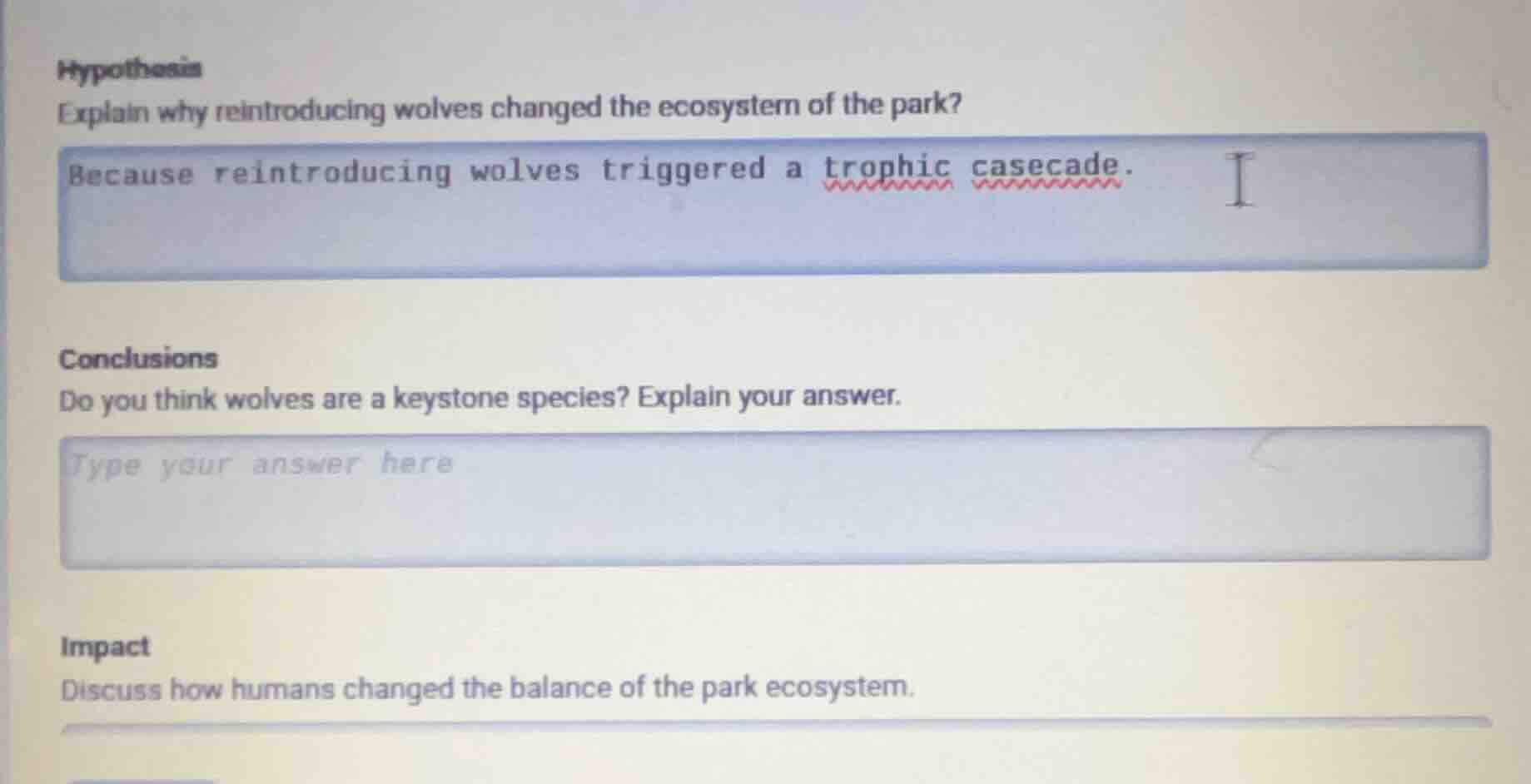
hypothesis
explain why reintroducing wolves changed the ecosystem of the park?
because reintroducing wolves triggered a trophic cascade.
conclusions
do you think wolves are a keystone species? explain your answer.
type your answer here
impact
discuss how humans changed the balance of the park ecosystem.
For the "Conclusions" question (Do you think wolves are a keystone species? Explain your answer.):
A keystone species has a disproportionately large impact on its ecosystem relative to its abundance. Wolves, as top predators, control herbivore (e.g., elk) populations. This control affects vegetation (e.g., trees, shrubs) by reducing overgrazing, which in turn impacts other species (e.g., beavers, birds) that depend on that vegetation. Their presence/absence drastically alters the ecosystem’s structure and function, as seen in the trophic cascade from their reintroduction.
Humans altered the park ecosystem in multiple ways. Initially, they removed wolves (overhunting), causing herbivore overpopulation (e.g., elk) that overgrazed vegetation, disrupting plant - herbivore - predator dynamics. Human land use (e.g., development, logging) also modified habitats. Reintroducing wolves was a human attempt to restore balance, but past actions (extirpating wolves, altering land) first destabilized the ecosystem.

Snap & solve any problem in the app
Get step-by-step solutions on Sovi AI
Photo-based solutions with guided steps
Explore more problems and detailed explanations
Yes, wolves are a keystone species. They regulate herbivore populations (like elk), which prevents overgrazing and maintains plant communities. This impacts other species (e.g., beavers, birds) and the ecosystem’s physical structure (e.g., riverbanks, tree growth), showing their disproportionate influence on the ecosystem’s balance.