QUESTION IMAGE
Question
identify the domain and range of each function.
a.
b.
a. identify the domain of the function. select the correct choice below and, if necessary, fill in the answer box(es) within your choice.
a. {x | x ≥ }
(type an integer or a simplified fraction.)
b. { }
(type your answer(s) as integers or simplified fractions. use a comma to separate answers as needed.)
c. {x | 1 ≤ x ≤ 3}
(type integers or simplified fractions.)
d. {x | x ≤ }
(type an integer or a simplified fraction.)
e. {x | x is a real number}
identify the range of the function. select the correct choice below and, if necessary, fill in the answer box(es) within your choice.
a. {y | y ≤ }
(type an integer or a simplified fraction.)
b. {y | ≤ y ≤ }
(type integers or simplified fractions.)
c. {y | y ≥ }
(type an integer or a simplified fraction.)
d. { }
(type your answer(s) as integers or simplified fractions. use a comma to separate answers as needed.)
e. {y | y is a real number}
Part a: Domain of the Function
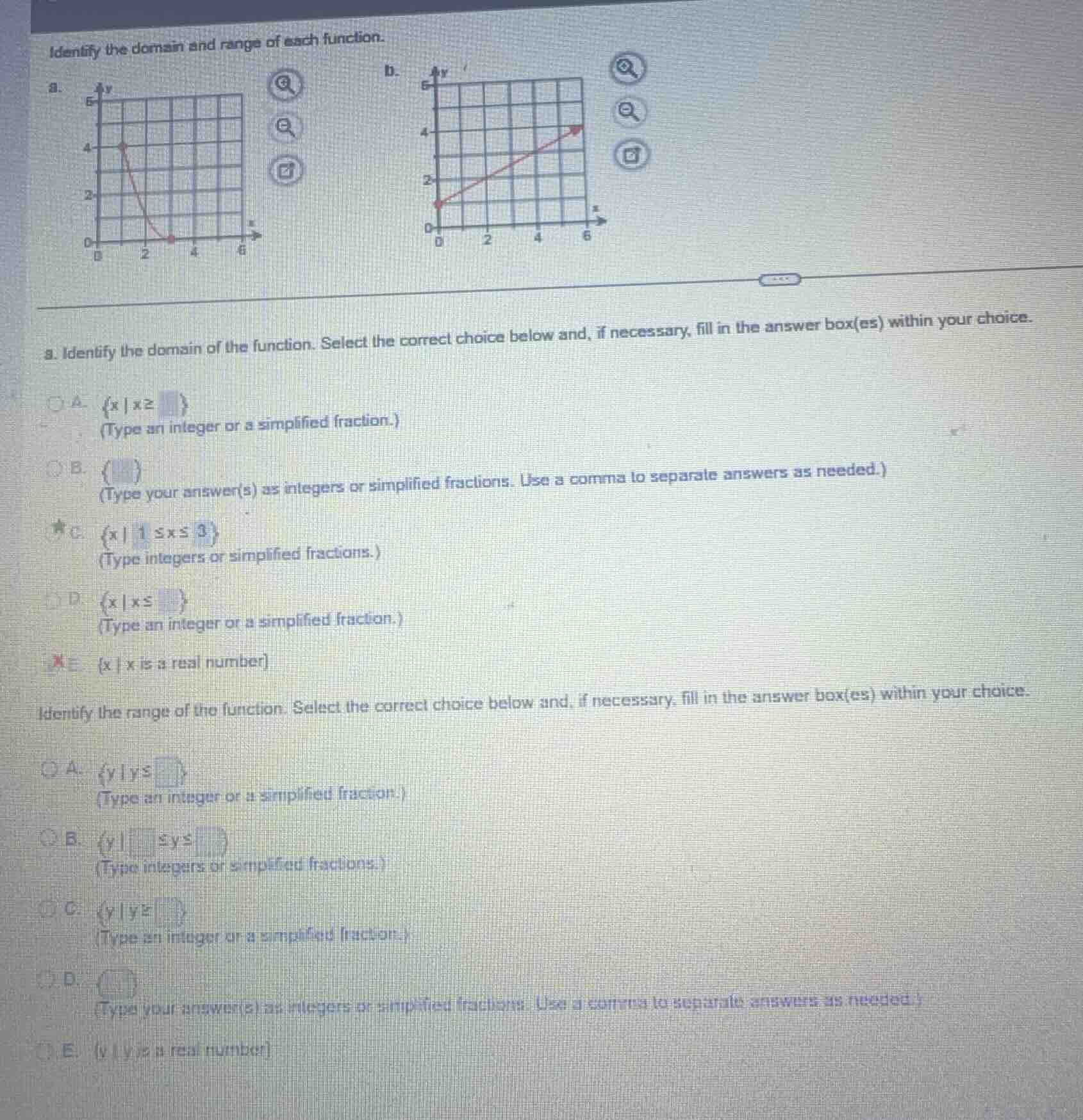
To determine the domain, we analyze the graph's horizontal extent. The graph spans from \( x = 1 \) (closed dot) to \( x = 3 \) (closed dot), so the domain includes all \( x \)-values between 1 and 3, inclusive.
Step 1: Identify Domain Interval
The graph starts at \( x = 1 \) (closed circle) and ends at \( x = 3 \) (closed circle), so the domain is \( \{x \mid 1 \leq x \leq 3\} \).
Part a: Range of the Function
To determine the range, we analyze the graph's vertical extent. The graph spans from \( y = 0 \) (closed dot at \( x = 3 \)) up to \( y = 4 \) (closed dot at \( x = 1 \)), so the range includes all \( y \)-values between 0 and 4, inclusive.
Step 1: Identify Range Interval
The lowest \( y \)-value is 0 (at \( x = 3 \)) and the highest is 4 (at \( x = 1 \)), so the range is \( \{y \mid 0 \leq y \leq 4\} \).
Final Answers for Part a:
- Domain: Option C, \( \boldsymbol{\{x \mid 1 \leq x \leq 3\}} \)
- Range: Option B, \( \boldsymbol{\{y \mid 0 \leq y \leq 4\}} \)
Part b: Domain of the Linear Function
The graph is a line from \( x = 0 \) (closed dot) to \( x = 6 \) (closed dot), so the domain includes all \( x \)-values between 0 and 6, inclusive: \( \{x \mid 0 \leq x \leq 6\} \).
Part b: Range of the Linear Function
The graph spans from \( y = 1 \) (closed dot at \( x = 0 \)) to \( y = 4 \) (closed dot at \( x = 6 \)), so the range includes all \( y \)-values between 1 and 4, inclusive: \( \{y \mid 1 \leq y \leq 4\} \).
Final Answers for Part b:
- Domain: \( \boldsymbol{\{x \mid 0 \leq x \leq 6\}} \)
- Range: \( \boldsymbol{\{y \mid 1 \leq y \leq 4\}} \)
(Note: For part b, follow the same format as part a to select the corresponding option with \( 0 \leq x \leq 6 \) for domain and \( 1 \leq y \leq 4 \) for range.)

Snap & solve any problem in the app
Get step-by-step solutions on Sovi AI
Photo-based solutions with guided steps
Explore more problems and detailed explanations
Part a: Domain of the Function
To determine the domain, we analyze the graph's horizontal extent. The graph spans from \( x = 1 \) (closed dot) to \( x = 3 \) (closed dot), so the domain includes all \( x \)-values between 1 and 3, inclusive.
Step 1: Identify Domain Interval
The graph starts at \( x = 1 \) (closed circle) and ends at \( x = 3 \) (closed circle), so the domain is \( \{x \mid 1 \leq x \leq 3\} \).
Part a: Range of the Function
To determine the range, we analyze the graph's vertical extent. The graph spans from \( y = 0 \) (closed dot at \( x = 3 \)) up to \( y = 4 \) (closed dot at \( x = 1 \)), so the range includes all \( y \)-values between 0 and 4, inclusive.
Step 1: Identify Range Interval
The lowest \( y \)-value is 0 (at \( x = 3 \)) and the highest is 4 (at \( x = 1 \)), so the range is \( \{y \mid 0 \leq y \leq 4\} \).
Final Answers for Part a:
- Domain: Option C, \( \boldsymbol{\{x \mid 1 \leq x \leq 3\}} \)
- Range: Option B, \( \boldsymbol{\{y \mid 0 \leq y \leq 4\}} \)
Part b: Domain of the Linear Function
The graph is a line from \( x = 0 \) (closed dot) to \( x = 6 \) (closed dot), so the domain includes all \( x \)-values between 0 and 6, inclusive: \( \{x \mid 0 \leq x \leq 6\} \).
Part b: Range of the Linear Function
The graph spans from \( y = 1 \) (closed dot at \( x = 0 \)) to \( y = 4 \) (closed dot at \( x = 6 \)), so the range includes all \( y \)-values between 1 and 4, inclusive: \( \{y \mid 1 \leq y \leq 4\} \).
Final Answers for Part b:
- Domain: \( \boldsymbol{\{x \mid 0 \leq x \leq 6\}} \)
- Range: \( \boldsymbol{\{y \mid 1 \leq y \leq 4\}} \)
(Note: For part b, follow the same format as part a to select the corresponding option with \( 0 \leq x \leq 6 \) for domain and \( 1 \leq y \leq 4 \) for range.)