QUESTION IMAGE
Question
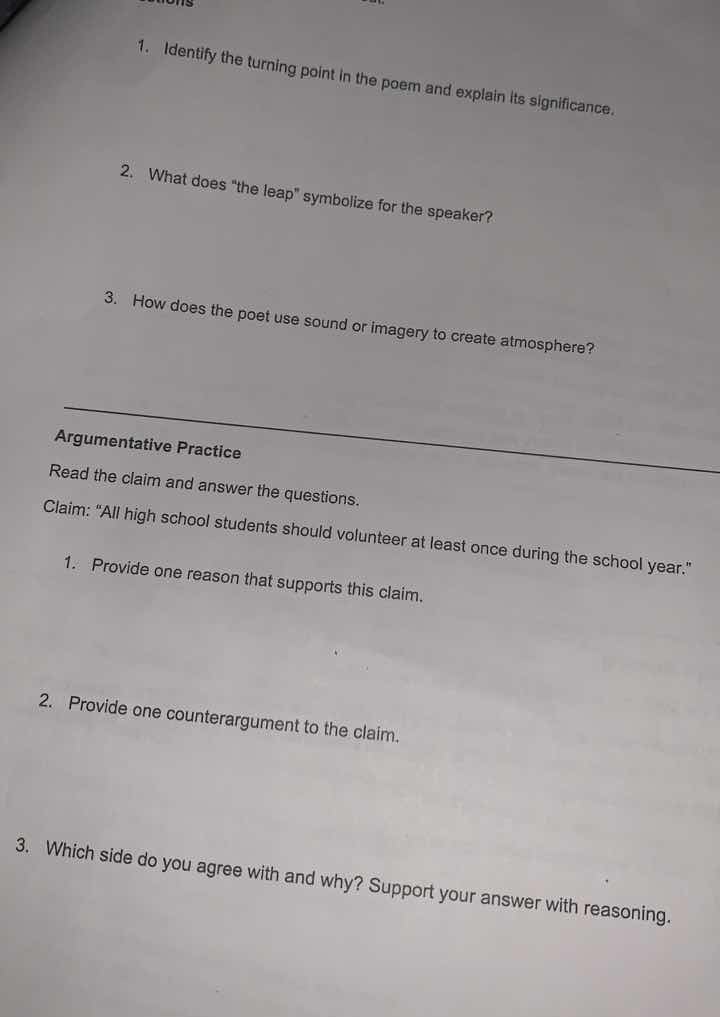
- identify the turning point in the poem and explain its significance.
- what does \the leap\ symbolize for the speaker?
- how does the poet use sound or imagery to create atmosphere?
argumentative practice
read the claim and answer the questions.
claim: \all high school students should volunteer at least once during the school year.\
- provide one reason that supports this claim.
- provide one counterargument to the claim.
- which side do you agree with and why? support your answer with reasoning.
For the poem - related questions (assuming a specific poem, here's a general approach, but since the poem isn't provided, we'll give a template):
Question 1: Identify the turning point in the poem and explain its significance.
A turning point (volta) in a poem often shifts tone, theme, or perspective. For example, in a sonnet, it's usually at the 9th line. Suppose the poem is about a speaker's fear of change, and the turning point is when they accept it. The significance would be the shift from anxiety to acceptance, altering the poem's message.
Symbols in poetry represent abstract ideas. "The leap" could symbolize taking a risk, embracing change, or a spiritual awakening. For instance, if the speaker is at a crossroads, "the leap" might symbolize leaving comfort for growth.
Sound devices (rhyme, alliteration) and imagery (sensory details) set mood. For example, dark imagery and harsh alliteration create a gloomy atmosphere. If the poem is about a peaceful forest, soft rhymes and nature imagery (birds, trees) create calm.

Snap & solve any problem in the app
Get step-by-step solutions on Sovi AI
Photo-based solutions with guided steps
Explore more problems and detailed explanations
(Depends on the poem. Example: In [Poem Name], the turning point is at line [X], where the speaker's tone shifts from despair to hope. This signifies a realization about [theme], changing the poem's emotional arc and meaning.)