QUESTION IMAGE
Question
identifying a solution from the graph of a system of two - variable inequalities
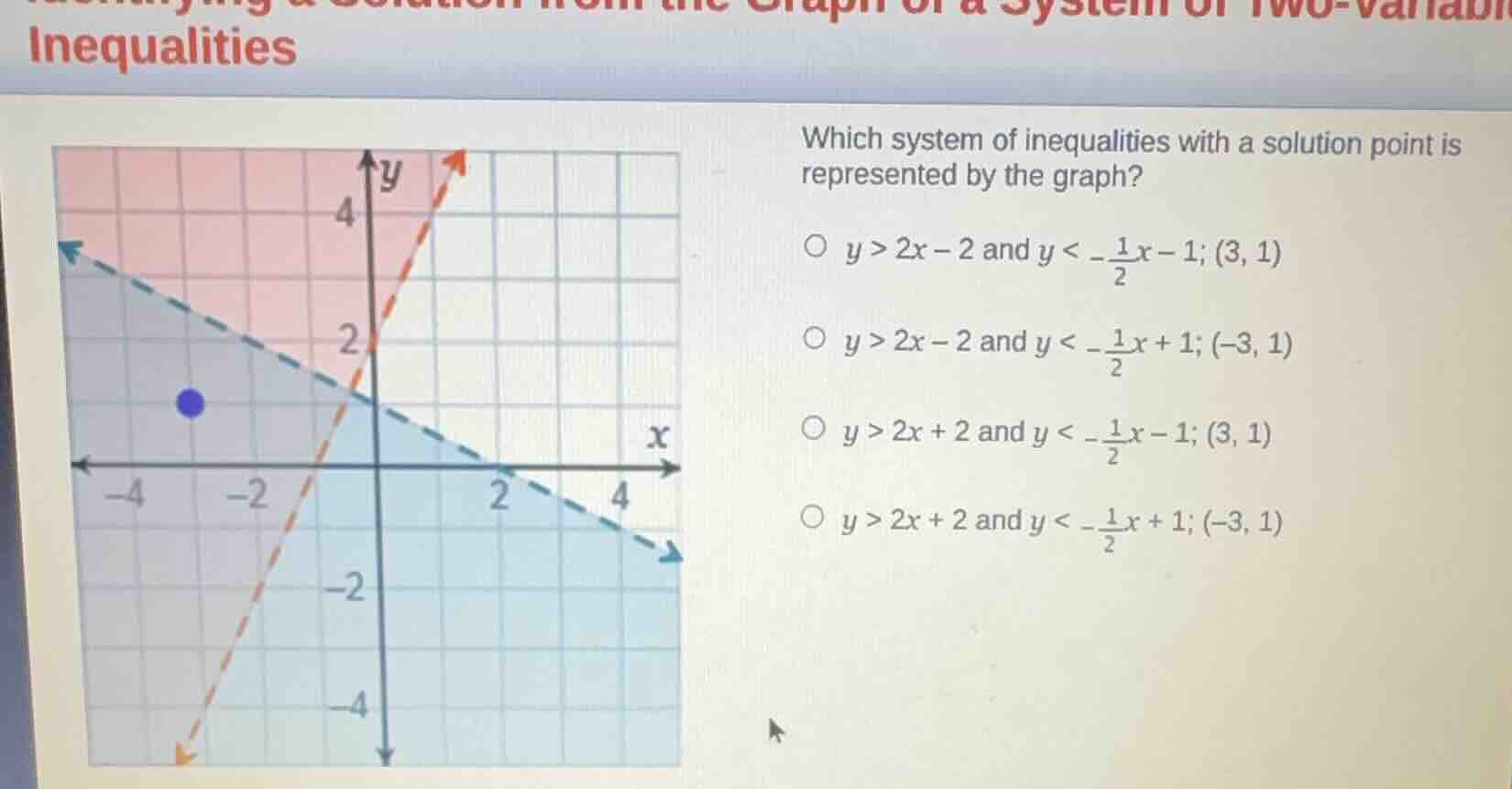
which system of inequalities with a solution point is represented by the graph?
\\(\circ\\) \\(y > 2x - 2\\) and \\(y < -\frac{1}{2}x - 1\\); \\((3, 1)\\)
\\(\circ\\) \\(y > 2x - 2\\) and \\(y < -\frac{1}{2}x + 1\\); \\((-3, 1)\\)
\\(\circ\\) \\(y > 2x + 2\\) and \\(y < -\frac{1}{2}x - 1\\); \\((3, 1)\\)
\\(\circ\\) \\(y > 2x + 2\\) and \\(y < -\frac{1}{2}x + 1\\); \\((-3, 1)\\)
Step1: Analyze the dashed lines
First, identify the equations of the two dashed lines. The orange dashed line has a slope of 2. Let's check its y - intercept. When \(x = 0\), from the line \(y=2x + b\), looking at the graph, when \(x = 0\), the line is at \(y = 2\)? Wait, no, let's take two points. The orange dashed line passes through, say, \((0, 2)\)? Wait, no, let's check the slope - intercept form \(y=mx + c\). The slope of the orange line: from the graph, when \(x\) increases by 1, \(y\) increases by 2, so \(m = 2\). Let's find the y - intercept. If we take the point \((0,2)\)? Wait, no, let's check the blue dashed line. The blue dashed line has a slope of \(-\frac{1}{2}\). Let's find its y - intercept. When \(x = 0\), \(y=1\), so the equation of the blue dashed line is \(y=-\frac{1}{2}x + 1\). The orange dashed line: let's take two points. For the orange line, when \(x=- 1\), \(y = 0\)? Wait, no, let's check the inequality signs. The region for the orange line (dashed) is above the line (since the shaded region for \(y>2x + 2\) or \(y>2x-2\))? Wait, let's check the solution point. The blue dot is at \((-3,1)\). Let's test the point \((-3,1)\) in the inequalities.
Step2: Test the point \((-3,1)\) in the inequalities
Let's take the fourth option: \(y>2x + 2\) and \(y<-\frac{1}{2}x + 1\). First, test \(y>2x + 2\): substitute \(x=-3\), \(y = 1\). Left - hand side: \(y = 1\), right - hand side: \(2\times(-3)+2=-6 + 2=-4\). Since \(1>-4\), \(y>2x + 2\) is satisfied. Now test \(y<-\frac{1}{2}x + 1\): substitute \(x=-3\), \(y = 1\). Right - hand side: \(-\frac{1}{2}\times(-3)+1=\frac{3}{2}+1=\frac{5}{2}=2.5\). Since \(1<2.5\), \(y<-\frac{1}{2}x + 1\) is satisfied.
Now check the other options:
First option: Solution point \((3,1)\). Test \(y>2x - 2\): \(1>2\times3-2=6 - 2 = 4\)? \(1>4\) is false.
Second option: \(y>2x - 2\), test \(x=-3\), \(y = 1\): \(1>2\times(-3)-2=-6 - 2=-8\) (true), but \(y<-\frac{1}{2}x + 1\)? Wait, no, the second option's blue line is \(y<-\frac{1}{2}x + 1\)? Wait, no, the second option's blue line equation is \(y<-\frac{1}{2}x + 1\)? Wait, no, the second option is \(y>2x - 2\) and \(y<-\frac{1}{2}x + 1\)? Wait, no, the second option's orange line is \(y = 2x-2\). Test \(x=-3\), \(y = 1\) in \(y>2x - 2\): \(1>2\times(-3)-2=-8\) (true), but the orange line in the graph has a y - intercept of 2, not - 2. So the orange line should be \(y = 2x+2\), not \(y = 2x - 2\).
Third option: Solution point \((3,1)\). Test \(y>2x + 2\): \(1>2\times3+2=8\)? False.
So the fourth option, with the point \((-3,1)\) and the inequalities \(y>2x + 2\) and \(y<-\frac{1}{2}x + 1\) is correct.

Snap & solve any problem in the app
Get step-by-step solutions on Sovi AI
Photo-based solutions with guided steps
Explore more problems and detailed explanations
D. \(y > 2x + 2\) and \(y < -\frac{1}{2}x + 1\); \((-3, 1)\) (where D is the fourth option in the list)