QUESTION IMAGE
Question
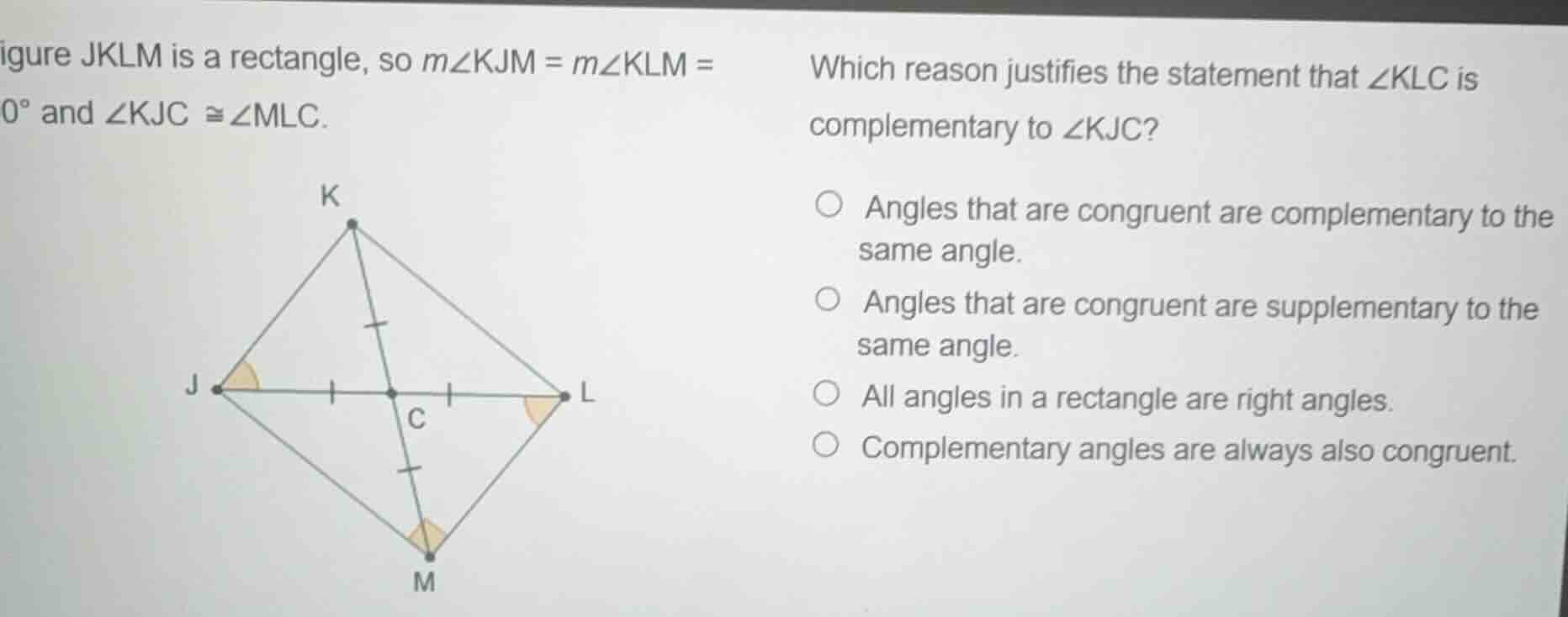
igure jklm is a rectangle, so $m\angle kjm = m\angle klm = 90^\circ$ and $\angle kjc \cong \angle mlc$.
which reason justifies the statement that $\angle klc$ is complementary to $\angle kjc$?
○ angles that are congruent are complementary to the same angle.
○ angles that are congruent are supplementary to the same angle.
○ all angles in a rectangle are right angles.
○ complementary angles are always also congruent.
Brief Explanations
- First, recall that in rectangle JKLM, $\angle KLM = 90^\circ$, so $\triangle KLC$ is a right triangle. This means $\angle KLC + \angle LKC = 90^\circ$, so $\angle KLC$ is complementary to $\angle LKC$.
- We are given $\angle KJC \cong \angle MLC$. Also, $\angle MLC$ is complementary to $\angle LKC$ (from the right triangle).
- The rule "Angles that are congruent are complementary to the same angle" applies here: since $\angle KJC \cong \angle MLC$, and $\angle MLC$ is complementary to $\angle LKC$, then $\angle KJC$ is also complementary to $\angle LKC$. By transitivity, $\angle KLC$ is complementary to $\angle KJC$.
- Eliminate other options:
- The second option refers to supplementary angles, which sum to $180^\circ$, not relevant here.
- The third option only tells us right angles exist but does not link the two specific angles.
- The fourth option is false, as complementary angles are not always congruent.

Snap & solve any problem in the app
Get step-by-step solutions on Sovi AI
Photo-based solutions with guided steps
Explore more problems and detailed explanations
Angles that are congruent are complementary to the same angle.